When you click on links to various merchants on this site and make a purchase, this can result in this site earning a commission. Affiliate programs and affiliations include, but are not limited to, the eBay Partner Network.
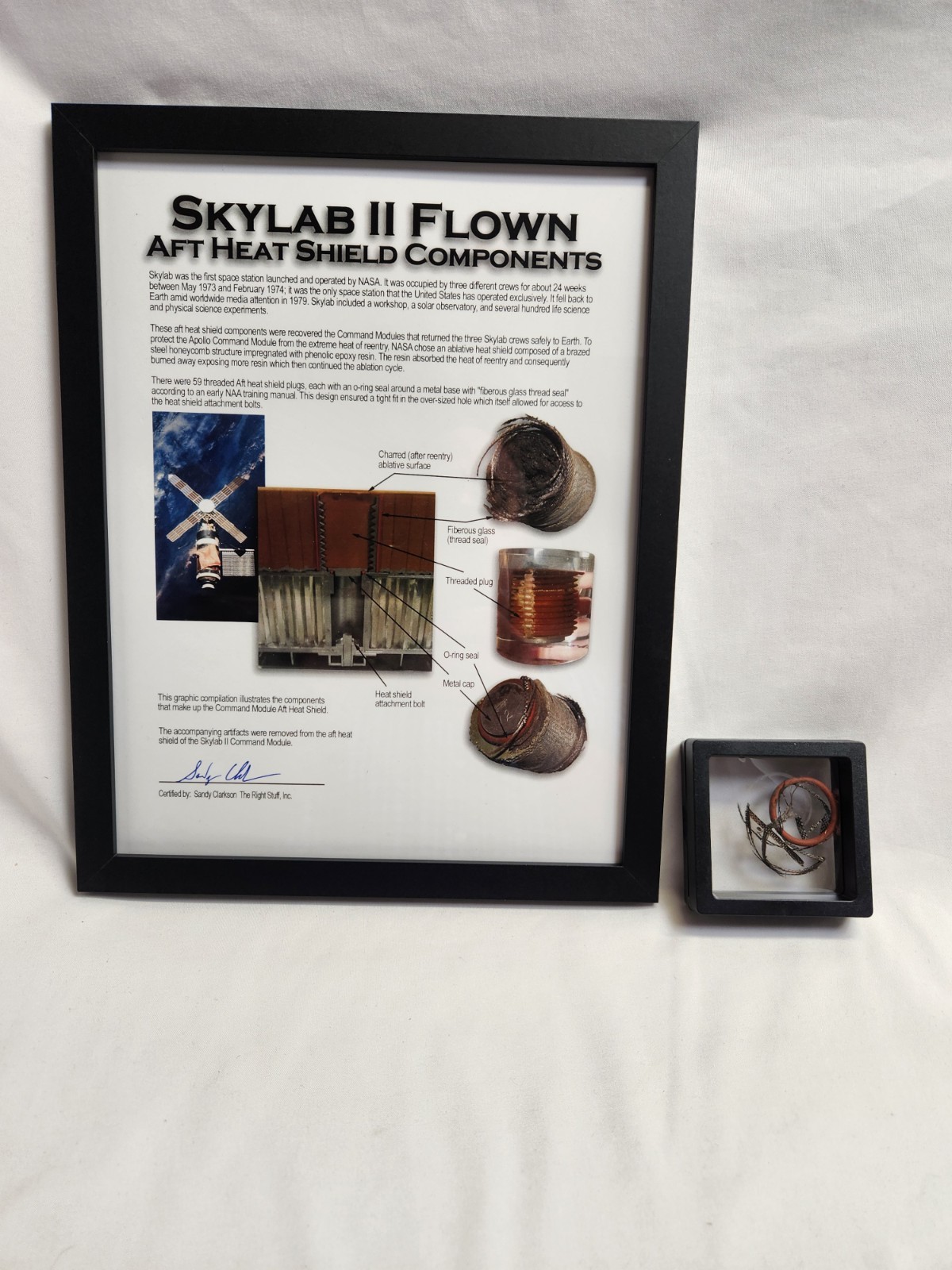
EXTREMELY RARE 1973 Skylab II Flown AFT Heat Shield Components with Framed COA
NASA - Apollo Spacecraft Part - Skylab II
Here is a 54-year-old piece of unique Space History***OWN A PIECE OF SPACE EXPLORATION HISTORY!***
Here is an item which not many people have ever seen let alone ever had the chance to own.
An exceptionally nice presentation COA for Skylab II Flown ALT Heat Shield components. These components were recovered from the Command Modules that returned the three Skylab crews safely to Earth. These components consist of charred ablative surface material and an O-ring seal from the ALT Heat Shield plugs of the Skylab II Command Module. The COA that accompanies these components is very informative. The flown component parts are housed in a small 3" removable display.
A certified piece of the Apollo Spacecraft flown on Skylab II
The Skylab II mission Crew was:PositionAstronautCommanderCharles "Pete" Conrad, Jr.
Fourth and last spaceflightScience PilotJoseph P. Kerwin
Only spaceflightPilotPaul J. Weitz
First spaceflightKerwin became the first medical doctor in space. NASA chose a doctor as the first Skylab scientist to better understand theeffect of spaceflight on the human bodyduring a long-duration mission.This is the mission that repaired the crippled Space Station and thus saved the Space Station for future missions.
The Skylab station suffered significant damage on its May 14, 1973 launch: its micrometeorite shield, and one of its primary solar arrays had torn loose during launch, and the remaining primary solar array was jammed. Without the shield, which was designed to also provide thermal protection, Skylab baked in the Sun, and rising temperatures inside the workshop released toxic materials into the station's atmosphere and endangered on-board film and food. The first crew was supposed to launch on May 15 but instead had to train practicing repair techniques as they were developed by the engineers. Ground controllers purged the atmosphere with pure nitrogen four times, before refilling it with the nitrogen/oxygen atmosphere for the crew. The secret National Reconnaissance Office used a KH-8 Gambit 3 to photograph the damaged station.
On May 25, Skylab 2 lifted from LC-39B, the first Saturn IB launch in almost five years and only the second-ever launch from Pad 39B. Booster performance was nominal except for one momentary glitch that could have threatened the mission – when the Commit signal was sent to the Saturn at ignition, the instrument unit sent a command to switch the launch vehicle from internal to external power. This would have shut down the Saturn's electrical system, but not the propulsion system, and likely cause the disaster scenario of an uncontrollable booster, requiring the Launch Escape System to be activated and the Command Module pulled away to safety, followed by Range Safety destroying the errant launch vehicle. However, the duration of the cutoff signal was less than one second, too short a time for the electrical relay in the booster to be activated, so nothing happened and the launch proceeded as planned. This glitch was traced to a modification of the pad electrical equipment and corrective steps were taken to prevent it from happening again. On reaching the station, Conrad flew their Apollo Command and Service Module (CSM) around it to inspect the damage, then soft-docked with it to avoid the necessity of station keeping while the crew ate, and flight controllers planned the first repair attempt. Then they undocked so that Conrad could position the CSM by the jammed solar panel, and Weitz could perform a stand-up EVA, trying to free the array by tugging at it with a 10-foot hooked pole, while Kerwin held onto his legs. This failed, and consumed a significant amount of the Skylab's nitrogen maneuvering fuel to keep it steady in the process.
The crew then attempted to perform the hard dock to Skylab, but the capture latches failed to operate. After eight failed attempts, they donned their pressure suits again and partially dis-assembled the CSM's docking probe; the next attempt worked. Once inside the station, the crew deployed a collapsible parasol through the small scientific airlock to act as a sunshade. (This approach was suggested and designed by NASA's "Mr. Fix It" Jack Kinzler, who was awarded the NASA Distinguished Service Medal for the effort.) Successful deployment of the sunshade dropped inside temperatures to sustainable levels.
Two weeks later, Conrad and Kerwin performed a second EVA, freeing the stuck solar panel and increasing the electrical power to the workshop. They had prepared for this repair by practicing in the Neutral Buoyancy Simulator at the Marshall Space Flight Center. Without power from the panel, the second and third Skylab missions would have been unable to perform their main experiments, and the station's critical battery system would have been seriously degraded. During this EVA, the sudden deployment of the solar panel structure caused both astronauts to be flung from the station's hull, testing their nerves as well as the strength of their safety tethers. After recovering their composure, both astronauts returned to their positions on the station and completed the EVA.
For nearly a month they made further repairs to the workshop, conducted medical experiments, gathered solar and Earth science data, and performed a total of 392 hours of experiments. The mission tracked two minutes of a large solar flare with the Apollo Telescope Mount; they took and returned some 29,000 frames of film of the sun. The Skylab 2 astronauts spent 28 days in space, which doubled the previous U.S. record. The mission ended successfully on June 22, 1973, when Skylab 2 splashing down in the Pacific Ocean 9.6 km from the recovery ship USS Ticonderoga. Skylab 2 set the records for the longest duration crewed spaceflight, greatest distance traveled and greatest mass docked in space. Conrad set the record for most time in space for an astronaut.
Item was purchased at an sale held by theAmerican Space Museum.
The American Space Museum is a museum in Titusville, Florida. It includes the US Space Walk of Fame, an outdoor plaza on the Indian River that honors both the astronauts and the NASA and contractor personnel who made American crewed space exploration possible. The monuments surround a pool and are dedicated to the Mercury, Gemini, Apollo and Space Shuttle programs. The museum houses related exhibits and artifacts and is located at 308 Pine Street.
A certified piece of the Apollo Spacecraft flown on Skylab II - COA Signed by Sandy Clarkson, The Right Stuff, Inc.
Items in this great of condition AND THIS RARE are getting harder and harder to find.
A great gift for any SPACE buff. Especially a NASA ITEM collector.
Please write and ask any questions as I will answer them to the best of my knowledge and ability. Please view photos for better detail as they are part of the description. Item is sold without warranty and "as is" with no returns.
All pictures are considered part of the description and should be examined carefully by buyers.
Now Shipping Worldwide (as outlined by )!
Ships two (2) days after payment posts. Tracking to be provided.
From a SMOKE FREE HOME.