When you click on links to various merchants on this site and make a purchase, this can result in this site earning a commission. Affiliate programs and affiliations include, but are not limited to, the eBay Partner Network.
Historic American Photographsfrom the Worldwide Collectibles Specialists atSaturday's Toys
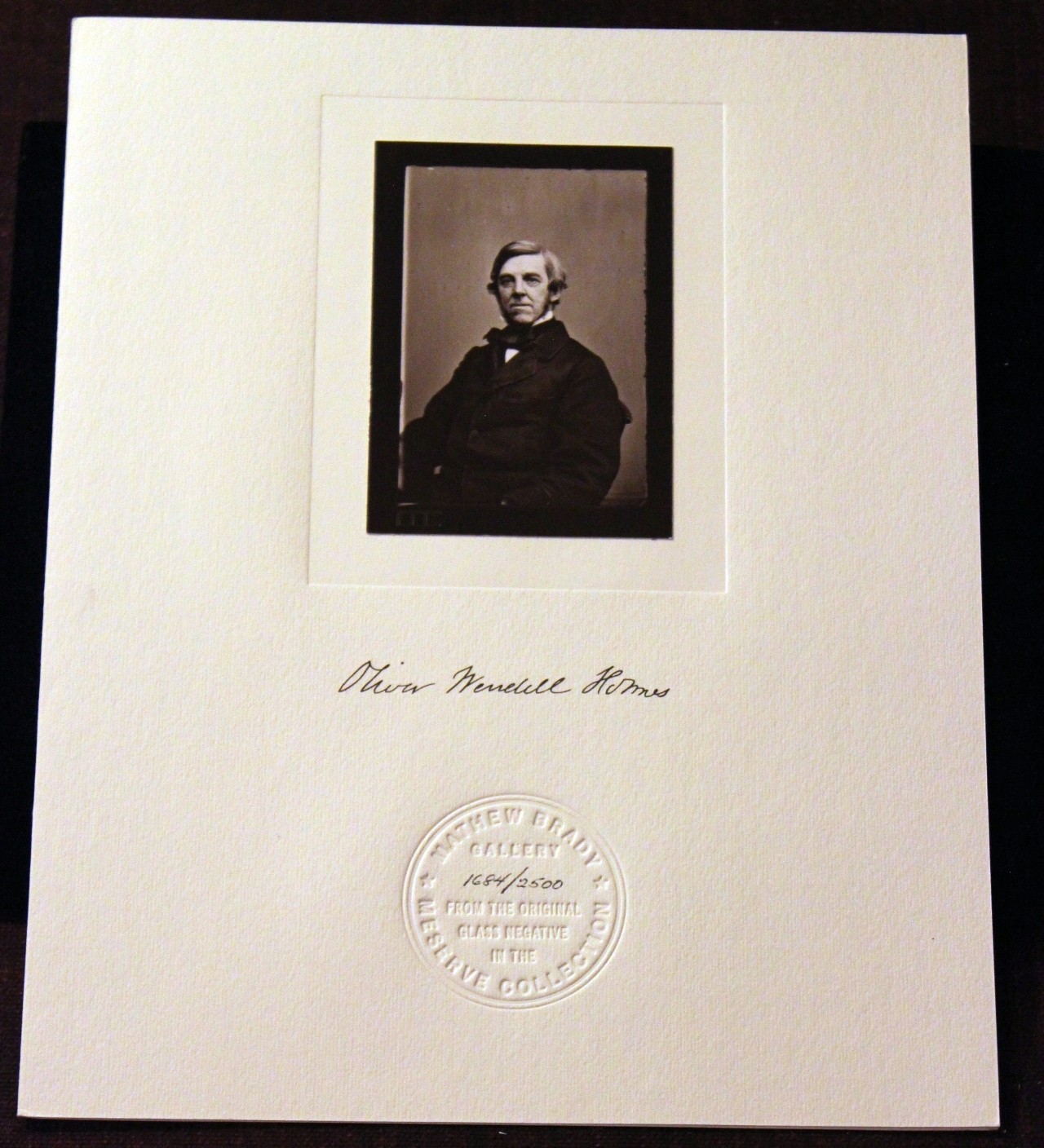
Presenting an exclusiveopportunity to own anauthenticated original limited editioncontactprint from MathewBrady's historic glass plate collodion negativefeaturing famed Civil Warera writer, physician, teacher and poet, Oliver Wendell Holmes, Sr (1809 -1894). He taught as Parkman Professor of Anatomy and Physiology at theHarvard Medical School and his colorful lectures earned him the affection ofhis students. His articles in "The Atlantic Monthly" provided a lively,literate and philosophical platform for a wide range of topics, making him anational figure, a role in which he was reveling when he sat for thisphotograph at the Mathew Brady Studio.
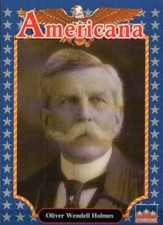
Holmes and his wife, Amelia Jackson, raised three children.The eldest, Oliver Wendell Holmes, Jr., went on to serve as a Justiceof the Supreme Court of the United States (1902 - 1932). He retired fromthe Court at 90 years of age; the oldestJustice in Supreme Court history.
The contact print itself measures 4 1/8" x 3" andwas originally photographed at Mathew Brady's studio in the 1860's
This original Mathew (often spelled incorrectly asMatthew)Brady contact print was issued in set number1684of2,500. Print is in pristine condition; as new; preserved in darkstoragefor over four decades. Several of theother companion printsfrom the edition will later beoffered exclusively through the marketplace.
Even prior to his epic achievements in photographing theCivil War, Brady attracted to his studios the great and near-greats of hisday... personalities such as Lincoln, Longfellow, Hawthorne, P.T. Barnum. Allleft behind them these magnificent portraits, undisturbed by time, fixed forposterity on priceless glass negatives. Through good luck and the remarkableforesight of a man named Frederick Hill Meserve (1865 - 1962), a singularlyfine private collection of these fragile plates has survived. In 1976, theseglass negatives were removed from the vaults in which they had been stored fordecades, authorizing the only edition of new contact prints ever to beproduced. The trustees of the Meserve Collection, custodians of the originalnegatives, made the new contact prints available in a strictly limited editionof 2,500 sets. These prints were the first made from Brady's glass negatives inapproximately 100 years. When these contact prints were produced, the trusteesvowed that the glass negatives would never be contacted again.
The print is mounted on a handsome folio mat, 8 3/4"by 11" and is suitable for archival framing. A facsimile signatureautograph appears directly beneath the contactprint. Aninformativebackfold contains a brief description of the subject and thehistorical background behind the photograph. The MC colophon of the MeserveCollection is blind-embossed on the margin of each photograph for permanentidentification. Here, the colophon provides the provenance required for futuregenerations to know that this image was original to the Mathew Brady Studio,and is printed from the original glass negative in the MeserveCollection.
The individual edition number was assigned to the print onthe folio mat, hand-inscribed within the embossed authentication seal of theMeserve Collection.
The collection was later owned by Meserve's daughter,Dorothy Meserve Kunhardt (1900 - 1978), who placed it in trust. The broader setof prints within this limited edition were taken directly from 10 of theoriginal Brady glass negatives, in collaboration with Mrs. Kunhardt and theother trustees who were charged with the supervision of the collection.Authenticated by Philip B. Kunhardt, Jr., Trustee, The MeserveCollection.
PRODUCTION NOTES:Theproduction of this print involved a combination of skill, time and handcraftsmanship that was truly extraordinary. Each print required more than threehours of hand work by a master technician (not including the hours of dryingtime). It was an extremely delicate and difficult operation, demandingexceptionally fine control -- not only of the quality of the solutions, butalso of the minute changes, scarcely perceptible to anyone but an experttechnician, that each print underwent. To begin, each print was exposeddirectly to the original glass negative, protected by a .00025-mil covering toensure the safety of the emulsion. The paper was then immersed in a specialsoft developer, at an exact temperature for a critically precise period oftime. The print was painstakingly carried through a series of nine separatebaths and washes -- more than twice the normal number. Each extra operation wasessential to further guarantee the permanence of the print. The print then wentinto a special gold formula solution, the best known substance for guarding theimage against deterioration. The print was then agitated gently by hand by amaster technician for about one hour. The finished print was air dried. (Anormal dryer belt might have contaminated a print, endangering its permanence.)The result: an archivally produced print of quality rarely encountered in thehistory of fine photographic printmaking.
The trustees of the Meserve Collection, custodians of theoriginal negatives, made the new prints available in a strictly limited editionof 2,500 sets. These prints were the first made from Brady's original glassnegatives in approximately 100 years. When these prints were produced, thetrustees vowed that the glass negatives would never be contacted again.
The Meserve-Kunhardtcollection was brieflyheldby Yale University's Beinecke Rare Book & Manuscript Librarywhere the original glass plates and other historicimages within thecollection were under tight control. Since that time, the Frederick HillMeserve Collection was acquired by the National Portrait Gallery of theSmithsonian Institution in Washington, D.C.