When you click on links to various merchants on this site and make a purchase, this can result in this site earning a commission. Affiliate programs and affiliations include, but are not limited to, the eBay Partner Network.
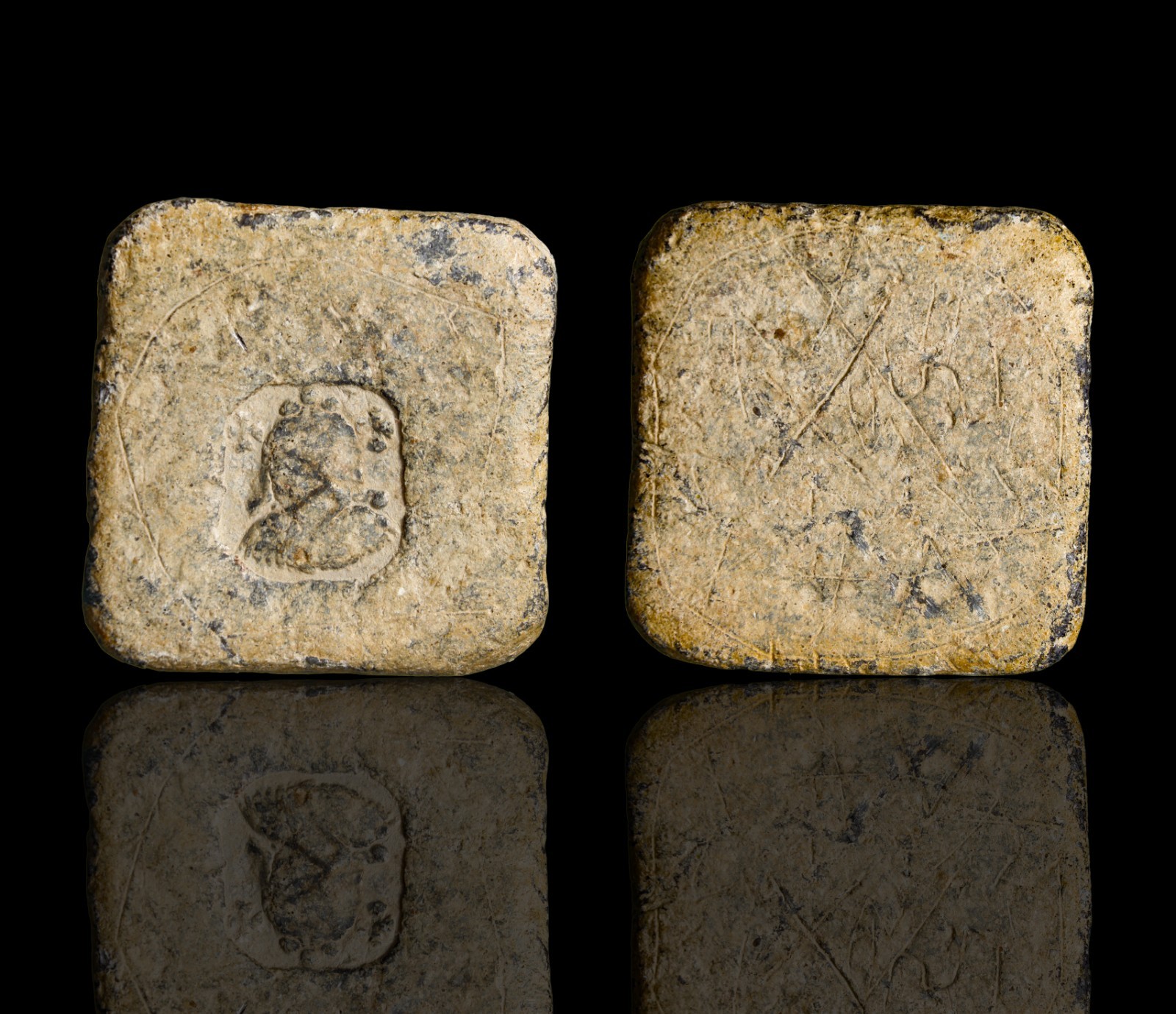
Late Roman to Early Byzantine Lead Commercial Weight of One-Fifth Libra
c. 4th–6th century AD
As with all items offered by Georgian Bay Antiquities, this artifact is guaranteed authentic and is accompanied by a Certificate of Authenticity detailing material, typology, dating, and cultural attribution.
Object: Commercial weight
Material: Lead
Date: Late Roman to Early Byzantine period, c. 300–600 AD
Cultural Attribution: Roman / Early Byzantine Empire
Weight: 68.3 grams
Form: Square lead weight with stamped authority bust
This object is an official Late Roman to Early Byzantine commercial weight, produced in lead and stamped with an authority bust to certify its validity. The bust is not a coin portrait and was never intended to circulate as money; it functions as a control mark indicating official approval for use in trade, taxation, or regulated commerce.
The weight corresponds to the Roman libra system. The Roman libra standard averaged approximately 327 grams. This example, weighing 68.3 grams, falls precisely within the accepted tolerance range for a one-fifth (1/5) libra weight, which theoretically equals approximately 65.4 grams. Variations of several grams are normal and expected in ancient weights due to wear, local calibration standards, and casting tolerances.
One-fifth libra weights were commonly used for measuring commodities such as foodstuffs, metals, textiles, and taxable goods. The square format provided stability during weighing, while the use of lead allowed compact mass and durability. The scratched reverse surface reflects repeated handling and placement on hard surfaces during daily commercial use.
Weights of this type belong to the transitional phase between the Late Roman and Early Byzantine systems, when bust stamps increasingly replaced purely numeric markings. The crude, utilitarian style of the bust is characteristic of official control stamps rather than artistic portraiture.
The object exhibits correct ancient lead fabric, surface oxidation, and wear patterns consistent with long-term use and burial. No evidence of modern casting, tooling, or artificial aging is observed.
Comparable square lead weights of one-fifth libra with stamped busts are documented in major institutional collections including the British Museum, Dumbarton Oaks Research Library and Collection, the Israel Museum, and the Metropolitan Museum of Art, where they are classified as Late Roman or Early Byzantine commercial weights.
References include Michael Hendy, Studies in the Byzantine Monetary Economy, Philip Grierson, Byzantine Weights and Measures, and Dumbarton Oaks catalogues of lead weights.
Condition: Good archaeological condition. Complete form. Authority bust visible though worn. Surface scratches and patina consistent with ancient commercial use. No restoration.
4-2