When you click on links to various merchants on this site and make a purchase, this can result in this site earning a commission. Affiliate programs and affiliations include, but are not limited to, the eBay Partner Network.
FROM PUEBLA, MEXICO:FABULOUS EXAMPLE OF MEXICAN POPULAR FOLK ART! #83
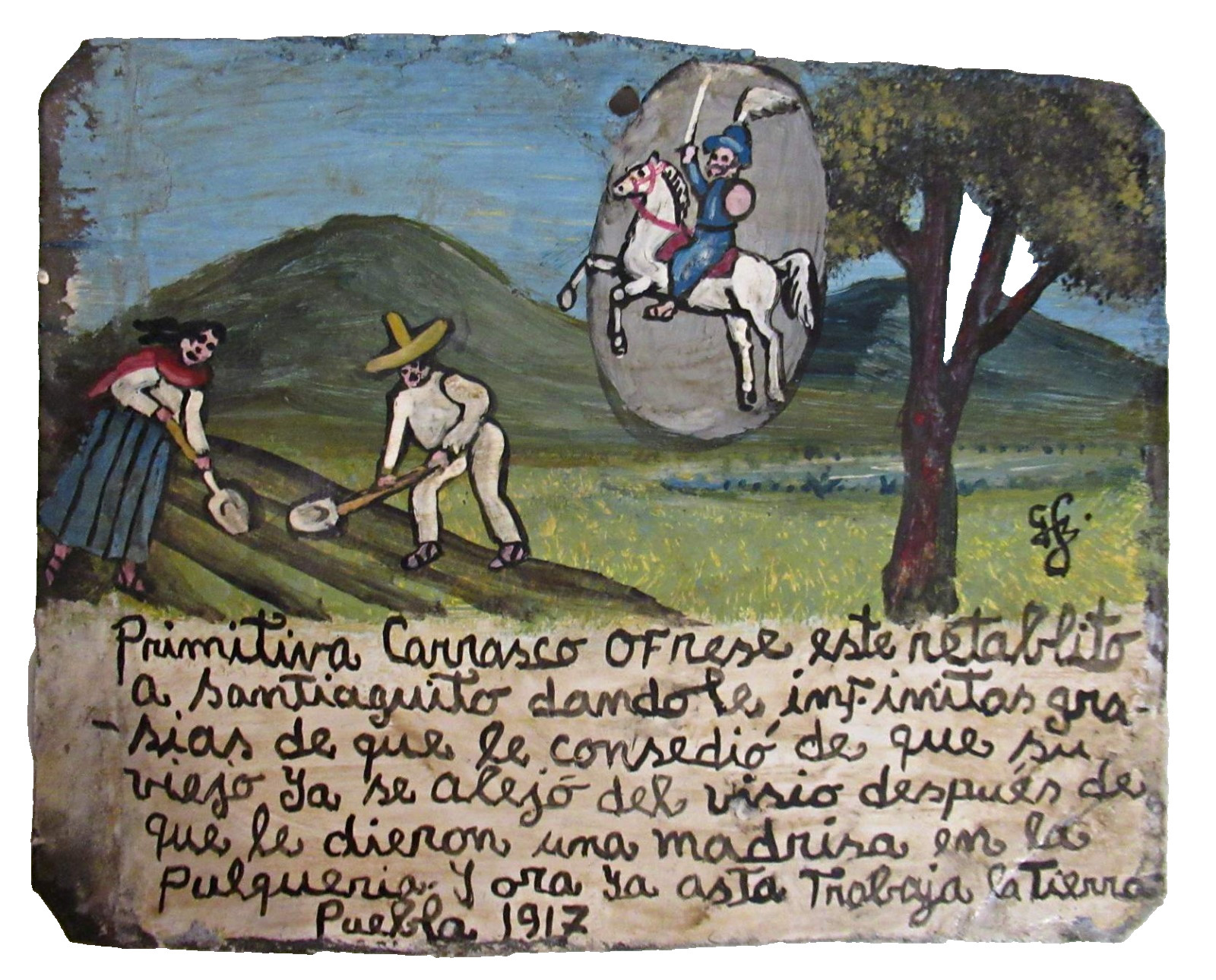
VINTAGE LARGE SIZE appr. 9\" x 7\" HAND-PAINTED TIN MEXICAN RETABLO (EX VOTO), dated 1917; most likely, painted likely around 1930\'s; signed by RETABLERO.
HIGHLY DETAILED TIN RETABLO, featuring A COUNTRYSIDE SCENE, SHOWING TRADICIONALLY DRESSED COUPLE WORKING THE FIELDS, WITH MOUNTAINS IN THE BACKGROUND AND A TREE IN THE RIGHT SIDE; APOSTLE SANTIAGO APPEARED ON A HORSEBACK TOP SENTER OF THE PAINTING. DATED 1917(most likely, painted around 1930\'s: it is customary to dedicate retablo to the patron saint for rendering a favor to a family member in the distant past)
TEXT (loosely translated from Spanish): PRIMITIVA CARRASCO OFFERS THIS RETABLO TO SANTIAGO, GIVING HIM INFINITE THANKS FOR ACHIEVING THAT HER OLD MAN ALREADY STAYS AWAY FROM VICE AFTER RECEIVING A SAVAGE BEATING AT THE PULQUERIA, AND NOW HE EVEN WORKS THE FIELDS. PUEBLA, 1917* SIGNED BY \"RETABLERO\"
There is a hole provided for hanging on the wall.The beautiful piece is ingood vintage condition; some rust &imperfections in front due to age; backside was painted at some point to prevent rust, but still has a lot of rusting. LARGE SIZE: 9\"x7\"; dated 1917 but most likely painted in the early 1930\'s; signed by retablero.
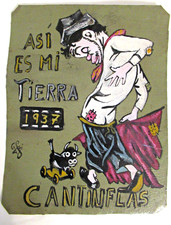
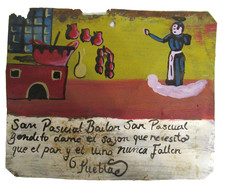
A NOTE of HISTORY OF RETABLO FOLK ART:Votive paintings in Mexico go by several names in Spanish such as “ex voto,” “retablo” or “lamina,” which refer to their purpose. The painting of religious images to give thanks for a miracle or favor received, is part of a long tradition started in Europe. The form that most votive paintings take from the colonial period to the presentwas brought to Mexico by the Spanish. As in Europe, votive paintings began as static images of saints or other religious figures which were then donated to a church. Later, narrative images, telling the personal story of a miracle or favor received appeared. These paintings were first produced by the wealthy and often on canvas; also on wood; however, as sheets of tin became affordable, lower classes began to have these painted on this medium.The narrative version on metal sheets is now the traditional and representative form of votive paintings. Though some ex votos have been painted by the person receiving the miracle, most are made byretableros: commissioned artistswho interpret people\'s stories and produce these tokens of appreciation to be placed/hung on church walls or shrines, reinforcing the owner\'s devotion and gratitude.These lovely miracle paintings are in fact advertisements of the power and mercy of the saints.Due their proliferation, especially in the 18th and 19th century, many older votive paintings have left the places they were deposited and found their way into public and private collections.The collecting of tin retablos was begun by Mexican artistDiego Rivera, whose work, along with those of a number of other painters past and present, has been influenced by them.(See last photo)
Hand-painted in MexicoDated 1917; likely painted in the 1930\'sSigned by retablero.