When you click on links to various merchants on this site and make a purchase, this can result in this site earning a commission. Affiliate programs and affiliations include, but are not limited to, the eBay Partner Network.
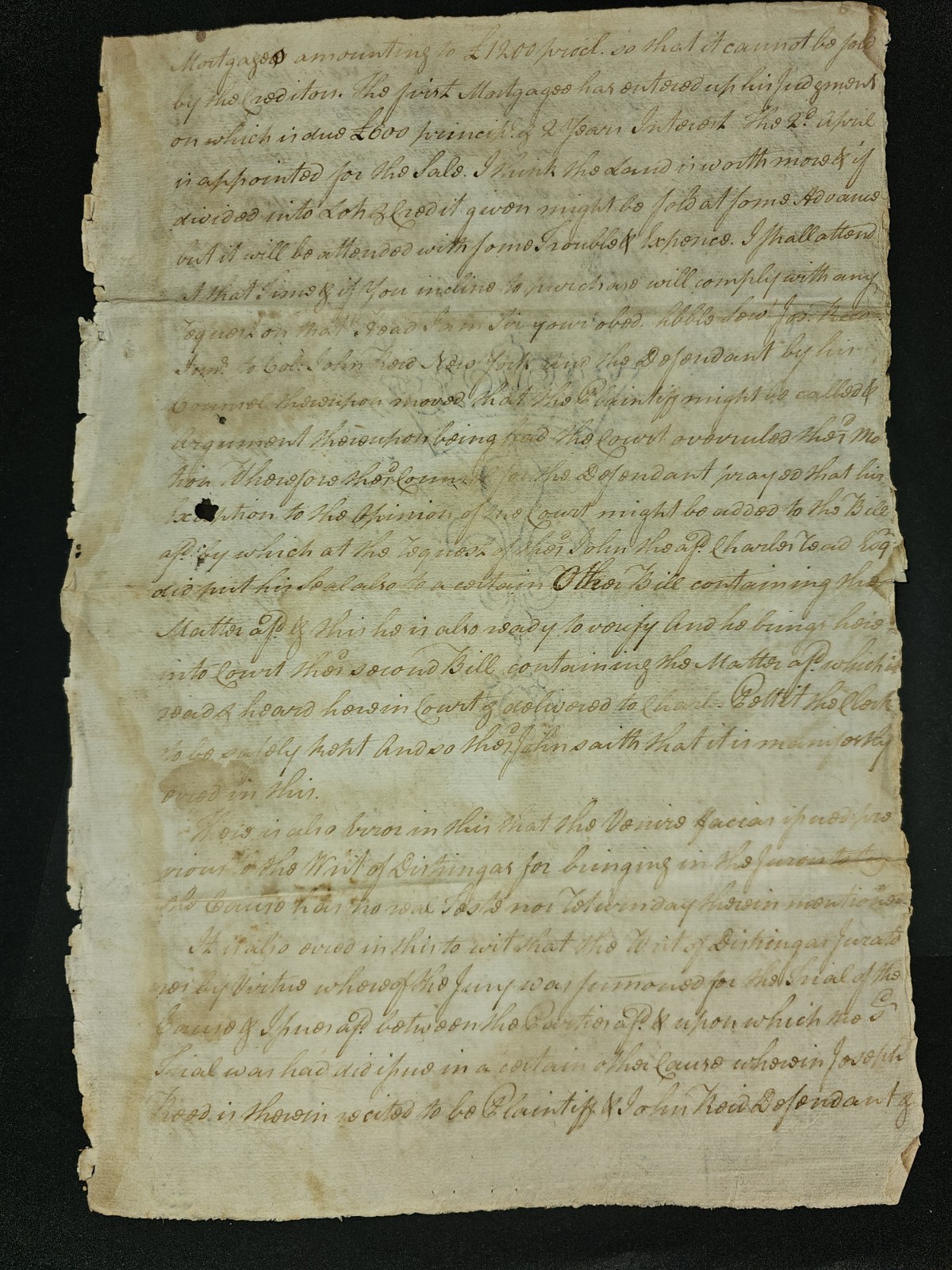
Original handwritten 1808 Philadelphia County, Pennsylvania Chancery Court equity memorandum, addressing the foreclosure of multiple mortgages securing a large 1,500-acre tract of land. The document was written after argument and summarizes the court’s opinion, discussing the insufficiency of security, the likelihood that land sales would fail to satisfy principal and interest, and the procedural steps available to the plaintiff.
The plaintiff is named as John Read. The case was processed through Philadelphia’s equity jurisdiction, with reference to the court clerk Charles Pettit, placing it firmly within the state’s chancery system at the seat of government.
Based on date, jurisdiction, subject matter, and the identity of the plaintiff, this foreclosure is very likely connected to the enforcement of older, British-era debts lingering after the American Revolution. Such cases were actively adjudicated in Philadelphia in the years following Jay’s Treaty, which reopened American courts to British creditor claims. John Read served from 1797 to 1809 as Agent General of the United States under Article VI of Jay’s Treaty, overseeing precisely these kinds of complex debt and property disputes. While the document does not explicitly name British creditors, the timing, scale, and equity posture make this association historically compelling.
Notable passages include frank assessments of economic distress, including statements that purchasers would receive “little or nothing,” and that few of the lands would bring more than the principal and interest due. The memorandum explicitly references a 1,500-acre tract under mortgage, reflecting the scale typical of post-Revolutionary speculative land holdings used to secure long-standing debts.
Written on laid paper with a clear crowned fleur-de-lis watermark, consistent with imported European paper used in American courts at the turn of the 19th century. Condition is typical for an early court filing: folds from filing, edge wear, and ink oxidation, with strong legibility throughout.
A substantial and historically rich manuscript connecting early U.S. chancery practice, post-Revolutionary British debt enforcement, and a senior federal legal figure active at the center of Jay’s Treaty claims. Well suited for collectors of early American legal history, Anglo-American finance, Jay’s Treaty material, or institutional archives.