When you click on links to various merchants on this site and make a purchase, this can result in this site earning a commission. Affiliate programs and affiliations include, but are not limited to, the eBay Partner Network.
1886 British Consular Court Constantinople Letter Italy Consulate - United Kingdom History Archive
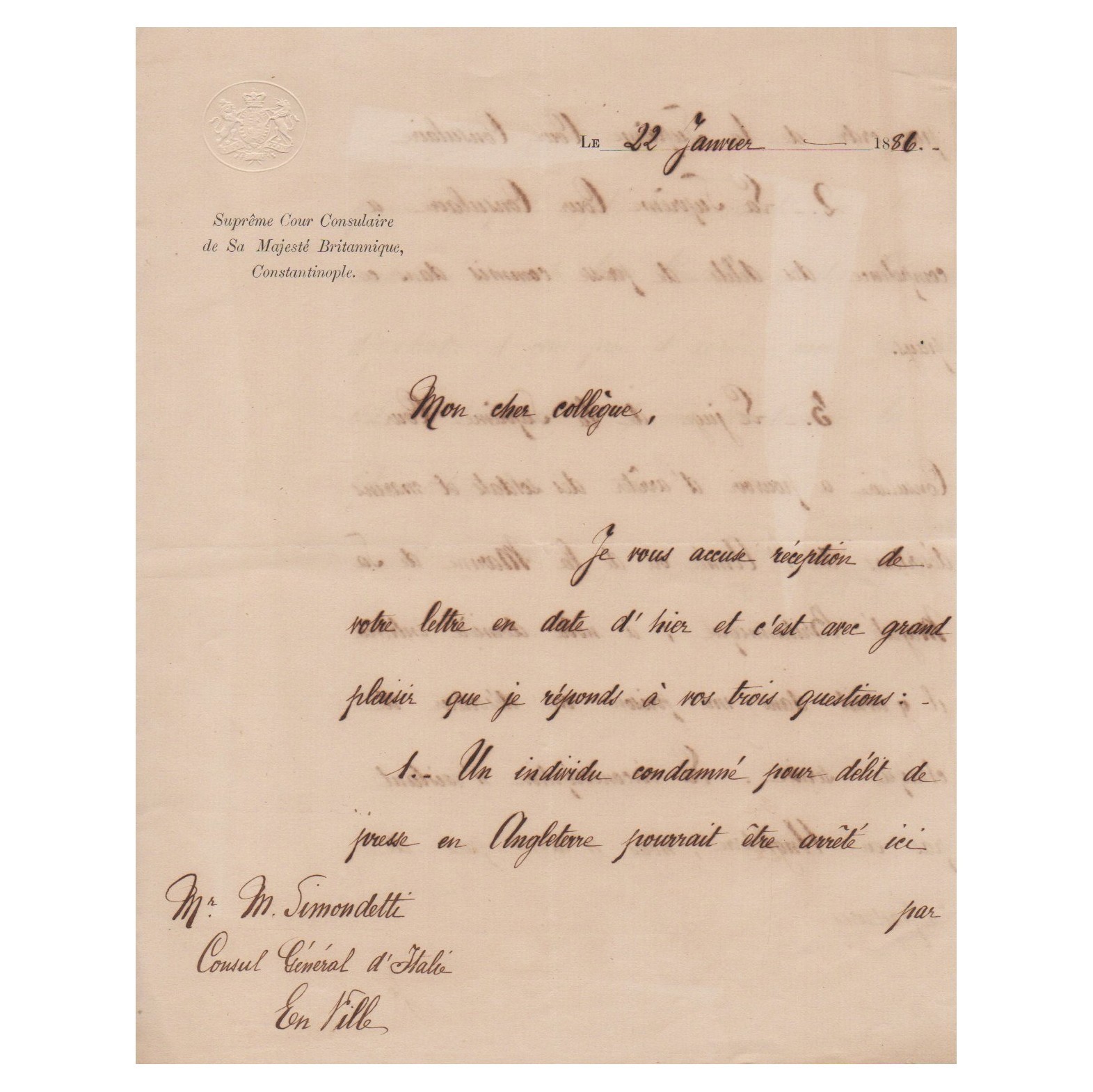
Original three-page handwritten diplomatic and legal letter meticulously preserved across files.Dated 22 Janvier 1886, the entire document is drafted in fluent French (the standard language of late 19th-century international diplomacy) on the official imprinted letterhead of the Suprême Cour Consulaire de Sa Majesté Britannique, Constantinople (Supreme Consular Court of Her Britannic Majesty, Constantinople). The pages feature an embossed British Royal arms seal in the upper corners. Sent and signed by the British Consular Judge, Henry Fawcett, whose prominent handwritten signature concludes the final page, the letter is addressed locally ("En Ville") to Mr. M. Simonetti, Consul Général d'Italie (Consul General of Italy) in Constantinople.
The correspondence serves as a significant primary source illustrating the intricate architecture of extraterritorial jurisdiction and inter-consular diplomacy under the Capitulations system in the Ottoman Empire. In the text, Judge Fawcett systematically answers three official legal inquiries posed by his Italian counterpart. He clarifies the protocols for apprehending individuals convicted of press offenses (délits de presse) in England, affirms the court's absolute jurisdiction over press-related infractions committed locally within the country, and defines his judicial power to arrest deserting soldiers and sailors from Her Britannic Majesty's Army and Navy. Fawcett uniquely highlights contemporary consular operations by noting that during their last meeting, a deserter from each branch was currently being held in his consular prison, while clarifying that because conscription does not exist in England, they do not contend with draft evaders ("réfractaires"). This cohesive archival set offers outstanding historical and collector value for researchers focusing on legal bureaucracy, military history, and European diplomatic relations in late Ottoman Istanbul.
Supreme Consular Court of Her Britannic Majesty, Constantinople.January 22, 1886.
My dear colleague,
I acknowledge receipt of your letter dated yesterday and it is with great pleasure that I reply to your three questions: —
— An individual convicted for a press offense in England could be arrested here by
Mr. M. SimonettiConsul General of ItalyIn Town (Constantinople)
...by order of the Supreme Consular Court.2. — The Supreme Consular Court has jurisdiction over press offenses committed in this country.3. — The judge of the Supreme Consular Court has the power to arrest deserting soldiers and sailors from the Army or Navy of Her Britannic Majesty; at our last meeting there was a deserter from each service in my prison. Conscription not existing in England, we do not have "réfractaires" [draft evaders].
I...would always be happy to provide you with further information on the jurisdiction of our Consular Court and the dependent Courts and beg you to accept, my dear colleague, the assurance of my highest consideration,
Henry Fawcett
(26 August 1833 – 6 November 1884) was a British academic, statesman and economist.
Background and education: "PROFESSOR FAWCETT, M.P and P.M.G., A Politician of a certain stamp, and President of the Republic of Letters at St. Martin-le-Grand's" Henry Fawcett Monument to Henry Fawcett in Salisbury Cathedral Henry Fawcett was born in Salisbury where his father was a gentleman farmer. He was educated at the Agricultural College, Queenwood, at King's College School and the University of Cambridge: entering Peterhouse in 1852, he migrated to Trinity Hall the following year, and became a fellow there in 1856, the year he graduated BA as 7th Wrangler. In September 1858, when he was 25, he was blinded in a shooting accident. Despite his blindness, he continued with his studies, especially in economics. He was able to enter Lincoln's Inn, but decided against a career as a barrister and took his name off their books in 1860. He became a student of John Stuart Mill and wrote a Manual of Political Economy in 1863.
Measures 21 x 29 centimeters (approx.)
We always ensure your item is securely packed in a protective plastic sleeve, placed between hard cardboard, and shipped in an envelope withregistered mail tracking!
Have questions? We're happy to help!Browse our storefor more.We are happy to offer combined shipping on multiple collectible purchases to help you save! Just add all items to your cart and request an invoice before paying, or send us a quick message — we’ll calculate the best shipping rate soyou can buy more and save more!
Please examine the listing, some bent corners, era folds, small tears and slight stains due to their genuine antique aging.As is antique good condition, what you see is what you will get. We try to present the real state of the object as completely as possible with photos.
Copyright ©2026 by LavenaVintage. All Rights Reserved. All photographs are the intellectual property of LavenaVintage and are protected under international copyright laws. Use or distribution of these images in any form without purchase or prior written permission is strictly prohibited.