When you click on links to various merchants on this site and make a purchase, this can result in this site earning a commission. Affiliate programs and affiliations include, but are not limited to, the eBay Partner Network.
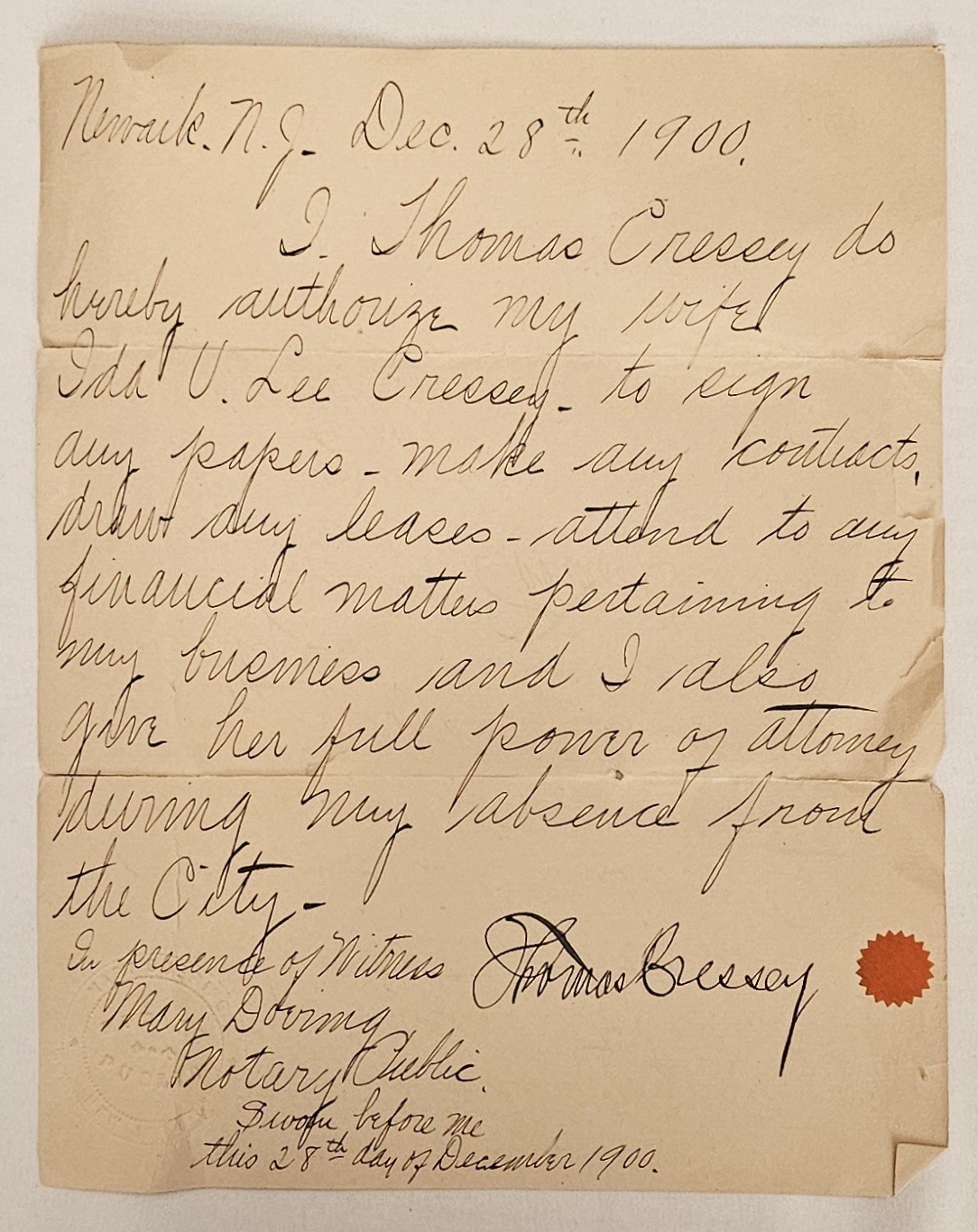
Original December 28, 1900 manuscript power of attorney signed by Thomas Cressey, the prominent Newark, New Jersey architect associated with a substantial body of late 19th-century commercial architecture in the city.
Written in Newark, the document authorizes Cressey’s wife, Ida V. Lee Cressey, to act broadly on his behalf during his absence from the city. She is empowered to sign papers, make contracts, draw leases, attend to financial matters relating to his business, and exercise full power of attorney.
The document is particularly interesting for its connection to both architectural history and women’s business history. Rather than granting narrowly defined authority, Cressey formally entrusted his wife with extensive control over his professional and financial affairs at a period when he was actively practicing in Newark.
Cressey was one of Newark’s notable late 19th-century architects and designed numerous commercial buildings in and around the city’s Broad and Market Street district. The document dates from an especially active point in his career, the same year he joined the American Institute of Architects and during the period in which he served as president of the organization’s New Jersey chapter.
Signed boldly “Thomas Cressey” at lower right and witnessed by Mary Downing, Notary Public. The original red seal and embossed notarial seal remain present.
A scarce original signed document connected with an important figure in Newark architectural history.
Edition Details
Author/Signer: Thomas Cressey
Recipient/Agent: Ida V. Lee Cressey
Document: Power of Attorney
Place: Newark, New Jersey
Date: December 28, 1900
Format: Manuscript document signed
Subject: Architecture, business history, legal history, Newark, New Jersey
Signatures: Thomas Cressey; Mary Downing, Notary Public
Seals: Red seal and embossed notarial seal present
Condition
Original manuscript document showing expected age and use. The sheet was folded into sections and has splitting and weakness along portions of the original fold lines, with several small edge tears and losses. There is an old reinforcement or repair visible from the reverse.
Paper is toned with scattered handling wear and minor soiling. The manuscript remains highly legible, including Cressey’s signature. Both the red seal and embossed notarial seal survive.
Please see photographs for the best description of condition.