When you click on links to various merchants on this site and make a purchase, this can result in this site earning a commission. Affiliate programs and affiliations include, but are not limited to, the eBay Partner Network.
Ancient Judaean / Roman Period Fractional Bronze Trade Weight, Circa 1st Century BC – 2nd Century AD. Certified Authentic Ancient Artifact
Item: 25
Culture: Judaean / Roman Provincial
Date: Circa 100 BC – 200 AD
Material: Bronze (High-Tin Copper Alloy)
Type: Disc-Shaped Fractional Weight
Weight: 4.27 grams
Provenance: Private collection; acquired by me in 2024
Description:
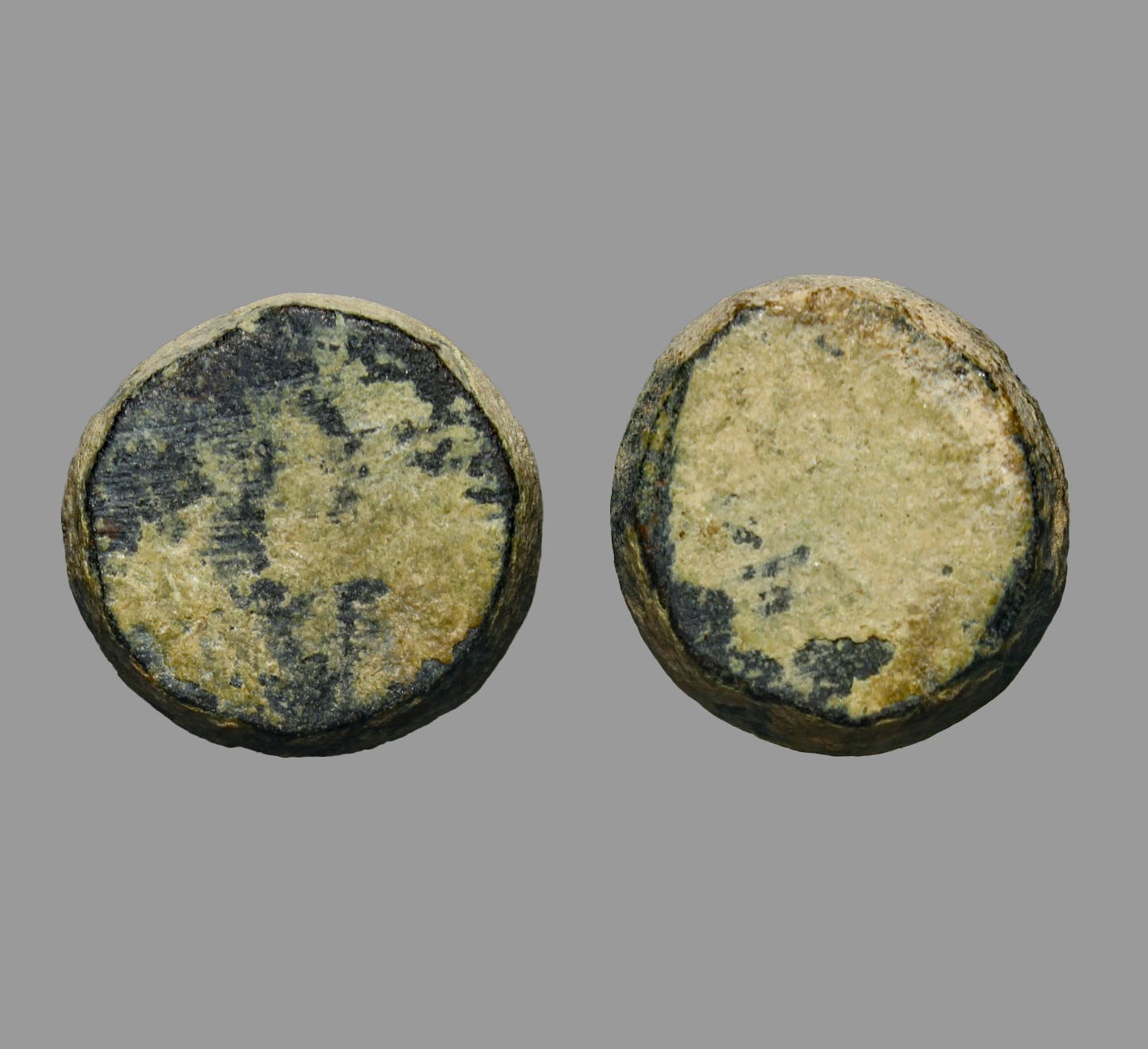
A finely preserved ancient bronze trade weight, weighing 4.27 grams, featuring a classic discoid or \"button\" form. This mass corresponds precisely to a fractional unit within the Eastern Mediterranean trade systems, likely representing a Third-Shekel or a Drachm standard. Unlike the more common lead versions, bronze weights were often used for higher-precision weighing of more valuable commodities or served as a more durable \"master\" weight for a merchant\'s set.
The weight is characterized by its circular, flat-faced geometry and a slight \"cupped\" or concave center on one face, a result of the ancient casting process. Such small weights were essential in the Roman and Judaean Levant for measuring lightweight high-value items like perfumes, incense, or medicinal compounds.
Authentication Notes (Ancient Surface and Tool Assessment):
Noble Bronze Patina: The surface exhibits a genuine, multi-layered archaeological patina consisting of deep forest-green malachite and earthy-tan mineral encrustations. This mineralization is chemically bonded to the metal matrix, a hallmark of long-term burial in the carbonate-rich soils of the Holy Land.
Fractional Standard Mass: The weight of 4.27g is a critical diagnostic. It aligns with known fractional shekel and drachm distributions found in archaeological contexts across the Roman East.
Investment Casting Morphology: The disc shows the subtle irregularities and \"softened\" edges consistent with ancient \"lost wax\" or clay-mold casting. Under magnification, the surface displays thousands of microscopic, multidirectional scratches and \"pitting\" formed over 2,000 years.
Material Density: The choice of bronze over lead for a weight of this size indicates a premium commercial tool, as bronze is less prone to the \"clipping\" or wear that could alter a lead weight\'s accuracy over time.
Cultural and Artistic Context:
In the ancient world, weights and measures were heavily regulated. Because this item is made of bronze, it was a more significant investment for a merchant than a lead equivalent. Market inspectors (Agoranomoi) oversaw the accuracy of these tools to prevent fraud. The discoid shape is a classic administrative form, designed to sit perfectly on the pans of a bronze balance scale.
Museum Parallels:
The Israel Museum, Jerusalem (Bronze and lead fractional weights from the Second Temple period).
The British Museum, 1901,0415.31 (Roman provincial commercial weights in bronze).
The Met Museum, 74.51.5552 (Ancient bronze and lead weights from the Levant).
Academic References:
Hendin, D., Guide to Biblical Coins, Section: Ancient Weights and Measures, p. 542 (Defining fractional shekel standards).
Kletter, R., Economic Keystones: The Weight System of the Kingdom of Judah, Section: Fractional Units.
Qedar, S., Gewichte aus Drei Jahrtausenden, Section: Roman and Provincial Bronze Standards.
Condition:
Excellent archaeological condition. The bronze is structurally stable and the ancient patina is exceptionally well-developed. The geometric form remains sharp and highly legible.
7-4