When you click on links to various merchants on this site and make a purchase, this can result in this site earning a commission. Affiliate programs and affiliations include, but are not limited to, the eBay Partner Network.
Antique Royal Cabinet “Holland Gin Type” Bottle
American Bottled | Guaranteed Under the Pure Food & Drugs Act (1906)
Pre-Prohibition Era | Original Paper Label | 10.75" Tall
There are bottles that simply held spirits — and then there are bottles that quietly document a turning point in American history. This is very much the latter.
Offered here is an authentic early 20th-century American “case gin” bottle, boldly labeled ROYAL CABINET – HOLLAND GIN TYPE, complete with its original paper label and the legally significant guarantee:
“Guaranteed under the Pure Food & Drugs Act — June 30th, 1906.”
That single line anchors this bottle to a remarkably narrow and important window in time, when American consumers, manufacturers, and lawmakers were all renegotiating trust, truth, and transparency in food and drink.
Confident Dating: Circa 1906–1912
The Pure Food & Drugs Act took effect in mid-1906, and manufacturers quickly added compliance language like this to reassure buyers. This specific phrasing, label style, and bottle form place production very shortly after the law’s passage, and well before Prohibition-era labeling conventions took hold.
Most likely production period: circa 1906–1912, with a high degree of confidence.
By the mid-to-late 1910s, bottle shapes, labeling language, and regulatory requirements all begin to shift. After 1920, this style essentially disappears.
What “Holland Gin Type” Really Means
“Holland Gin” refers to Dutch genever-style gin, a malt-forward spirit that predates modern London Dry gin and was widely respected for its depth and perceived quality.
By the early 1900s:
True Dutch gin was often imported in bulk
Bottled domestically in the United States
Marketed as refined, European, and upscale
The word “TYPE” is critical. It reflects legal compliance under the 1906 Act, allowing American bottlers to imitate the Dutch style without falsely claiming country of origin. This was gin for customers who read labels — and cared.
Bottle Form & Manufacture
This is a classic large square “case gin” bottle, designed for tight packing in shipping crates and storage cabinets:
Height: approx. 10.75 inches
Glass: deep olive / dark olive green, period-correct for spirits
Construction: mold-blown, transitional era (pre-fully automated)
Finish: applied lip for cork closure (no screw threads)
Base: recessed square panel with a small molded maker’s mark
The glass shows subtle waviness, thickness variation, and surface texture consistent with early 20th-century manufacture — exactly what collectors want to see.
Label & Graphics
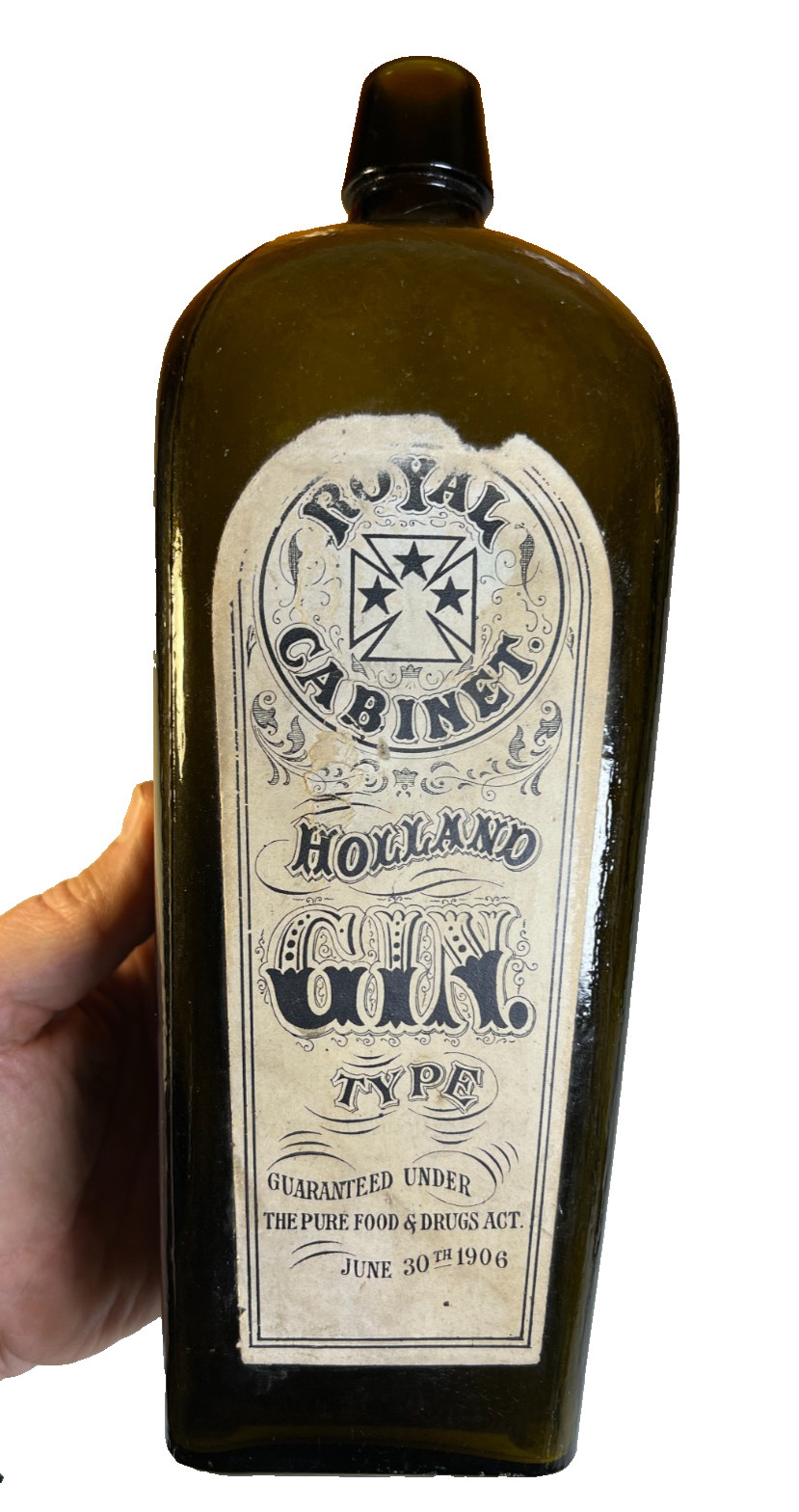
The original paper label remains intact and displayable, featuring:
Ornate Gothic and scroll typography
Heraldic cross and star motif evoking European pedigree
Tall vertical layout designed for visibility in a cabinet or bar
There is honest age wear, edge loss, and handling marks, as expected on a bottle now more than a century old. Importantly, the key text, graphics, and legal wording remain legible and complete. Mint labels on bottles of this size and age are exceptionally rare; this example presents very well.
Where It Was Made (Responsibly Stated)
No city or state is printed on the label, and none is molded into the glass.
What can be said confidently:
This was American bottled, not imported as a finished bottle
The bottle form, labeling style, and compliance language point to a major urban spirits hub
The New York / Brooklyn area is the strongest statistical likelihood, though no specific attribution can be proven
Correct collector phrasing:
American bottled, likely New York–area production, circa 1906–1912.
Historical Context: Life When This Was Used
Picture a kitchen, pantry, or back-room bar around 1908:
Wood floors, coal or wood stove nearby
Squared bottles packed tightly on shelves
Gin used not just for cocktails, but for hospitality, home remedies, and evening rituals
Gin at this time crossed boundaries between medicine, social drinking, and tradition. This bottle wasn’t hidden — it was meant to be seen.
Condition Summary
No cracks or structural damage noted
Honest surface wear consistent with age
Label intact with expected wear and losses
Strong display presence
Please review photos closely, as they are part of the description.