When you click on links to various merchants on this site and make a purchase, this can result in this site earning a commission. Affiliate programs and affiliations include, but are not limited to, the eBay Partner Network.
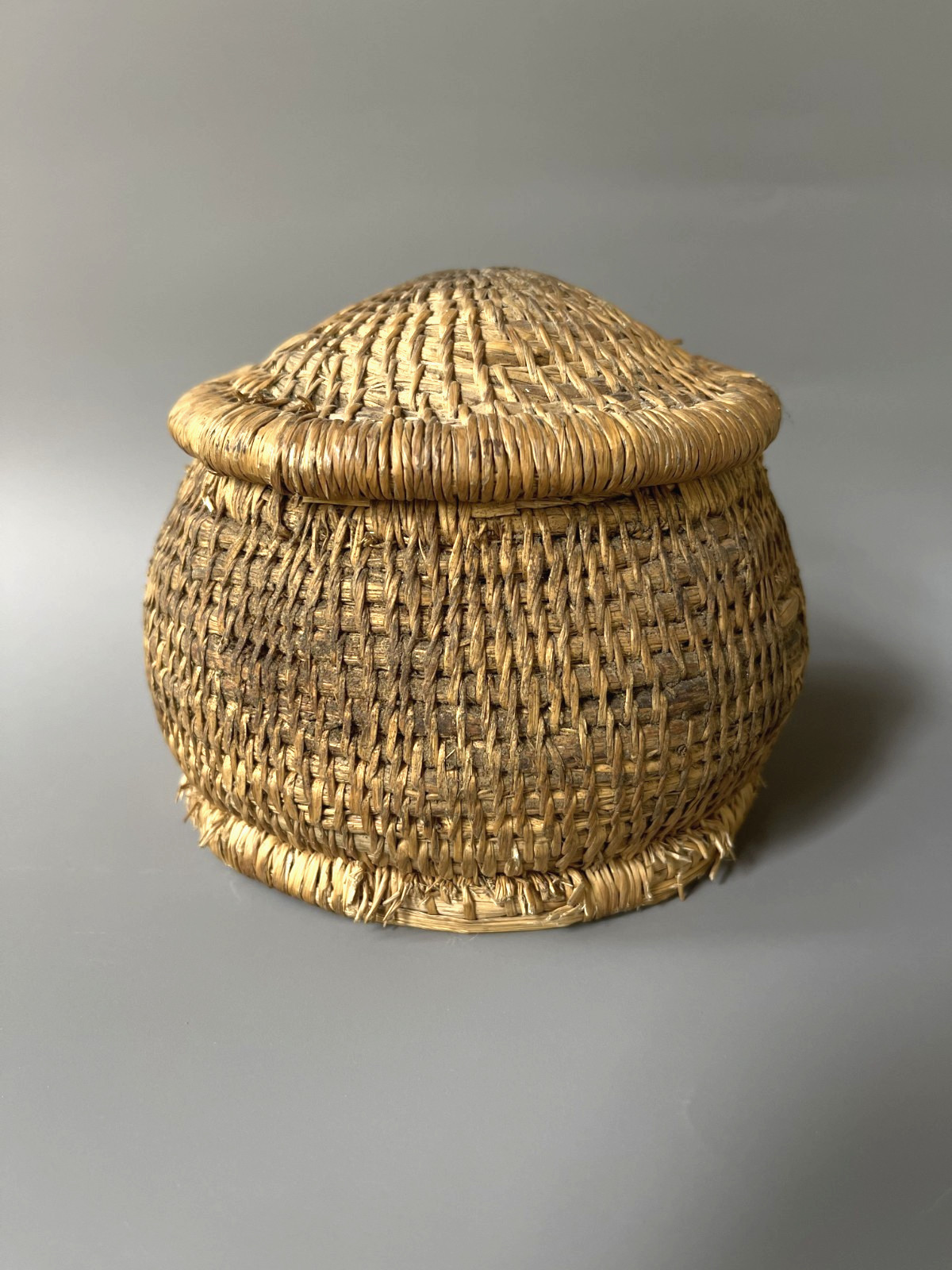
Early Native American Potent-Material Storage Basket, 18th C.
This object comes from a long-held private collection formed over decades of collecting. The seller has been an member since 2015 as a buyer and only recently began releasing selected pieces, including this one.
Rare early Native American lidded containment basket featuring an engineered friction-seal closure system, dating ca. 1760–1810. Constructed from tightly woven native plant fibers, the basket employs a deliberately narrowed neck and fitted lid designed to create compression-based sealing rather than simple loose coverage.
The object is highly austere and functional in character, with no decorative emphasis. The unusually tight weave and pressure-fit lid create a dark, minimally ventilated interior intended for prolonged containment and protection of contents. Both the lid and basket rim retain clear evidence of repeated historical engagement through localized friction wear and compression fatigue, confirming that the sealing system was integral to the basket’s original function.
The basket’s advanced material aging, brittle fiber condition, structural compression wear, and long-term oxidation support an early date within the late 18th to early 19th century period. The survival of such a mechanically sealed organic containment system in intact condition is exceptionally uncommon.
While exact tribal attribution remains under study, the basket is consistent with early Indigenous North American utilitarian containment traditions rather than later decorative or commercial basket production. The form and engineering suggest specialized storage use rather than ordinary household covering technology.
In correspondence with the owner (2026), folklorist Cynthia Vidaurri of the National Museum of the American Indian noted that restricted access to containers is often an important mechanism for preserving the cultural value of sacred or spiritually significant objects within Indigenous communities, and that access may be structured through gender, social status, or ceremonial cycles.
This perspective aligns with the basket’s highly controlled containment design and reinforces the interpretation of the object as a protected storage vessel rather than a decorative or tourist-market basket.
This is not a decorative or tourist-market basket. Its survival with lid intact, combined with advanced material aging and structural sophistication, places it among the earliest and rarest surviving forms of Native Californian basketry in private hands.
A museum-caliber artifact of Indigenous containment engineering and cultural continuity.
Measurements
Height: 4 ⅜ in
Diameter: 5 4/8 in (5.5 in)
Weight: 255.6 g
Dating
Late 18th century (circa 1760–1810).
Material characteristics suggest possible extension into the late 17th century.
Material Dehydration and Texture: The extreme brittleness and “fossilized” density you describe—and which is visible in the detailed closeups—is not characteristic of 20th-century examples. It typically results from decades of low-humidity exposure, oxidative degradation of organic matter, and the slow breakdown of cell walls in native grasses. That kind of aging takes well over a century under typical conditions, especially in arid climates like inland California.
Color and Patina: The blackened surface and inner rim discoloration appear to result from oxidation and carbon-based residue, not mold or high moisture. California\'s arid interior (especially Pomo, Yokuts, or Mission regions) would have prevented mold formation, meaning this basket’s darkening is more likely due to:
Prolonged sun exposure
Accumulated carbon or resin from use
Smoke curing or hearth-side storage
Or even hand oils and ritual contents over decades.
Lack of Decoration: This is not a basket for display, gifting, or trade. The absence of design elements (like stepped patterns or dyed weft) and the tight, utilitarian form suggest pre-market, pre-tourist function. This places it most plausibly before 1900, when aestheticized baskets were increasingly produced for non-Native collectors, anthropologists, and tourists.
Functionality Over Form: The pressure-fit lid, hard-walled shape, and inward-turned lip were engineered for preservation and practical use, not market appeal. This kind of form was mostly replaced in the early 20th century by more commodified designs.
Provenance statement:
Acquired in the United States from an antique shop (2020s); prior collection history unknown.
Disclaimer
This item is offered as an antique ethnographic artifact and is not represented as contemporary Native American-made under the Indian Arts and Crafts Act.
Guarantee
This item was carefully researched, appraised and authenticated. It is described and photographed as accurate as I can. The description and condition report are guaranteed to match the item condition. Please review photos as they form part of the description.
Returns & Inspection
A 14-day inspection period is provided from the date of delivery to allow in-person evaluation of the piece, for domestic sell only.
Returns are accepted within this period provided the item is returned in the same condition in which it was received.
Please contact me before retuning for coordinating the return with my signature safely.
Returned items must be shipped fully insured and with signature confirmation required upon delivery. Buyer pays for insured return.
If the reason for return is a damage, please document the damage and package condition for insurance purposes.
Returns not accepted for international sells. Please review description and images carefully or contact prior to purchase.”
Shipping
All items are packed professionally with insurance equal to purchase price. High value items will require an adult signature for the delivery to be completed
If an item arrives damaged, please photograph the box, packaging, and item immediately and retain all materials until the insurance claim is processed.
Note: All international sales are final. Buyers are responsible for customs duties, taxes, and clearance requirements.