When you click on links to various merchants on this site and make a purchase, this can result in this site earning a commission. Affiliate programs and affiliations include, but are not limited to, the eBay Partner Network.
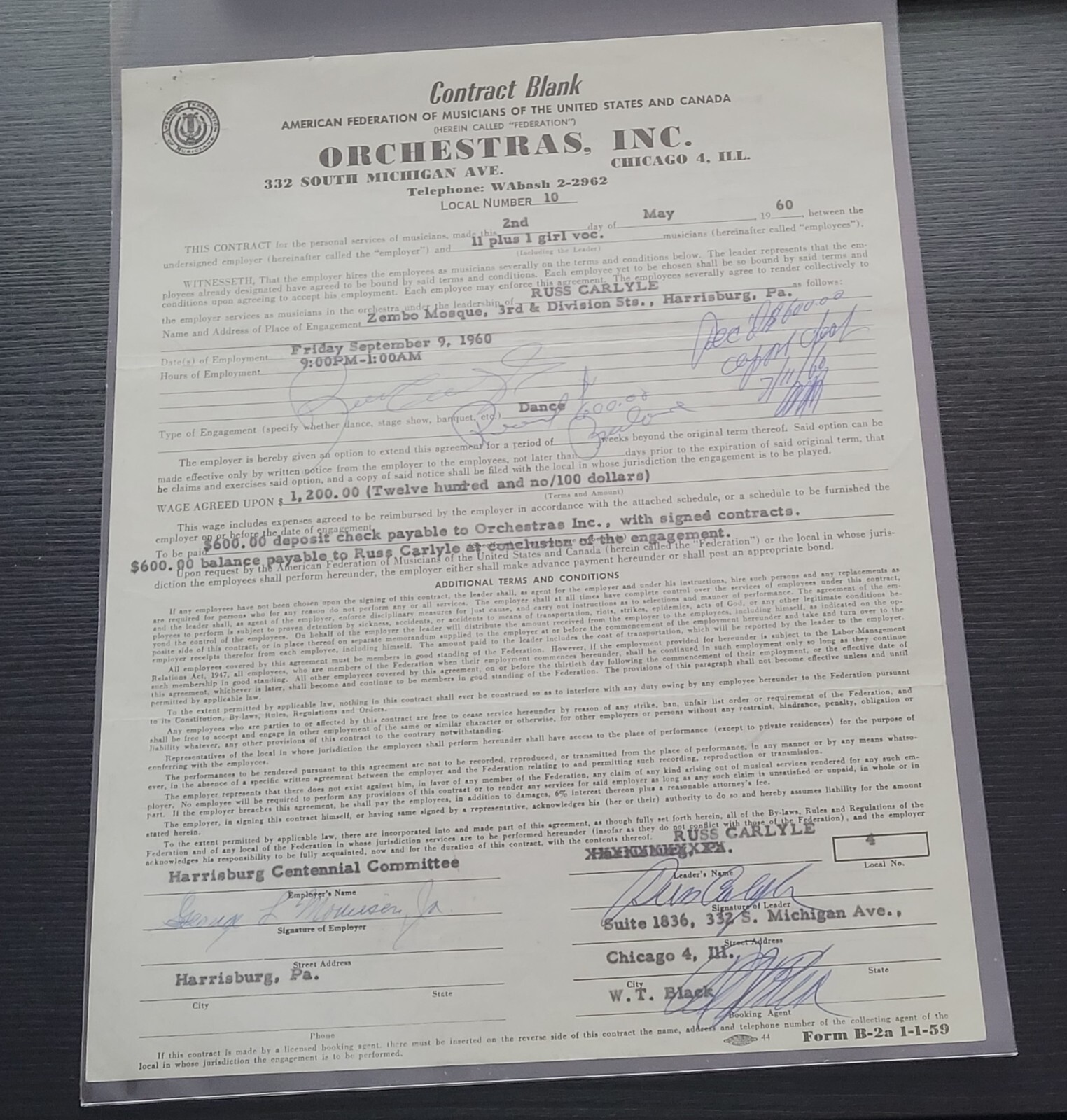
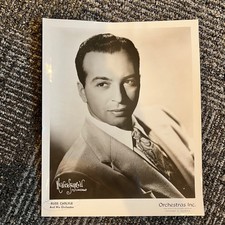
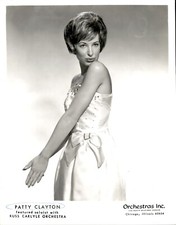
This rare jazz contract signed by Russ Carlyle in 1960 is a must-have for any music memorabilia collector. The contract, which features the signature of the renowned musician, is a testament to his legacy and impact on the industry. The contract is in excellent shape and has been well-preserved, making it a valuable addition to any collection. It is perfect for those interested in music history, autographs, and collectibles. Don\'t miss this opportunity to own a piece of jazz history!He was born Phillip Gantose in Cleveland, Ohio, but once embarked on his professional career decided that a showier name was required and so changed it (albeit never legally) to \'Carlyle\', after a well-known hotel in New York. At one time he was voted by Billboard Magazine the 4th top vocalist in America, while performing as lead singer with Blue Barron and his orchestra (1936-39). He formed his own dance band in 1940 in New York, using the tagline \'The Romantic Style of Russ Carlyle\'. His career was interrupted by wartime service, but after the war Carlyle regrouped and adopted a more swinging Hal Kemp ensemble sound. He eventually reverted to the \'sweet\' style of dance music performing at top ballrooms, hotels and country clubs, including prestigious venues such as Roseland Dance City in New York, the Roosevelt in New Orleans and the Peabody Hotel in Memphis. His band remained popular throughout the fifties and sixties and even garnered an award from the National Ballroom Operators Association. The Carlyle band was signed by ABC/Paramount in 1951 and recorded three albums. The band\'s long-standing female lead vocalist was Patty Clayton whom Russ married in 1970. In his later years, Carlyle and his band had long annual stints at the Dunes Hotel in Nevada. He retired in 1990.___________________Russ CarlyleRuss CarlyleReal Name:Phillip Gantose.Profile:American bandleader and singer.Born : December 03, 1914 in Cleveland, Ohio.Died : May 03, 2011 in St. Cloud, Minnesota. Brother of singer Louise Carlyle. He was married to singer Patty Clayton (2).
Russ Carlyle began his career as a nightclub singer in Cleveland since the mid-1930s, from 1936 to 1939 was lead singer of Blue Barron orchestra (also from Cleveland).In 1940 he formed his own orchestra (\"Russ Carlyle and His ABC Paramount Recording Orchestra\") that interrupted his musical career in 1943 with the departure of Russ military service,returned after the Second World War, the orchestra gained in later years a commercial success.Clayton joined his band in 1960, being discovered by Carlyle in St. Louis Missiouri. From 1972 to 1978, Carlye and Clayton performed as a duo for four months of the year at the Dunes Hotel in Las Vegas, then during the summer at Breezy Point, Minnesota and at Christmas time at the Petroleum Club in Tulsa, Oklahoma. In the same decade, Calyle set up his own label, Fona Records.He retired from the music scene in 1990.Later on, he wrote often with songwriter Ivan Washabaugh and songwriter Mike Caranda.Carbaugh was the music publisher used when any of the three songwriters worked together--associated with publishing companies: Carbaugh, Carbaugh Pub., and Carbaugh Music Co.
Jazz is a music genre that originated in the African-American communities of New Orleans, Louisiana, in the late 19th and early 20th centuries, with its roots in blues, ragtime, European harmony and African rhythmic rituals.[1][2][3][4][5][6] Since the 1920s Jazz Age, it has been recognized as a major form of musical expression in traditional and popular music. Jazz is characterized by swing and blue notes, complex chords, call and response vocals, polyrhythms and improvisation.
As jazz spread around the world, it drew on national, regional, and local musical cultures, which gave rise to different styles. New Orleans jazz began in the early 1910s, combining earlier brass band marches, French quadrilles, biguine, ragtime and blues with collective polyphonic improvisation. However, jazz did not begin as a single musical tradition in New Orleans or elsewhere.[7] In the 1930s, arranged dance-oriented swing big bands, Kansas City jazz (a hard-swinging, bluesy, improvisational style), and gypsy jazz (a style that emphasized musette waltzes) were the prominent styles. Bebop emerged in the 1940s, shifting jazz from danceable popular music toward a more challenging \"musician\'s music\" which was played at faster tempos and used more chord-based improvisation. Cool jazz developed near the end of the 1940s, introducing calmer, smoother sounds and long, linear melodic lines.[8]
The mid-1950s saw the emergence of hard bop, which introduced influences from rhythm and blues, gospel, and blues to small groups and particularly to saxophone and piano. Modal jazz developed in the late 1950s, using the mode, or musical scale, as the basis of musical structure and improvisation, as did free jazz, which explored playing without regular meter, beat and formal structures. Jazz-rock fusion appeared in the late 1960s and early 1970s, combining jazz improvisation with rock music\'s rhythms, electric instruments, and highly amplified stage sound. In the early 1980s, a commercial form of jazz fusion called smooth jazz became successful, garnering significant radio airplay. Other styles and genres abound in the 21st century, such as Latin and Afro-Cuban jazz.
Etymology and definitionMain article: Jazz (word)
American jazz composer, lyricist, and pianist Eubie Blake made an early contribution to the genre\'s etymology.The origin of the word jazz has resulted in considerable research, and its history is well documented. It is believed to be related to jasm, a slang term dating back to 1860 meaning \'pep, energy\'.[9][10] The earliest written record of the word is in a 1912 article in the Los Angeles Times in which a minor league baseball pitcher described a pitch which he called a \'jazz ball\' \"because it wobbles and you simply can\'t do anything with it\".[9][10]
The use of the word in a musical context was documented as early as 1915 in the Chicago Daily Tribune.[10][11] Its first documented use in a musical context in New Orleans was in a November 14, 1916, Times-Picayune article about \"jas bands\".[12] In an interview with National Public Radio, musician Eubie Blake offered his recollections of the slang connotations of the term, saying: \"When Broadway picked it up, they called it \'J-A-Z-Z\'. It wasn\'t called that. It was spelled \'J-A-S-S\'. That was dirty, and if you knew what it was, you wouldn\'t say it in front of ladies.\"[13] The American Dialect Society named it the Word of the 20th Century.[14]Albert Gleizes, 1915, Composition for \"Jazz\" from the Solomon R. Guggenheim Museum, New YorkJazz is difficult to define because it encompasses a wide range of music spanning a period of over 100 years, from ragtime to rock-infused fusion. Attempts have been made to define jazz from the perspective of other musical traditions, such as European music history or African music. But critic Joachim-Ernst Berendt argues that its terms of reference and its definition should be broader,[15] defining jazz as a \"form of art music which originated in the United States through the confrontation of the Negro with European music\"[16] and arguing that it differs from European music in that jazz has a \"special relationship to time defined as \'swing\'\". Jazz involves \"a spontaneity and vitality of musical production in which improvisation plays a role\" and contains a \"sonority and manner of phrasing which mirror the individuality of the performing jazz musician\".[15]
A broader definition that encompasses different eras of jazz has been proposed by Travis Jackson: \"it is music that includes qualities such as swing, improvising, group interaction, developing an \'individual voice\', and being open to different musical possibilities\".[17] Krin Gibbard argued that \"jazz is a construct\" which designates \"a number of musics with enough in common to be understood as part of a coherent tradition\".[18] Duke Ellington, one of jazz\'s most famous figures, said, \"It\'s all article: Jazz improvisationAlthough jazz is considered difficult to define, in part because it contains many subgenres, improvisation is one of its defining elements. The centrality of improvisation is attributed to the influence of earlier forms of music such as blues, a form of folk music which arose in part from the work songs and field hollers of African-American slaves on plantations. These work songs were commonly structured around a repetitive call-and-response pattern, but early blues was also improvisational. Classical music performance is evaluated more by its fidelity to the musical score, with less attention given to interpretation, ornamentation, and accompaniment. The classical performer\'s goal is to play the composition as it was written. In contrast, jazz is often characterized by the product of interaction and collaboration, placing less value on the contribution of the composer, if there is one, and more on the performer.[20] The jazz performer interprets a tune in individual ways, never playing the same composition twice. Depending on the performer\'s mood, experience, and interaction with band members or audience members, the performer may change melodies, harmonies, and time signatures.[21]
In early Dixieland, a.k.a. New Orleans jazz, performers took turns playing melodies and improvising countermelodies. In the swing era of the 1920s–\'40s, big bands relied more on arrangements which were written or learned by ear and memorized. Soloists improvised within these arrangements. In the bebop era of the 1940s, big bands gave way to small groups and minimal arrangements in which the melody was stated briefly at the beginning and most of the piece was improvised. Modal jazz abandoned chord progressions to allow musicians to improvise even more. In many forms of jazz, a soloist is supported by a rhythm section of one or more chordal instruments (piano, guitar), double bass, and drums. The rhythm section plays chords and rhythms that outline the composition structure and complement the soloist.[22] In avant-garde and free jazz, the separation of soloist and band is reduced, and there is license, or even a requirement, for the abandoning of chords, scales, and meters.
TraditionalismSince the emergence of bebop, forms of jazz that are commercially oriented or influenced by popular music have been criticized. According to Bruce Johnson, there has always been a \"tension between jazz as a commercial music and an art form\".[17] Regarding the Dixieland jazz revival of the 1940s, Black musicians rejected it as being shallow nostalgia entertainment for white audiences.[23][24] On the other hand, traditional jazz enthusiasts have dismissed bebop, free jazz, and jazz fusion as forms of debasement and betrayal. An alternative view is that jazz can absorb and transform diverse musical styles.[25] By avoiding the creation of norms, jazz allows avant-garde styles to emerge.[17]
Diversity in jazzJazz and raceFor some African Americans, jazz has drawn attention to African-American contributions to culture and history. For others, jazz is a reminder of \"an oppressive and racist society and restrictions on their artistic visions\".[26] Amiri Baraka argues that there is a \"white jazz\" genre that expresses whiteness.[27] White jazz musicians appeared in the Midwest and in other areas throughout the U.S. Papa Jack Laine, who ran the Reliance band in New Orleans in the 1910s, was called \"the father of white jazz\".[28] The Original Dixieland Jazz Band, whose members were white, were the first jazz group to record, and Bix Beiderbecke was one of the most prominent jazz soloists of the 1920s.[29] The Chicago Style was developed by white musicians such as Eddie Condon, Bud Freeman, Jimmy McPartland, and Dave Tough. Others from Chicago such as Benny Goodman and Gene Krupa became leading members of swing during the 1930s.[30] Many bands included both Black and white musicians. These musicians helped change attitudes toward race in the U.S.[31]
Roles of womenMain article: Women in jazz
Ethel Waters sang \"Stormy Weather\" at the Cotton Club.Female jazz performers and composers have contributed to jazz throughout its history. Although Betty Carter, Ella Fitzgerald, Adelaide Hall, Billie Holiday, Peggy Lee, Abbey Lincoln, Anita O\'Day, Dinah Washington, and Ethel Waters were recognized for their vocal talent, less familiar were bandleaders, composers, and instrumentalists such as pianist Lil Hardin Armstrong, trumpeter Valaida Snow, and songwriters Irene Higginbotham and Dorothy Fields. Women began playing instruments in jazz in the early 1920s, drawing particular recognition on piano.[32]
When male jazz musicians were drafted during World War II, many all-female bands replaced them.[32] The International Sweethearts of Rhythm, which was founded in 1937, was a popular band that became the first all-female integrated band in the U.S. and the first to travel with the USO, touring Europe in 1945. Women were members of the big bands of Woody Herman and Gerald Wilson. Beginning in the 1950s, many women jazz instrumentalists were prominent, some sustaining long careers. Some of the most distinctive improvisers, composers, and bandleaders in jazz have been women.[33] Trombonist Melba Liston is acknowledged as the first female horn player to work in major bands and to make a real impact on jazz, not only as a musician but also as a respected composer and arranger, particularly through her collaborations with Randy Weston from the late 1950s into the 1990s.[34][35]
Jews in jazzMain articles: Jews in jazz and Jewish women in jazz
Al Jolson in 1929Jewish Americans played a significant role in jazz. As jazz spread, it developed to encompass many different cultures, and the work of Jewish composers in Tin Pan Alley helped shape the many different sounds that jazz came to incorporate.[36]
Jewish Americans were able to thrive in Jazz because of the probationary whiteness that they were allotted at the time.[37] George Bornstein wrote that African Americans were sympathetic to the plight of the Jewish American and vice versa. As disenfranchised minorities themselves, Jewish composers of popular music saw themselves as natural allies with African Americans.[38]
The Jazz Singer with Al Jolson is one example of how Jewish Americans were able to bring jazz, music that African Americans developed, into popular culture.[39] Benny Goodman was a vital Jewish American to the progression of Jazz. Goodman was the leader of a racially integrated band named King of Swing. His jazz concert in the Carnegie Hall in 1938 was the first ever to be played there. The concert was described by Bruce Eder as \"the single most important jazz or popular music concert in history\".[40]
Shep Fields also helped to popularize \"Sweet\" Jazz music through his appearances and Big band remote broadcasts from such landmark venues as Chicago\'s Palmer House, Broadway\'s Paramount Theater and the Starlight Roof at the famed Waldorf-Astoria Hotel. He entertained audiences with a light elegant musical style which remained popular with audiences for nearly three decades from the 1930s until the late 1950s.[41][42][43]
Early developmentJazz originated in the late-19th to early-20th century. It developed out of many forms of music, including blues, spirituals, hymns, marches, vaudeville song, ragtime, and dance music.[44] It also incorporated interpretations of American and European classical music, entwined with African and slave folk songs and the influences of West African culture.[45] Its composition and style have changed many times throughout the years with each performer\'s personal interpretation and improvisation, which is also one of the greatest appeals of the genre.[46]
Blended African and European music sensibilities
Dance in Congo Square in the late 1700s, artist\'s conception by E. W. Kemble from a century later
The late 18th-century painting The Old Plantation, depicting African-Americans on a Virginia plantation dancing to percussion and a banjoBy the 18th century, slaves in the New Orleans area gathered socially at a special market, in an area which later became known as Congo Square, famous for its African dances.[47]
By 1866, the Atlantic slave trade had brought nearly 400,000 Africans to North America.[48] The slaves came largely from West Africa and the greater Congo River basin and brought strong musical traditions with them.[49] The African traditions primarily use a single-line melody and call-and-response pattern, and the rhythms have a counter-metric structure and reflect African speech patterns.[50]
An 1885 account says that they were making strange music (Creole) on an equally strange variety of \'instruments\'—washboards, washtubs, jugs, boxes beaten with sticks or bones and a drum made by stretching skin over a flour-barrel.[4][51]
Lavish festivals with African-based dances to drums were organized on Sundays at Place Congo, or Congo Square, in New Orleans until 1843.[52] There are historical accounts of other music and dance gatherings elsewhere in the southern United States. Robert Palmer said of percussive slave music:
Usually such music was associated with annual festivals, when the year\'s crop was harvested and several days were set aside for celebration. As late as 1861, a traveler in North Carolina saw dancers dressed in costumes that included horned headdresses and cow tails and heard music provided by a sheepskin-covered \"gumbo box\", apparently a frame drum; triangles and jawbones furnished the auxiliary percussion. There are quite a few [accounts] from the southeastern states and Louisiana dating from the period 1820–1850. Some of the earliest [Mississippi] Delta settlers came from the vicinity of New Orleans, where drumming was never actively discouraged for very long and homemade drums were used to accompany public dancing until the outbreak of the Civil War.[53]
Another influence came from the harmonic style of hymns of the church, which black slaves had learned and incorporated into their own music as spirituals.[54] The origins of the blues are undocumented, though they can be seen as the secular counterpart of the spirituals. However, as Gerhard Kubik points out, whereas the spirituals are homophonic, rural blues and early jazz \"was largely based on concepts of heterophony\".[55]The blackface Virginia Minstrels in 1843, featuring tambourine, fiddle, banjo, and bonesDuring the early 19th century an increasing number of black musicians learned to play European instruments, particularly the violin, which they used to parody European dance music in their own cakewalk dances. In turn, European American minstrel show performers in blackface popularized the music internationally, combining syncopation with European harmonic accompaniment. In the mid-1800s the white New Orleans composer Louis Moreau Gottschalk adapted slave rhythms and melodies from Cuba and other Caribbean islands into piano salon music. New Orleans was the main nexus between the Afro-Caribbean and African American cultures.
African rhythmic retentionSee also: Traditional sub-Saharan African harmonyThe Black Codes outlawed drumming by slaves, which meant that African drumming traditions were not preserved in North America, unlike in Cuba, Haiti, and elsewhere in the Caribbean. African-based rhythmic patterns were retained in the United States in large part through \"body rhythms\" such as stomping, clapping, and patting juba dancing.[56]
In the opinion of jazz historian Ernest Borneman, what preceded New Orleans jazz before 1890 was \"Afro-Latin music\", similar to what was played in the Caribbean at the time.[57] A three-stroke pattern known in Cuban music as tresillo is a fundamental rhythmic figure heard in many different slave musics of the Caribbean, as well as the Afro-Caribbean folk dances performed in New Orleans Congo Square and Gottschalk\'s compositions (for example \"Souvenirs From Havana\" (1859)). Tresillo (shown below) is the most basic and most prevalent duple-pulse rhythmic cell in sub-Saharan African music traditions and the music of the African Diaspora.[58][59]\ew RhythmicStaff { \\clef percussion \\time 2/4 \epeat volta 2 { c8. c16 r8[ c] }}Duration: 3 seconds.0:03Tresillo is heard prominently in New Orleans second line music and in other forms of popular music from that city from the turn of the 20th century to present.[60] \"By and large the simpler African rhythmic patterns survived in jazz ... because they could be adapted more readily to European rhythmic conceptions,\" jazz historian Gunther Schuller observed. \"Some survived, others were discarded as the Europeanization progressed.\"[61]
In the post-Civil War period (after 1865), African Americans were able to obtain surplus military bass drums, snare drums and fifes, and an original African-American drum and fife music emerged, featuring tresillo and related syncopated rhythmic figures.[62] This was a drumming tradition that was distinct from its Caribbean counterparts, expressing a uniquely African-American sensibility. \"The snare and bass drummers played syncopated cross-rhythms,\" observed the writer Robert Palmer, speculating that \"this tradition must have dated back to the latter half of the nineteenth century, and it could have not have developed in the first place if there hadn\'t been a reservoir of polyrhythmic sophistication in the culture it nurtured.\"[56]
Afro-Cuban influenceFurther information: Music of African heritage in CubaAfrican-American music began incorporating Afro-Cuban rhythmic motifs in the 19th century when the habanera (Cuban contradanza) gained international popularity.[63] Musicians from Havana and New Orleans would take the twice-daily ferry between both cities to perform, and the habanera quickly took root in the musically fertile Crescent City. John Storm Roberts states that the musical genre habanera \"reached the U.S. twenty years before the first rag was published.\"[64] For the more than quarter-century in which the cakewalk, ragtime, and proto-jazz were forming and developing, the habanera was a consistent part of African-American popular music.[64]
Habaneras were widely available as sheet music and were the first written music which was rhythmically based on an African motif (1803).[65] From the perspective of African-American music, the \"habanera rhythm\" (also known as \"congo\"),[65] \"tango-congo\",[66] or tango.[67] can be thought of as a combination of tresillo and the backbeat.[68] The habanera was the first of many Cuban music genres which enjoyed periods of popularity in the United States and reinforced and inspired the use of tresillo-based rhythms in African-American music. \ew Staff << \elative c\' { \\clef percussion \\time 2/4 \epeat volta 2 { g8. g16 d\'8 g, } } >>Duration: 0 seconds.0:00New Orleans native Louis Moreau Gottschalk\'s piano piece \"Ojos Criollos (Danse Cubaine)\" (1860) was influenced by the composer\'s studies in Cuba: the habanera rhythm is clearly heard in the left hand.[58]: 125 In Gottschalk\'s symphonic work \"A Night in the Tropics\" (1859), the tresillo variant cinquillo appears extensively.[69] The figure was later used by Scott Joplin and other ragtime composers.\ew RhythmicStaff { \\clef percussion \\time 2/4 \epeat volta 2 { c8 c16 c r[ c c r] }}Duration: 0 seconds.0:00Comparing the music of New Orleans with the music of Cuba, Wynton Marsalis observes that tresillo is the New Orleans \"clavé\", a Spanish word meaning \"code\" or \"key\", as in the key to a puzzle, or mystery.[70] Although the pattern is only half a clave, Marsalis makes the point that the single-celled figure is the guide-pattern of New Orleans music. Jelly Roll Morton called the rhythmic figure the Spanish tinge and considered it an essential ingredient of jazz.[71]
RagtimeMain article: Ragtime
Scott Joplin in 1903The abolition of slavery in 1865 led to new opportunities for the education of freed African Americans. Although strict segregation limited employment opportunities for most blacks, many were able to find work in entertainment. Black musicians were able to provide entertainment in dances, minstrel shows, and in vaudeville, during which time many marching bands were formed. Black pianists played in bars, clubs, and brothels, as ragtime developed.[72][73]
Ragtime appeared as sheet music, popularized by African-American musicians such as the entertainer Ernest Hogan, whose hit songs appeared in 1895. Two years later, Vess Ossman recorded a medley of these songs as a banjo solo known as \"Rag Time Medley\".[74][75] Also in 1897, the white composer William Krell published his \"Mississippi Rag\" as the first written piano instrumental ragtime piece, and Tom Turpin published his \"Harlem Rag\", the first rag published by an African-American.
Classically trained pianist Scott Joplin produced his \"Original Rags\" in 1898 and, in 1899, had an international hit with \"Maple Leaf Rag\", a multi-strain ragtime march with four parts that feature recurring themes and a bass line with copious seventh chords. Its structure was the basis for many other rags, and the syncopations in the right hand, especially in the transition between the first and second strain, were novel at the time.[76] The last four measures of Scott Joplin\'s \"Maple Leaf Rag\" (1899) are shown below.
{ \ew PianoStaff << \ew Staff << \ew Voice \elative c\' { \\clef treble \\key aes \\major \\time 2/4 <f aes>16 bes <f aes>8 <fes aes> <fes bes>16 <es aes>~ <es aes> bes\' <es, c\'> aes bes <es, c\'>8 <d aes\'>16~ <d aes\'> bes\' <d, c\'> aes\' r <des, bes\'>8 es16 <c aes\'>8 <g\' des\' es> <aes c es aes> } >> \ew Staff << \elative c, { \\clef bass \\key aes \\major \\time 2/4 <des des\'>8 <des des\'> <bes bes\'> <d d\'> <es es\'> <es\' aes c> <es, es\'> <e e\'> <f f\'> <f f\'> <g g\'> <g g\'> <aes aes\'> <es es\'> <aes, aes\'> \\bar \"|.\" } >> >>}Duration: 6 seconds.0:06African-based rhythmic patterns such as tresillo and its variants, the habanera rhythm and cinquillo, are heard in the ragtime compositions of Joplin and Turpin. Joplin\'s \"Solace\" (1909) is generally considered to be in the habanera genre:[77][78] both of the pianist\'s hands play in a syncopated fashion, completely abandoning any sense of a march rhythm. Ned Sublette postulates that the tresillo/habanera rhythm \"found its way into ragtime and the cakewalk,\"[79] whilst Roberts suggests that \"the habanera influence may have been part of what freed black music from ragtime\'s European bass\".[80]
Ragtime in other regionsIn the northeastern United States, a \"hot\" style of playing ragtime had developed, notably James Reese Europe\'s symphonic Clef Club orchestra in New York City, which played a benefit concert at Carnegie Hall in 1912.[81][82] The Baltimore rag style of Eubie Blake influenced James P. Johnson\'s development of stride piano playing, in which the right hand plays the melody, while the left hand provides the rhythm and bassline.[83]
In Ohio and elsewhere in the mid-west the major influence was ragtime, until about 1919. Around 1912, when the four-string banjo and saxophone came in, musicians began to improvise the melody line, but the harmony and rhythm remained unchanged. A contemporary account states that blues could only be heard in jazz in the gut-bucket cabarets, which were generally looked down upon by the Black middle-class.[84]
BluesMain article: BluesAfrican genesis{\\override Score.TimeSignature #\'stencil = ##f\elative c\' { \\clef treble \\time 6/4 c4^\\markup { \"C blues scale\" } es f fis g bes c2} } {\\override Score.TimeSignature #\'stencil = ##f\elative c\' { \\clef treble \\time 5/4 c4^\\markup { \"C minor pentatonic scale\" } es f g bes c2} }A hexatonic blues scale on C, ascendingBlues is the name given to both a musical form and a music genre,[85] which originated in African-American communities of primarily the Deep South of the United States at the end of the 19th century from their spirituals, work songs, field hollers, shouts and chants and rhymed simple narrative ballads.[86]
The African use of pentatonic scales contributed to the development of blue notes in blues and jazz.[87] As Kubik explains:
Many of the rural blues of the Deep South are stylistically an extension and merger of basically two broad accompanied song-style traditions in the west central Sudanic belt:
A strongly Arabic/Islamic song style, as found for example among the Hausa. It is characterized by melisma, wavy intonation, pitch instabilities within a pentatonic framework, and a declamatory voice.An ancient west central Sudanic stratum of pentatonic song composition, often associated with simple work rhythms in a regular meter, but with notable off-beat accents.[88]W. C. Handy: early published blues
W. C. Handy at 19, 1892W. C. Handy became interested in folk blues of the Deep South while traveling through the Mississippi Delta. In this folk blues form, the singer would improvise freely within a limited melodic range, sounding like a field holler, and the guitar accompaniment was slapped rather than strummed, like a small drum which responded in syncopated accents, functioning as another \"voice\".[89] Handy and his band members were formally trained African-American musicians who had not grown up with the blues, yet he was able to adapt the blues to a larger band instrument format and arrange them in a popular music form.
Handy wrote about his adopting of the blues:
The primitive southern Negro, as he sang, was sure to bear down on the third and seventh tone of the scale, slurring between major and minor. Whether in the cotton field of the Delta or on the Levee up St. Louis way, it was always the same. Till then, however, I had never heard this slur used by a more sophisticated Negro, or by any white man. I tried to convey this effect ... by introducing flat thirds and sevenths (now called blue notes) into my song, although its prevailing key was major ... , and I carried this device into my melody as well.[90]
The publication of his \"Memphis Blues\" sheet music in 1912 introduced the 12-bar blues to the world (although Gunther Schuller argues that it is not really a blues, but \"more like a cakewalk\").[91] This composition, as well as his later \"St. Louis Blues\" and others, included the habanera rhythm,[92] and would become jazz standards. Handy\'s music career began in the pre-jazz era and contributed to the codification of jazz through the publication of some of the first jazz sheet music.
New Orleans originsMain articles: Dixieland jazz and Music of LouisianaThis article is part of a series on theCulture ofLouisiana
SocietyFrench languageHistoryReligion Roman CatholicismVoodooPeople Louisiana FrenchCajunsCreolesArts and literatureCreole ArchitectureArtCajun DanceLouisiana literatureMusic JazzZydecoOtherLouisiana cuisine of allegianceAnthemBirdWorld Heritage SitesFleur-de-lis
Louisiana portalvte
The Bolden Band around 1905The music of New Orleans, Louisiana had a profound effect on the creation of early jazz. In New Orleans, slaves could practice elements of their culture such as voodoo and playing drums.[93] Many early jazz musicians played in the bars and brothels of the red-light district around Basin Street called Storyville.[94] In addition to dance bands, there were marching bands which played at lavish funerals (later called jazz funerals). The instruments used by marching bands and dance bands became the instruments of jazz: brass, drums, and reeds tuned in the European 12-tone scale. Small bands contained a combination of self-taught and formally educated musicians, many from the funeral procession tradition. These bands traveled in black communities in the deep south. Beginning in 1914, Louisiana Creole and African-American musicians played in vaudeville shows which carried jazz to cities in the northern and western parts of the U.S.[95] Jazz became international in 1914, when the Creole Band with cornettist Freddie Keppard performed the first ever jazz concert outside the United States, at the Pantages Playhouse Theatre in Winnipeg, Canada.[96]
In New Orleans, a white bandleader named Papa Jack Laine integrated blacks and whites in his marching band. He was known as \"the father of white jazz\" because of the many top players he employed, such as George Brunies, Sharkey Bonano, and future members of the Original Dixieland Jass Band. During the early 1900s, jazz was mostly performed in African-American and mulatto communities due to segregation laws. Storyville brought jazz to a wider audience through tourists who visited the port city of New Orleans.[97] Many jazz musicians from African-American communities were hired to perform in bars and brothels. These included Buddy Bolden and Jelly Roll Morton in addition to those from other communities, such as Lorenzo Tio and Alcide Nunez. Louis Armstrong started his career in Storyville[98] and found success in Chicago. Storyville was shut down by the U.S. government in 1917.[99]
Syncopation
Jelly Roll Morton, a Louisiana Creole jazz artist, c. 1917 or 1918Cornetist Buddy Bolden played in New Orleans from 1895 to 1906. No recordings by him exist. His band is credited with creating the big four: the first syncopated bass drum pattern to deviate from the standard on-the-beat march.[100] As the example below shows, the second half of the big four pattern is the habanera rhythm. \ew Staff << \elative c\' { \\clef percussion \\time 4/4 \epeat volta 2 { g8 \\xNote a\' g, \\xNote a\' g, \\xNote a\'16. g,32 g8 <g \\xNote a\'> } \epeat volta 2 { r8 \\xNote a\'\oBeam g, \\xNote a\' g, \\xNote a\'16. g,32 g8 <g \\xNote a\'> } } >>Duration: 0 seconds.0:00Afro-Creole pianist Jelly Roll Morton began his career in Storyville. Beginning in 1904, he toured with vaudeville shows to southern cities, Chicago, and New York City. In 1905, he composed \"Jelly Roll Blues\", which became the first jazz arrangement in print when it was published in 1915. It introduced more musicians to the New Orleans style.[101]
Morton considered the tresillo/habanera, which he called the Spanish tinge, an essential ingredient of jazz.[102] \"Now in one of my earliest tunes, \"New Orleans Blues,\" you can notice the Spanish tinge. In fact, if you can\'t manage to put tinges of Spanish in your tunes, you will never be able to get the right seasoning, I call it, for jazz.\"[71]
An excerpt of \"New Orleans Blues\" is shown below. In the excerpt, the left hand plays the tresillo rhythm, while the right hand plays variations on cinquillo. { \ew PianoStaff << \ew Staff << \elative c\'\' { \\clef treble \\key bes \\major \\time 2/2 f8 <f, f\'> <g g\'> <f~ cis\'> <f d\'> <f f\'> <g d\' g>4 r8 <f f\'> <g g\'> <f~ cis\'> <f d\'> <f f\'> <g d\' g>4 r8 <f d\' f> <g d\' g> <f~ cis\'> <f d\'> <f d\' f> <g d\' g> <f d\' f> } >> \ew Staff << \elative c { \\clef bass \\key bes \\major \\time 2/2 <bes bes\'>4. <f\' d\'>8~ <f d\'>4 <f, f\'>4 <bes f\' bes>4. <f\' d\'>8~ <f d\'>4 <f, f\'>4 <bes f\' bes>4. <f\' d\'>8~ <f d\'>4 <f, f\'>4 } >> >> }Duration: 7 seconds.0:07Morton was a crucial innovator in the evolution from the early jazz form known as ragtime to jazz piano, and could perform pieces in either style; in 1938, Morton made a series of recordings for the Library of Congress in which he demonstrated the difference between the two styles. Morton\'s solos, however, were still close to ragtime, and were not merely improvisations over chord changes as in later jazz, but his use of the blues was of equal importance.
Swing in the early 20th century
\ew RhythmicStaff { \\clef percussion \\time 4/4 \epeat volta 2 { c8^\\markup { \"Even subdivisions\" } c16 c c8 c16 c c8 c16 c c8 c16 c }}Duration: 0 seconds.0:00\ew RhythmicStaff { \\clef percussion \\time 4/4 \epeat volta 2 { c8[^\\markup { \"Swung correlative\" } \\tuplet 3/2 { c16 r c] } c8[ \\tuplet 3/2 { c16 r c] } c8[ \\tuplet 3/2 { c16 r c] } c8[ \\tuplet 3/2 { c16 r c] } }}Duration: 0 seconds.0:00Morton loosened ragtime\'s rigid rhythmic feeling, decreasing its embellishments and employing a swing feeling.[103] Swing is the most important and enduring African-based rhythmic technique used in jazz. An oft quoted definition of swing by Louis Armstrong is: \"if you don\'t feel it, you\'ll never know it.\"[104] The New Harvard Dictionary of Music states that swing is: \"An intangible rhythmic momentum in jazz...Swing defies analysis; claims to its presence may inspire arguments.\" The dictionary does nonetheless provide the useful description of triple subdivisions of the beat contrasted with duple subdivisions:[105] swing superimposes six subdivisions of the beat over a basic pulse structure or four subdivisions. This aspect of swing is far more prevalent in African-American music than in Afro-Caribbean music. One aspect of swing, which is heard in more rhythmically complex Diaspora musics, places strokes in-between the triple and duple-pulse \"grids\".[106]
New Orleans brass bands are a lasting influence, contributing horn players to the world of professional jazz with the distinct sound of the city whilst helping black children escape poverty. The leader of New Orleans\' Camelia Brass Band, D\'Jalma Ganier, taught Louis Armstrong to play trumpet; Armstrong would then popularize the New Orleans style of trumpet playing, and then expand it. Like Jelly Roll Morton, Armstrong is also credited with the abandonment of ragtime\'s stiffness in favor of swung notes. Armstrong, perhaps more than any other musician, codified the rhythmic technique of swing in jazz and broadened the jazz solo vocabulary.[107]
The Original Dixieland Jass Band made the music\'s first recordings early in 1917, and their \"Livery Stable Blues\" became the earliest released jazz That year, numerous other bands made recordings featuring \"jazz\" in the title or band name, but most were ragtime or novelty records rather than jazz. In February 1918 during World War I, James Reese Europe\'s \"Hellfighters\" infantry band took ragtime to Europe,[115][116] then on their return recorded Dixieland standards including \"Darktown Strutters\' Ball\".[81]
The Jazz AgeMain article: Jazz Age
The King & Carter Jazzing Orchestra photographed in Houston, Texas, January 1921From 1920 to 1933, Prohibition in the United States banned the sale of alcoholic drinks, resulting in illicit speakeasies which became lively venues of the \"Jazz Age\", hosting popular music, dance songs, novelty songs, and show tunes. Jazz began to get a reputation as immoral, and many members of the older generations saw it as a threat to the old cultural values by promoting the decadent values of the Roaring 20s. Henry van Dyke of Princeton University wrote, \"... it is not music at all. It\'s merely an irritation of the nerves of hearing, a sensual teasing of the strings of physical passion.\"[117] The New York Times reported that Siberian villagers used jazz to scare away bears, but the villagers had used pots and pans; another story claimed that the fatal heart attack of a celebrated conductor was caused by jazz.[117]Jazz Me BluesDuration: 2 minutes and 59 seconds.2:59The Original Dixieland Jass Band performing \"Jazz Me Blues\", an example of a jazz piece from 1921Problems playing this file? See media help.In 1919, Kid Ory\'s Original Creole Jazz Band of musicians from New Orleans began playing in San Francisco and Los Angeles, where in 1922 they became the first black jazz band of New Orleans origin to make recordings.[118][119] During the same year, Bessie Smith made her first recordings.[120] Chicago was developing \"Hot Jazz\", and King Oliver joined Bill Johnson. Bix Beiderbecke formed The Wolverines in 1924.
Despite its Southern black origins, there was a larger market for jazzy dance music played by white orchestras. In 1918, Paul Whiteman and his orchestra became a hit in San Francisco. He signed a contract with Victor and became the top bandleader of the 1920s, giving hot jazz a white component, hiring white musicians such as Bix Beiderbecke, Jimmy Dorsey, Tommy Dorsey, Frankie Trumbauer, and Joe Venuti. In 1924, Whiteman commissioned George Gershwin\'s Rhapsody in Blue, which was premiered by his orchestra. Jazz began to be recognized as a notable musical form. Olin Downes, reviewing the concert in The New York Times, wrote, \"This composition shows extraordinary talent, as it shows a young composer with aims that go far beyond those of his ilk, struggling with a form of which he is far from being master. ... In spite of all this, he has expressed himself in a significant and, on the whole, highly original form. ... His first theme ... is no mere dance-tune ... it is an idea, or several ideas, correlated and combined in varying and contrasting rhythms that immediately intrigue the listener.\"[121]
After Whiteman\'s band successfully toured Europe, huge hot jazz orchestras in theater pits caught on with other whites, including Fred Waring, Jean Goldkette, and Nathaniel Shilkret. According to Mario Dunkel, Whiteman\'s success was based on a \"rhetoric of domestication\" according to which he had elevated and rendered valuable (read \"white\") a previously inchoate (read \"black\") kind of music.[122]Louis Armstrong began his career in New Orleans and became one of jazz\'s most recognizable performers.Whiteman\'s success caused black artists to follow suit, including Earl Hines (who opened in The Grand Terrace Cafe in Chicago in 1928), Washington, D.C.-native Duke Ellington (who opened at the Cotton Club in Harlem in 1927), Lionel Hampton, Fletcher Henderson, Claude Hopkins, and Don Redman, with Henderson and Redman developing the \"talking to one another\" formula for \"hot\" swing music.[123]
In 1924, Louis Armstrong joined the Fletcher Henderson dance band for a year, as featured soloist. By 1924, one of Armstrong\'s favorite \"Sweet Jazz\" Big bands was also formed in Canada by Guy Lombardo. His Royal Canadians Orchestra specialized in performances of \"the Sweetest music this side of Heaven\" which transcended racial boundaries.[124][125] The original New Orleans style was polyphonic, with theme variation and simultaneous collective improvisation. Armstrong was a master of his hometown style, but by the time he joined Henderson\'s band, he was already a trailblazer in a new phase of jazz, with its emphasis on arrangements and soloists. Armstrong\'s solos went well beyond the theme-improvisation concept and extemporized on chords, rather than melodies. According to Schuller, by comparison, the solos by Armstrong\'s bandmates (including a young Coleman Hawkins), sounded \"stiff, stodgy\", with \"jerky rhythms and a grey undistinguished tone quality\".[126] The following example shows a short excerpt of the straight melody of \"Mandy, Make Up Your Mind\" by George W. Meyer and Arthur Johnston (top), compared with Armstrong\'s solo improvisations (below) (recorded 1924).[127] Armstrong\'s solos were a significant factor in making jazz a true 20th-century language. After leaving Henderson\'s group, Armstrong formed his Hot Five band, where he popularized scat singing.[128]
Swing in the 1920s and 1930sMain articles: Swing music and 1930s in jazz
Benny Goodman (1943)The 1930s belonged to popular swing big bands, in which some virtuoso soloists became as famous as the band leaders. Key figures in developing the \"big\" jazz band included bandleaders and arrangers Count Basie, Cab Calloway, Jimmy and Tommy Dorsey, Duke Ellington, Benny Goodman, Fletcher Henderson, Earl Hines, Harry James, Jimmie Lunceford, Glenn Miller and Artie Shaw. Although it was a collective sound, swing also offered individual musicians a chance to \"solo\" and improvise melodic, thematic solos which could at times be complex \"important\" music.
Over time, social strictures regarding racial segregation began to relax in America: white bandleaders began to recruit black musicians and black bandleaders white ones. In the mid-1930s, Benny Goodman hired pianist Teddy Wilson, vibraphonist Lionel Hampton and guitarist Charlie Christian to join small groups. In the 1930s, Kansas City Jazz as exemplified by tenor saxophonist Lester Young marked the transition from big bands to the bebop influence of the 1940s. An early 1940s style known as \"jumping the blues\" or jump blues used small combos, uptempo music and blues chord progressions, drawing on boogie-woogie from the 1930s.
The influence of Duke Ellington
Duke Ellington at the Hurricane Club (1943)While swing was reaching the height of its popularity, Duke Ellington spent the late 1920s and 1930s in Washington, D.C.\'s jazz scene, developing an innovative musical idiom for his orchestra. Abandoning the conventions of swing, he experimented with orchestral sounds, harmony, and musical form with complex compositions that still translated well for popular audiences; some of his tunes became hits, and his own popularity spanned from the United States to Europe.[129]
Ellington called his music American Music, rather than jazz, and liked to describe those who impressed him as \"beyond category\".[130] These included many musicians from his orchestra, some of whom are considered among the best in jazz in their own right, but it was Ellington who melded them into one of the most popular jazz orchestras in the history of jazz. He often composed for the style and skills of these individuals, such as \"Jeep\'s Blues\" for Johnny Hodges, \"Concerto for Cootie\" for Cootie Williams (which later became \"Do Nothing Till You Hear from Me\" with Bob Russell\'s lyrics), and \"The Mooche\" for Tricky Sam Nanton and Bubber Miley. He also recorded compositions written by his bandsmen, such as Juan Tizol\'s \"Caravan\" and \"Perdido\", which brought the \"Spanish Tinge\" to big-band jazz. Several members of the orchestra remained with him for several decades. The band reached a creative peak in the early 1940s, when Ellington and a small hand-picked group of his composers and arrangers wrote for an orchestra of distinctive voices who displayed tremendous creativity.[131]
Beginnings of European jazzAs only a limited number of American jazz records were released in Europe, European jazz traces many of its roots to American artists such as James Reese Europe, Paul Whiteman, and Lonnie Johnson, who visited Europe during and after World War I. It was their live performances which inspired European audiences\' interest in jazz, as well as the interest in all things American (and therefore exotic) which accompanied the economic and political woes of Europe during this time.[132] The beginnings of a distinct European style of jazz began to emerge in this interwar period.
British jazz began with a tour by the Original Dixieland Jazz Band in 1919. In 1926, Fred Elizalde and His Cambridge Undergraduates began broadcasting on the BBC. Thereafter jazz became an important element in many leading dance orchestras, and jazz instrumentalists became numerous.[133]
This style entered full swing in France with the Quintette du Hot Club de France, which began in 1934. Much of this French jazz was a combination of African-American jazz and the symphonic styles in which French musicians were well-trained; in this, it is easy to see the inspiration taken from Paul Whiteman since his style was also a fusion of the two.[134] Belgian guitarist Django Reinhardt popularized gypsy jazz, a mix of 1930s American swing, French dance hall \"musette\", and Eastern European folk with a languid, seductive feel; the main instruments were steel stringed guitar, violin, and double bass. Solos pass from one player to another as guitar and bass form the rhythm section. Some researchers believe Eddie Lang and Joe Venuti pioneered the guitar-violin partnership characteristic of the genre,[135] which was brought to France after they had been heard live or on Okeh Records in the late 1920s.[136]
Post-war jazzSee also: 1940s in jazz, 1950s in jazz, 1960s in jazz, 1970s in jazz, and album era
The \"classic quintet\": Charlie Parker, Tommy Potter, Miles Davis, Dizzy Gillespie, and Max Roach performing at Three Deuces in New York City. Photograph by William P. Gottlieb (August 1947), Library of Congress.The outbreak of World War II marked a turning point for jazz. The swing-era jazz of the previous decade had challenged other popular music as being representative of the nation\'s culture, with big bands reaching the height of the style\'s success by the early 1940s; swing acts and big bands traveled with U.S. military overseas to Europe, where it also became popular.[137] Stateside, however, the war presented difficulties for the big-band format: conscription shortened the number of musicians available; the military\'s need for shellac (commonly used for pressing gramophone records) limited record production; a shortage of rubber (also due to the war effort) discouraged bands from touring via road travel; and a demand by the musicians\' union for a commercial recording ban limited music distribution between 1942 and 1944.[138]
Many of the big bands who were deprived of experienced musicians because of the war effort began to enlist young players who were below the age for conscription, as was the case with saxophonist Stan Getz\'s entry in a band as a teenager.[139] This coincided with a nationwide resurgence in the Dixieland style of pre-swing jazz; performers such as clarinetist George Lewis, cornetist Bill Davison, and trombonist Turk Murphy were hailed by conservative jazz critics as more authentic than the big bands.[138] Elsewhere, with the limitations on recording, small groups of young musicians developed a more uptempo, improvisational style of jazz,[137] collaborating and experimenting with new ideas for melodic development, rhythmic language, and harmonic substitution, during informal, late-night jam sessions hosted in small clubs and apartments. Key figures in this development were largely based in New York and included pianists Thelonious Monk and Bud Powell, drummers Max Roach and Kenny Clarke, saxophonist Charlie Parker, and trumpeter Dizzy Gillespie.[138] This musical development became known as bebop.[137]
Bebop and subsequent post-war jazz developments featured a wider set of notes, played in more complex patterns and at faster tempos than previous jazz.[139] According to Clive James, bebop was \"the post-war musical development which tried to ensure that jazz would no longer be the spontaneous sound of joy ... Students of race relations in America are generally agreed that the exponents of post-war jazz were determined, with good reason, to present themselves as challenging artists rather than tame entertainers.\"[140] The end of the war marked \"a revival of the spirit of experimentation and musical pluralism under which it had been conceived\", along with \"the beginning of a decline in the popularity of jazz music in America\", according to American academic Michael H. Burchett.[137]
With the rise of bebop and the end of the swing era after the war, jazz lost its cachet as pop music. Vocalists of the famous big bands moved on to being marketed and performing as solo pop singers; these included Frank Sinatra, Peggy Lee, Dick Haymes, and Doris Day.[139] Older musicians who still performed their pre-war jazz, such as Armstrong and Ellington, were gradually viewed in the mainstream as passé. Other younger performers, such as singer Big Joe Turner and saxophonist Louis Jordan, who were discouraged by bebop\'s increasing complexity, pursued more lucrative endeavors in rhythm and blues, jump blues, and eventually rock and roll.[137] Some, including Gillespie, composed intricate yet danceable pieces for bebop musicians in an effort to make them more accessible, but bebop largely remained on the fringes of American audiences\' purview. \"The new direction of postwar jazz drew a wealth of critical acclaim, but it steadily declined in popularity as it developed a reputation as an academic genre that was largely inaccessible to mainstream audiences\", Burchett said. \"The quest to make jazz more relevant to popular audiences, while retaining its artistic integrity, is a constant and prevalent theme in the history of postwar jazz.\"[137] During its swing period, jazz had been an uncomplicated musical scene; according to Paul Trynka, this changed in the post-war years:
Suddenly jazz was no longer straightforward. There was bebop and its variants, there was the last gasp of swing, there were strange new brews like the progressive jazz of Stan Kenton, and there was a completely new phenomenon called revivalism – the rediscovery of jazz from the past, either on old records or performed live by aging players brought out of retirement. From now on it was no good saying that you liked jazz, you had to specify what kind of jazz. And that is the way it has been ever since, only more so. Today, the word \'jazz\' is virtually meaningless without further definition.[139]
BebopMain article: BebopIn the early 1940s, bebop-style performers began to shift jazz from danceable popular music toward a more challenging \"musician\'s music\". The most influential bebop musicians included saxophonist Charlie Parker, pianists Bud Powell and Thelonious Monk, trumpeters Dizzy Gillespie and Clifford Brown, and drummer Max Roach. Divorcing itself from dance music, bebop established itself more as an art form, thus lessening its potential popular and commercial appeal.
Composer Gunther Schuller wrote: \"In 1943 I heard the great Earl Hines band which had Bird in it and all those other great musicians. They were playing all the flatted fifth chords and all the modern harmonies and substitutions and Dizzy Gillespie runs in the trumpet section work. Two years later I read that that was \'bop\' and the beginning of modern jazz ... but the band never made recordings.\"[141]
Dizzy Gillespie wrote: \"People talk about the Hines band being \'the incubator of bop\' and the leading exponents of that music ended up in the Hines band. But people also have the erroneous impression that the music was new. It was not. The music evolved from what went before. It was the same basic music. The difference was in how you got from here to here to here...naturally each age has got its own shit.\"[142]
Since bebop was meant to be listened to, not danced to, it could use faster tempos. Drumming shifted to a more elusive and explosive style, in which the ride cymbal was used to keep time while the snare and bass drum were used for accents. This led to a highly syncopated music with a linear rhythmic complexity.[143]
Bebop musicians employed several harmonic devices which were not previously typical in jazz, engaging in a more abstracted form of chord-based improvisation. Bebop scales are traditional scales with an added chromatic passing note;[144] bebop also uses \"passing\" chords, substitute chords, and altered chords. New forms of chromaticism and dissonance were introduced into jazz, and the dissonant tritone (or \"flatted fifth\") interval became the \"most important interval of bebop\"[145] Chord progressions for bebop tunes were often taken directly from popular swing-era tunes and reused with a new and more complex melody or reharmonized with more complex chord progressions to form new compositions, a practice which was already well-established in earlier jazz, but came to be central to the bebop style. Bebop made use of several relatively common chord progressions, such as blues (at base, I–IV–V, but often infused with ii–V motion) and \"rhythm changes\" (I-vi-ii-V) – the chords to the 1930s pop standard \"I Got Rhythm\". Late bop also moved towards extended forms that represented a departure from pop and show tunes.
The harmonic development in bebop is often traced back to a moment experienced by Charlie Parker while performing \"Cherokee\" at Clark Monroe\'s Uptown House, New York, in early 1942. \"I\'d been getting bored with the stereotyped changes that were being used...and I kept thinking there\'s bound to be something else. I could hear it sometimes. I couldn\'t play it...I was working over \'Cherokee,\' and, as I did, I found that by using the higher intervals of a chord as a melody line and backing them with appropriately related changes, I could play the thing I\'d been hearing. It came alive.\"[146] Gerhard Kubik postulates that harmonic development in bebop sprang from blues and African-related tonal sensibilities rather than 20th-century Western classical music. \"Auditory inclinations were the African legacy in [Parker\'s] life, reconfirmed by the experience of the blues tonal system, a sound world at odds with the Western diatonic chord categories. Bebop musicians eliminated Western-style functional harmony in their music while retaining the strong central tonality of the blues as a basis for drawing upon various African matrices.\"[146]
Samuel Floyd states that blues was both the bedrock and propelling force of bebop, bringing about a new harmonic conception using extended chord structures that led to unprecedented harmonic and melodic variety, a developed and even more highly syncopated, linear rhythmic complexity and a melodic angularity in which the blue note of the fifth degree was established as an important melodic-harmonic device; and reestablishment of the blues as the primary organizing and functional principle.[143] Kubik wrote:
While for an outside observer, the harmonic innovations in bebop would appear to be inspired by experiences in Western \"serious\" music, from Claude Debussy to Arnold Schoenberg, such a scheme cannot be sustained by the evidence from a cognitive approach. Claude Debussy did have some influence on jazz, for example, on Bix Beiderbecke\'s piano playing. And it is also true that Duke Ellington adopted and reinterpreted some harmonic devices in European contemporary music. West Coast jazz would run into such debts as would several forms of cool jazz, but bebop has hardly any such debts in the sense of direct borrowings. On the contrary, ideologically, bebop was a strong statement of rejection of any kind of eclecticism, propelled by a desire to activate something deeply buried in self. Bebop then revived tonal-harmonic ideas transmitted through the blues and reconstructed and expanded others in a basically non-Western harmonic approach. The ultimate significance of all this is that the experiments in jazz during the 1940s brought back to African-American music several structural principles and techniques rooted in African traditions.[147]
These divergences from the jazz mainstream of the time met a divided, sometimes hostile response among fans and musicians, especially swing players who bristled at the new harmonic sounds. To hostile critics, bebop seemed filled with \"racing, nervous phrases\".[148] But despite the friction, by the 1950s bebop had become an accepted part of the jazz vocabulary.
Afro-Cuban jazz (cu-bop)Main article: Afro-Cuban jazz
Machito (maracas) and his sister Graciella Grillo (claves)Machito and Mario BauzaThe general consensus among musicians and musicologists is that the first original jazz piece to be overtly based in clave was \"Tanga\" (1943), composed by Cuban-born Mario Bauza and recorded by Machito and his Afro-Cubans in New York City. \"Tanga\" began as a spontaneous descarga (Cuban jam session), with jazz solos superimposed on top.[149]
This was the birth of Afro-Cuban jazz. The use of clave brought the African timeline, or key pattern, into jazz. Music organized around key patterns convey a two-celled (binary) structure, which is a complex level of African cross-rhythm.[150] Within the context of jazz, however, harmony is the primary referent, not rhythm. The harmonic progression can begin on either side of clave, and the harmonic \"one\" is always understood to be \"one\". If the progression begins on the \"three-side\" of clave, it is said to be in 3–2 clave (shown below). If the progression begins on the \"two-side\", it is in 2–3 clave.[151]\ew RhythmicStaff { \\clef percussion \\time 4/4 \epeat volta 2 { c8. c16 r8[ c] r[ c] c4 }}Duration: 8 seconds.0:08Dizzy Gillespie and Chano Pozo
Dizzy Gillespie, 1955Mario Bauzá introduced bebop innovator Dizzy Gillespie to Cuban conga drummer and composer Chano Pozo. Gillespie and Pozo\'s brief collaboration produced some of the most enduring Afro-Cuban jazz standards. \"Manteca\" (1947) is the first jazz standard to be rhythmically based on clave. According to Gillespie, Pozo composed the layered, contrapuntal guajeos (Afro-Cuban ostinatos) of the A section and the introduction, while Gillespie wrote the bridge. Gillespie recounted: \"If I\'d let it go like [Chano] wanted it, it would have been strictly Afro-Cuban all the way. There wouldn\'t have been a bridge. I thought I was writing an eight-bar bridge, but ... I had to keep going and ended up writing a sixteen-bar bridge.\"[152] The bridge gave \"Manteca\" a typical jazz harmonic structure, setting the piece apart from Bauza\'s modal \"Tanga\" of a few years earlier.
Gillespie\'s collaboration with Pozo brought specific African-based rhythms into bebop. While pushing the boundaries of harmonic improvisation, cu-bop also drew from African rhythm. Jazz arrangements with a Latin A section and a swung B section, with all choruses swung during solos, became common practice with many Latin tunes of the jazz standard repertoire. This approach can be heard on pre-1980 recordings of \"Manteca\", \"A Night in Tunisia\", \"Tin Tin Deo\", and \"On Green Dolphin Street\".
\"Un Poco Loco\"Another jazz composition critical to the development of Afro-Cuban jazz was Bud Powell\'s \"Un Poco Loco,\" recorded with Curley Russell on bass and Max Roach on drums. Noted for its \"frenetic energy\" and \"clanging cowbell and polyrhythmic accompaniment,\"[153] the composition combined Afro-Cuban rhythm with polytonality and preceded further use of modality and avant-garde harmony in Latin jazz.[154]
African cross-rhythm
Mongo Santamaria (1969)Cuban percussionist Mongo Santamaria first recorded his composition \"Afro Blue\" in 1959.[155] \"Afro Blue\" was the first jazz standard built upon a typical African three-against-two (3:2) cross-rhythm, or hemiola.[156] The piece begins with the bass repeatedly playing 6 cross-beats per each measure of 128, or 6 cross-beats per 4 main beats—6:4 (two cells of 3:2).
The following example shows the original ostinato \"Afro Blue\" bass line. The cross noteheads indicate the main beats (not bass notes). \ew Staff << \ew voice \elative c { \\set Staff.midiInstrument = #\"acoustic bass\" \\set Score.tempoHideNote = ##t \\tempo 4 = 105 \\time 12/8 \\clef bass \\stemUp \epeat volta 2 { d4 a\'8~ a d4 d,4 a\'8~ a d4 } } \ew voice \elative c { \\override NoteHead.style = #\'cross \\stemDown \epeat volta 2 { g4. g g g } } >>When John Coltrane covered \"Afro Blue\" in 1963, he inverted the metric hierarchy, interpreting the tune as a 34 jazz waltz with duple cross-beats superimposed (2:3). Originally a B♭ pentatonic blues, Coltrane expanded the harmonic structure of \"Afro Blue\".
Perhaps the most respected Afro-cuban jazz combo of the late 1950s was vibraphonist Cal Tjader\'s band. Tjader had Mongo Santamaria, Armando Peraza, and Willie Bobo on his early recording dates.
Dixieland revivalIn the late 1940s, there was a revival of Dixieland, harking back to the contrapuntal New Orleans style. This was driven in large part by record company reissues of jazz classics by the Oliver, Morton, and Armstrong bands of the 1930s. There were two types of musicians involved in the revival: the first group was made up of those who had begun their careers playing in the traditional style and were returning to it (or continuing what they had been playing all along), such as Bob Crosby\'s Bobcats, Max Kaminsky, Eddie Condon, and Wild Bill Davison.[157] Most of these players were originally Midwesterners, although there were a small number of New Orleans musicians involved. The second group of revivalists consisted of younger musicians, such as those in the Lu Watters band, Conrad Janis, and Ward Kimball and his Firehouse Five Plus Two Jazz Band. By the late 1940s, Louis Armstrong\'s Allstars band became a leading ensemble. Through the 1950s and 1960s, Dixieland was one of the most commercially popular jazz styles in the US, Europe, and Japan, although critics paid little attention to it.[157]
Hard bopMain article: Hard bop
Art Blakey (1973)Hard bop is an extension of bebop (or \"bop\") music that incorporates influences from blues, rhythm and blues, and gospel, especially in saxophone and piano playing. Hard bop was developed in the mid-1950s, coalescing in 1953 and 1954; it developed partly in response to the vogue for cool jazz in the early 1950s and paralleled the rise of rhythm and blues. It has been described as \"funky\" and can be considered a relative of soul jazz.[158] Some elements of the genre were simplified from their bebop roots.[159]
Miles Davis\' 1954 performance of \"Walkin\'\" at the first Newport Jazz Festival introduced the style to the jazz world.[160] Further leaders of hard bop\'s development included the Clifford Brown/Max Roach Quintet, Art Blakey\'s Jazz Messengers, the Horace Silver Quintet, and trumpeters Lee Morgan and Freddie Hubbard. The late 1950s to early 1960s saw hard boppers form their own bands as a new generation of blues- and bebop-influenced musicians entered the jazz world, from pianists Wynton Kelly and Tommy Flanagan[161] to saxophonists Joe Henderson and Hank Mobley. Coltrane, Johnny Griffin, Mobley, and Morgan all participated on the album A Blowin\' Session (1957), considered by Al Campbell to have been one of the high points of the hard bop era.[162]
Hard bop was prevalent within jazz for about a decade spanning from 1955 to 1965,[161] but has remained highly influential on mainstream[159] or \"straight-ahead\" jazz. It went into decline in the late 1960s through the 1970s due to the emergence of other styles such as jazz fusion, but again became influential following the Young Lions Movement and the emergence of neo-bop.[159]
Modal jazzMain article: Modal jazzModal jazz is a development which began in the later 1950s which takes the mode, or musical scale, as the basis of musical structure and improvisation. Previously, a solo was meant to fit into a given chord progression, but with modal jazz, the soloist creates a melody using one (or a small number of) modes. The emphasis is thus shifted from harmony to melody:[163] \"Historically, this caused a seismic shift among jazz musicians, away from thinking vertically (the chord), and towards a more horizontal approach (the scale)\",[164] explained pianist Mark Levine.
The modal theory stems from a work by George Russell. Miles Davis introduced the concept to the greater jazz world with Kind of Blue (1959), an exploration of the possibilities of modal jazz which would become the best selling jazz album of all time. In contrast to Davis\' earlier work with hard bop and its complex chord progression and improvisation, Kind of Blue was composed as a series of modal sketches in which the musicians were given scales that defined the parameters of their improvisation and style.[165]
\"I didn\'t write out the music for Kind of Blue, but brought in sketches for what everybody was supposed to play because I wanted a lot of spontaneity,\"[166] recalled Davis. The track \"So What\" has only two chords: D-7 and E♭-7.[167]
Other innovators in this style include Jackie McLean,[168] and two of the musicians who had also played on Kind of Blue: John Coltrane and Bill Evans.
Free jazzMain article: Free jazz
John Coltrane, 1963Free jazz, and the related form of avant-garde jazz, broke through into an open space of \"free tonality\" in which meter, beat, and formal symmetry all disappeared, and a range of world music from India, Africa, and Arabia were melded into an intense, even religiously ecstatic or orgiastic style of playing.[169] While loosely inspired by bebop, free jazz tunes gave players much more latitude; the loose harmony and tempo was deemed controversial when this approach was first developed. The bassist Charles Mingus is also frequently associated with the avant-garde in jazz, although his compositions draw from myriad styles and genres.
The first major stirrings came in the 1950s with the early work of Ornette Coleman (whose 1960 album Free Jazz: A Collective Improvisation coined the term) and Cecil Taylor. In the 1960s, exponents included Albert Ayler, Gato Barbieri, Carla Bley, Don Cherry, Larry Coryell, John Coltrane, Bill Dixon, Jimmy Giuffre, Steve Lacy, Michael Mantler, Sun Ra, Roswell Rudd, Pharoah Sanders, and John Tchicai. In developing his late style, Coltrane was especially influenced by the dissonance of Ayler\'s trio with bassist Gary Peacock and drummer Sunny Murray, a rhythm section honed with Cecil Taylor as leader. In November 1961, Coltrane played a gig at the Village Vanguard, which resulted in the classic Chasin\' the \'Trane, which DownBeat magazine panned as \"anti-jazz\". On his 1961 tour of France, he was booed, but persevered, signing with the new Impulse! Records in 1960 and turning it into \"the house that Trane built\", while championing many younger free jazz musicians, notably Archie Shepp, who often played with trumpeter Bill Dixon, who organized the 4-day \"October Revolution in Jazz\" in Manhattan in 1964, the first free jazz festival.
A series of recordings with the Classic Quartet in the first half of 1965 show Coltrane\'s playing becoming increasingly abstract, with greater incorporation of devices like multiphonics, utilization of overtones, and playing in the altissimo register, as well as a mutated return to Coltrane\'s sheets of sound. In the studio, he all but abandoned his soprano to concentrate on the tenor saxophone. In addition, the quartet responded to the leader by playing with increasing freedom. The group\'s evolution can be traced through the recordings The John Coltrane Quartet Plays, Living Space and Transition (both June 1965), New Thing at Newport (July 1965), Sun Ship (August 1965), and First Meditations (September 1965).
In June 1965, Coltrane and 10 other musicians recorded Ascension, a 40-minute-long piece without breaks that included adventurous solos by young avant-garde musicians as well as Coltrane, and was controversial primarily for the collective improvisation sections that separated the solos. Dave Liebman later called it \"the torch that lit the free jazz thing\". After recording with the quartet over the next few months, Coltrane invited Pharoah Sanders to join the band in September 1965. While Coltrane used over-blowing frequently as an emotional exclamation-point, Sanders would opt to overblow his entire solo, resulting in a constant screaming and screeching in the altissimo range of the instrument.
Free jazz in Europe
Peter Brötzmann is a key figure in European free jazz.Free jazz was played in Europe in part because musicians such as Ayler, Taylor, Steve Lacy, and Eric Dolphy spent extended periods of time there, and European musicians such as Michael Mantler and John Tchicai traveled to the U.S. to experience American music firsthand. European contemporary jazz was shaped by Peter Brötzmann, John Surman, Krzysztof Komeda, Zbigniew Namysłowski, Tomasz Stanko, Lars Gullin, Joe Harriott, Albert Mangelsdorff, Kenny Wheeler, Graham Collier, Michael Garrick and Mike Westbrook. They were eager to develop approaches to music that reflected their heritage.
Since the 1960s, creative centers of jazz in Europe have developed, such as the creative jazz scene in Amsterdam. Following the work of drummer Han Bennink and pianist Misha Mengelberg, musicians started to explore by improvising collectively until a form (melody, rhythm, a famous song) is found Jazz critic Kevin Whitehead documented the free jazz scene in Amsterdam and some of its main exponents such as the ICP (Instant Composers Pool) orchestra in his book New Dutch Swing. Since the 1990s Keith Jarrett has defended free jazz from criticism. British writer Stuart Nicholson has argued European contemporary jazz has an identity different from American jazz and follows a different trajectory.[170]
Latin jazzMain article: Latin jazzLatin jazz is jazz that employs Latin American rhythms and is generally understood to have a more specific meaning than simply jazz from Latin America. A more precise term might be Afro-Latin jazz, as the jazz subgenre typically employs rhythms that either have a direct analog in Africa or exhibit an African rhythmic influence beyond what is ordinarily heard in other jazz. The two main categories of Latin jazz are Afro-Cuban jazz and Brazilian jazz.
In the 1960s and 1970s, many jazz musicians had only a basic understanding of Cuban and Brazilian music, and jazz compositions which used Cuban or Brazilian elements were often referred to as \"Latin tunes\", with no distinction between a Cuban son montuno and a Brazilian bossa nova. Even as late as 2000, in Mark Gridley\'s Jazz Styles: History and Analysis, a bossa nova bass line is referred to as a \"Latin bass figure\".[171] It was not uncommon during the 1960s and 1970s to hear a conga playing a Cuban tumbao while the drumset and bass played a Brazilian bossa nova pattern. Many jazz standards such as \"Manteca\", \"On Green Dolphin Street\" and \"Song for My Father\" have a \"Latin\" A section and a swung B section. Typically, the band would only play an even-eighth \"Latin\" feel in the A section of the head and swing throughout all of the solos. Latin jazz specialists like Cal Tjader tended to be the exception. For example, on a 1959 live Tjader recording of \"A Night in Tunisia\", pianist Vince Guaraldi soloed through the entire form over an authentic mambo.[172]
Afro-Cuban jazz renaissanceFor most of its history, Afro-Cuban jazz had been a matter of superimposing jazz phrasing over Cuban rhythms. But by the end of the 1970s, a new generation of New York City musicians had emerged who were fluent in both salsa dance music and jazz, leading to a new level of integration of jazz and Cuban rhythms. This era of creativity and vitality is best represented by the Gonzalez brothers Jerry (congas and trumpet) and Andy (bass).[173] During 1974–1976, they were members of one of Eddie Palmieri\'s most experimental salsa groups: salsa was the medium, but Palmieri was stretching the form in new ways. He incorporated parallel fourths, with McCoy Tyner-type vamps. The innovations of Palmieri, the Gonzalez brothers and others led to an Afro-Cuban jazz renaissance in New York City.
This occurred in parallel with developments in Cuba[174] The first Cuban band of this new wave was Irakere. Their \"Chékere-son\" (1976) introduced a style of \"Cubanized\" bebop-flavored horn lines that departed from the more angular guajeo-based lines which were typical of Cuban popular music and Latin jazz up until that time. It was based on Charlie Parker\'s composition \"Billie\'s Bounce\", jumbled together in a way that fused clave and bebop horn lines.[175] In spite of the ambivalence of some band members towards Irakere\'s Afro-Cuban folkloric / jazz fusion, their experiments forever changed Cuban jazz: their innovations are still heard in the high level of harmonic and rhythmic complexity in Cuban jazz and in the jazzy and complex contemporary form of popular dance music known as timba.
Afro-Brazilian jazz
Naná Vasconcelos playing the Afro-Brazilian BerimbauBrazilian jazz, such as bossa nova, is derived from samba, with influences from jazz and other 20th-century classical and popular music styles. Bossa is generally moderately paced, with melodies sung in Portuguese or English, whilst the related jazz-samba is an adaptation of street samba into jazz.
The bossa nova style was pioneered by Brazilians João Gilberto and Antônio Carlos Jobim and was made popular by Elizete Cardoso\'s recording of \"Chega de Saudade\" on the Canção do Amor Demais LP. Gilberto\'s initial releases, and the 1959 film Black Orpheus, achieved significant popularity in Latin America; this spread to North America via visiting American jazz musicians. The resulting recordings by Charlie Byrd and Stan Getz cemented bossa nova\'s popularity and led to a worldwide boom, with 1963\'s Getz/Gilberto, numerous recordings by famous jazz performers such as Ella Fitzgerald and Frank Sinatra, and the eventual entrenchment of the bossa nova style as a lasting influence in world music.
Brazilian percussionists such as Airto Moreira and Naná Vasconcelos also influenced jazz internationally by introducing Afro-Brazilian folkloric instruments and rhythms into a wide variety of jazz styles, thus attracting a greater audience to them.[176][177][178]
While bossa nova has been labeled as jazz by music critics, namely those from outside of Brazil, it has been rejected by many prominent bossa nova musicians such as Jobim, who once said \"Bossa nova is not Brazilian WestonRhythmThe first jazz standard composed by a non-Latino to use an overt African 128 cross-rhythm was Wayne Shorter\'s \"Footprints\" (1967).[181] On the version recorded on Miles Smiles by Miles Davis, the bass switches to a 44 tresillo figure at 2:20. \"Footprints\" is not, however, a Latin jazz tune: African rhythmic structures are accessed directly by Ron Carter (bass) and Tony Williams (drums) via the rhythmic sensibilities of swing. Throughout the piece, the four beats, whether sounded or not, are maintained as the temporal referent. The following example shows the 128 and 44 forms of the bass line. The slashed noteheads indicate the main beats (not bass notes), where one ordinarily taps their foot to \"keep time\".{ \elative c, << \ew Staff << \ew voice { \\clef bass \\time 12/8 \\key c \\minor \\set Score.tempoHideNote = ##t \\tempo 4 = 100 \\stemDown \\override NoteHead.style = #\'cross \epeat volta 2 { es4. es es es } } \ew voice { \\set Score.tempoHideNote = ##t \\tempo 4 = 100 \\time 12/8 \\stemUp \epeat volta 2 { c\'4 g\'8~ g c4 es4.~ es4 g,8 } \\bar \":|.\" } >> \ew Staff << \ew voice { \\clef bass \\time 12/8 \\key c \\minor \\set Staff.timeSignatureFraction = 4/4 \\scaleDurations 3/2 { \\set Score.tempoHideNote = ##t \\tempo 8 = 100 \\stemDown \\override NoteHead.style = #\'cross \epeat volta 2 { es,4 es es es } } } \ew voice \elative c\' { \\time 12/8 \\set Staff.timeSignatureFraction = 4/4 \\scaleDurations 3/2 { \\set Score.tempoHideNote = ##t \\tempo 4 = 100 \\stemUp \epeat volta 2 { c,8. g\'16~ g8 c es4~ es8. g,16 } \\bar \":|.\" } } >> >> }Pentatonic scalesThe use of pentatonic scales was another trend associated with Africa. The use of pentatonic scales in Africa probably goes back thousands of years.[182]
McCoy Tyner perfected the use of the pentatonic scale in his solos,[183] and also used parallel fifths and fourths, which are common harmonies in West Africa.[184]
The minor pentatonic scale is often used in blues improvisation, and like a blues scale, a minor pentatonic scale can be played over all of the chords in a blues. The following pentatonic lick was played over blues changes by Joe Henderson on Horace Silver\'s \"African Queen\" (1965).[185]
Jazz pianist, theorist, and educator Mark Levine refers to the scale generated by beginning on the fifth step of a pentatonic scale as the V pentatonic scale.[186]C pentatonic scale beginning on the I (C pentatonic), IV (F pentatonic), and V (G pentatonic) steps of the scale.[clarification needed]Levine points out that the V pentatonic scale works for all three chords of the standard II–V–I jazz progression.[187] This is a very common progression, used in pieces such as Miles Davis\' \"Tune Up\". The following example shows the V pentatonic scale over a II–V–I progression.[188]V pentatonic scale over II–V–I chord progressionAccordingly, John Coltrane\'s \"Giant Steps\" (1960), with its 26 chords per 16 bars, can be played using only three pentatonic scales. Coltrane studied Nicolas Slonimsky\'s Thesaurus of Scales and Melodic Patterns, which contains material that is virtually identical to portions of \"Giant Steps\".[189] The harmonic complexity of \"Giant Steps\" is on the level of the most advanced 20th-century art music. Superimposing the pentatonic scale over \"Giant Steps\" is not merely a matter of harmonic simplification, but also a sort of \"Africanizing\" of the piece, which provides an alternate approach for soloing. Mark Levine observes that when mixed in with more conventional \"playing the changes\", pentatonic scales provide \"structure and a feeling of increased space\".[190]
Sacred and liturgical jazzMain article: Sacred jazzAs noted above, jazz has incorporated from its inception aspects of African-American sacred music including spirituals and hymns. Secular jazz musicians often performed renditions of spirituals and hymns as part of their repertoire or isolated compositions such as \"Come Sunday\", part of \"Black and Beige Suite\" by Duke Ellington. Later many other jazz artists borrowed from black gospel music. However, it was only after World War II that a few jazz musicians began to compose and perform extended works intended for religious settings or as religious expression. Since the 1950s, sacred and liturgical music has been performed and recorded by many prominent jazz composers and musicians.[191] The \"Abyssinian Mass\" by Wynton Marsalis (Blueengine Records, 2016) is a recent example.
Relatively little has been written about sacred and liturgical jazz. In a 2013 doctoral dissertation, Angelo Versace examined the development of sacred jazz in the 1950s using disciplines of musicology and history. He noted that the traditions of black gospel music and jazz were combined in the 1950s to produce a new genre, \"sacred jazz\".[192] Versace maintained that the religious intent separates sacred from secular jazz. Most prominent in initiating the sacred jazz movement were pianist and composer Mary Lou Williams, known for her jazz masses in the 1950s and Duke Ellington. Prior to his death in 1974 in response to contacts from Grace Cathedral in San Francisco, Duke Ellington wrote three Sacred Concerts: 1965 – A Concert of Sacred Music; 1968 – Second Sacred Concert; 1973 – Third Sacred Concert.
The most prominent form of sacred and liturgical jazz is the jazz mass. Although most often performed in a concert setting rather than church worship setting, this form has many examples. An eminent example of composers of the jazz mass was Mary Lou Williams. Williams converted to Catholicism in 1957, and proceeded to compose three masses in the jazz idiom.[193] One was composed in 1968 to honor the recently assassinated Martin Luther King Jr. and the third was commissioned by a pontifical commission. It was performed once in 1975 in St Patrick\'s Cathedral in New York City. However the Catholic Church has not embraced jazz as appropriate for worship. In 1966 Joe Masters recorded \"Jazz Mass\" for Columbia Records. A jazz ensemble was joined by soloists and choir using the English text of the Roman Catholic Mass.[194] Other examples include \"Jazz Mass in Concert\" by Lalo Schiffrin (Aleph Records, 1998, UPC 0651702632725) and \"Jazz Mass\" by Vince Guaraldi (Fantasy Records, 1965). In England, classical composer Will Todd recorded his \"Jazz Missa Brevis\" with a jazz ensemble, soloists and the St Martin\'s Voices on a 2018 Signum Records release, \"Passion Music/Jazz Missa Brevis\" also released as \"Mass in Blue\", and jazz organist James Taylor composed \"The Rochester Mass\" (Cherry Red Records, 2015).[195] In 2013, Versace put forth bassist Ike Sturm and New York composer Deanna Witkowski as contemporary exemplars of sacred and liturgical jazz.[192]
Jazz fusionMain article: Jazz fusion
Fusion trumpeter Miles Davis in 1989In the late 1960s and early 1970s, the hybrid form of jazz-rock fusion was developed by combining jazz improvisation with rock rhythms, electric instruments and the highly amplified stage sound of rock musicians such as Jimi Hendrix and Frank Zappa. Jazz fusion often uses mixed meters, odd time signatures, syncopation, complex chords, and harmonies.
According to AllMusic:
... until around 1967, the worlds of jazz and rock were nearly completely separate. [However, ...] as rock became more creative and its musicianship improved, and as some in the jazz world became bored with hard bop and did not want to play strictly avant-garde music, the two different idioms began to trade ideas and occasionally combine forces.[196]
Miles Davis\' new directionsIn 1969, Davis fully embraced the electric instrument approach to jazz with In a Silent Way, which can be considered his first fusion album. Composed of two side-long suites edited heavily by producer Teo Macero, this quiet, static album would be equally influential to the development of ambient music.
As Davis recalls:
The music I was really listening to in 1968 was James Brown, the great guitar player Jimi Hendrix, and a new group who had just come out with a hit record, \"Dance to the Music\", Sly and the Family Stone ... I wanted to make it more like rock. When we recorded In a Silent Way I just threw out all the chord sheets and told everyone to play off of that.[197]
Two contributors to In a Silent Way also joined organist Larry Young to create one of the early acclaimed fusion albums: Emergency! (1969) by The Tony Williams Lifetime.
Psychedelic-jazzWeather ReportWeather Report\'s self-titled electronic and psychedelic Weather Report debut album caused a sensation in the jazz world on its arrival in 1971, thanks to the pedigree of the group\'s members (including percussionist Airto Moreira), and their unorthodox approach to music. The album featured a softer sound than would be the case in later years (predominantly using acoustic bass with Shorter exclusively playing soprano saxophone, and with no synthesizers involved), but is still considered a classic of early fusion. It built on the avant-garde experiments which Joe Zawinul and Shorter had pioneered with Miles Davis on Bitches Brew, including an avoidance of head-and-chorus composition in favor of continuous rhythm and movement – but took the music further. To emphasize the group\'s rejection of standard methodology, the album opened with the inscrutable avant-garde atmospheric piece \"Milky Way\", which featured by Shorter\'s extremely muted saxophone inducing vibrations in Zawinul\'s piano strings while the latter pedaled the instrument. DownBeat described the album as \"music beyond category\", and awarded it Album of the Year in the magazine\'s polls that year.
Weather Report\'s subsequent releases were creative funk-jazz works.[198]
Jazz-rockAlthough some jazz purists protested against the blend of jazz and rock, many jazz innovators crossed over from the contemporary hard bop scene into fusion. As well as the electric instruments of rock (such as electric guitar, electric bass, electric piano and synthesizer keyboards), fusion also used the powerful amplification, \"fuzz\" pedals, wah-wah pedals and other effects that were used by 1970s-era rock bands. Notable performers of jazz fusion included Miles Davis, Eddie Harris, keyboardists Joe Zawinul, Chick Corea, and Herbie Hancock, vibraphonist Gary Burton, drummer Tony Williams, violinist Jean-Luc Ponty, guitarists Larry Coryell, Al Di Meola, John McLaughlin, Ryo Kawasaki, and Frank Zappa, saxophonist Wayne Shorter and bassists Jaco Pastorius and Stanley Clarke. Jazz fusion was also popular in Japan, where the band Casiopea released more than thirty fusion albums.
According to jazz writer Stuart Nicholson, \"just as free jazz appeared on the verge of creating a whole new musical language in the 1960s ... jazz-rock briefly suggested the promise of doing the same\" with albums such as Williams\' Emergency! (1970) and Davis\' Agharta (1975), which Nicholson said \"suggested the potential of evolving into something that might eventually define itself as a wholly independent genre quite apart from the sound and conventions of anything that had gone before.\" This development was stifled by commercialism, Nicholson said, as the genre \"mutated into a peculiar species of jazz-inflected pop music that eventually took up residence on FM radio\" at the end of the 1970s.[199]
Electronic musicAlthough jazz-rock fusion reached the height of its popularity in the 1970s, the use of electronic instruments and rock-derived musical elements in jazz continued in the 1990s and 2000s. Musicians using this approach include Pat Metheny, John Abercrombie, John Scofield and the Swedish group e.s.t. Since the beginning of the 1990s, electronic music had significant technical improvements that popularized and created new possibilities for the genre. Jazz elements such as improvisation, rhythmic complexities and harmonic textures were introduced to the genre and consequently had a big impact in new listeners and in some ways kept the versatility of jazz relatable to a newer generation that did not necessarily relate to what the traditionalists call real jazz (bebop, cool and modal jazz).[200] Artists such as Squarepusher, Aphex Twin, Flying Lotus and sub genres like IDM, drum \'n\' bass, jungle and techno ended up incorporating a lot of these elements.[201] Squarepusher being cited as one big influence for jazz performers drummer Mark Guiliana and pianist Brad Mehldau, showing the correlations between jazz and electronic music are a two-way street.[202]
Jazz-funkMain article: Jazz-funkBy the mid-1970s, the sound known as jazz-funk had developed, characterized by a strong back beat (groove), electrified sounds[203] and, often, the presence of electronic analog synthesizers. Jazz-funk also draws influences from traditional African music, Afro-Cuban rhythms and Jamaican reggae, notably Kingston bandleader Sonny Bradshaw. Another feature is the shift of emphasis from improvisation to composition: arrangements, melody and overall writing became important. The integration of funk, soul, and R&B music into jazz resulted in the creation of a genre whose spectrum is wide and ranges from strong jazz improvisation to soul, funk or disco with jazz arrangements, jazz riffs and jazz solos, and sometimes soul vocals.[204]
Early examples are Herbie Hancock\'s Headhunters band and Miles Davis\' On the Corner album, which, in 1972, began Davis\' foray into jazz-funk and was, he claimed, an attempt at reconnecting with the young black audience which had largely forsaken jazz for rock and funk. While there is a discernible rock and funk influence in the timbres of the instruments employed, other tonal and rhythmic textures, such as the Indian tambora and tablas and Cuban congas and bongos, create a multi-layered soundscape. The album was a culmination of sorts of the musique concrète approach that Davis and producer Teo Macero had begun to explore in the late 1960s.
Straight-ahead jazzMain articles: Straight-ahead jazz and 1980s in jazz
Wynton MarsalisThe 1980s saw something of a reaction against the fusion and free jazz that had dominated the 1970s. Trumpeter Wynton Marsalis emerged early in the decade, and strove to create music within what he believed was the tradition, rejecting both fusion and free jazz and creating extensions of the small and large forms initially pioneered by artists such as Louis Armstrong and Duke Ellington, as well as the hard bop of the 1950s. It is debatable whether Marsalis\' critical and commercial success was a cause or a symptom of the reaction against Fusion and Free Jazz and the resurgence of interest in the kind of jazz pioneered in the 1960s (particularly modal jazz and post-bop); nonetheless there were many other manifestations of a resurgence of traditionalism, even if fusion and free jazz were by no means abandoned and continued to develop and evolve.
For example, several musicians who had been prominent in the fusion genre during the 1970s began to record acoustic jazz once more, including Chick Corea and Herbie Hancock. Other musicians who had experimented with electronic instruments in the previous decade had abandoned them by the 1980s; for example, Bill Evans, Joe Henderson, and Stan Getz. Even the 1980s music of Miles Davis, although certainly still fusion, adopted a far more accessible and recognizably jazz-oriented approach than his abstract work of the mid-1970s, such as a return to a theme-and-solos approach.
A similar reaction[vague] took place against free jazz. According to Ted Gioia:
the very leaders of the avant garde started to signal a retreat from the core principles of free jazz. Anthony Braxton began recording standards over familiar chord changes. Cecil Taylor played duets in concert with Mary Lou Williams, and let her set out structured harmonies and familiar jazz vocabulary under his blistering keyboard attack. And the next generation of progressive players would be even more accommodating, moving inside and outside the changes without thinking twice. Musicians such as David Murray or Don Pullen may have felt the call of free-form jazz, but they never forgot all the other ways one could play African-American music for fun and profit.[205]
Pianist Keith Jarrett—whose bands of the 1970s had played only original compositions with prominent free jazz elements—established his so-called \'Standards Trio\' in 1983, which, although also occasionally exploring collective improvisation, has primarily performed and recorded jazz standards. Chick Corea similarly began exploring jazz standards in the 1980s, having neglected them for the 1970s.
In 1987, the United States House of Representatives and Senate passed a bill proposed by Democratic Representative John Conyers Jr. to define jazz as a unique form of American music, stating \"jazz is hereby designated as a rare and valuable national American treasure to which we should devote our attention, support and resources to make certain it is preserved, understood and promulgated.\" It passed in the House on September 23, 1987, and in the Senate on November 4, 1987.[206]
In 2001, Ken Burns\'s documentary Jazz premiered on PBS, featuring Wynton Marsalis and other experts reviewing the entire history of American jazz to that time. It received some criticism, however, for its failure to reflect the many distinctive non-American traditions and styles in jazz that had developed, and its limited representation of US developments in the last quarter of the 20th century.
Neo-bopMain article: Neo-bopThe emergence of young jazz talent beginning to perform in older, established musicians\' groups further impacted the resurgence of traditionalism in the jazz community. In the 1970s, the groups of Betty Carter and Art Blakey and the Jazz Messengers retained their conservative jazz approaches in the midst of fusion and jazz-rock, and in addition to difficulty booking their acts, struggled to find younger generations of personnel to authentically play traditional styles such as hard bop and bebop. In the late 1970s, however, a resurgence of younger jazz players in Blakey\'s band began to occur. This movement included musicians such as Valery Ponomarev and Bobby Watson, Dennis Irwin and James Williams. In the 1980s, in addition to Wynton and Branford Marsalis, the emergence of pianists in the Jazz Messengers such as Donald Brown, Mulgrew Miller, and later, Benny Green, bassists such as Charles Fambrough, Lonnie Plaxico (and later, Peter Washington and Essiet Essiet) horn players such as Bill Pierce, Donald Harrison and later Javon Jackson and Terence Blanchard emerged as talented jazz musicians, all of whom made significant contributions in the 1990s and 2000s.
The young Jazz Messengers\' contemporaries, including Roy Hargrove, Marcus Roberts, Wallace Roney and Mark Whitfield were also influenced by Wynton Marsalis\'s emphasis toward jazz tradition. These younger rising stars rejected avant-garde approaches and instead championed the acoustic jazz sound of Charlie Parker, Thelonious Monk and early recordings of the first Miles Davis quintet. This group of \"Young Lions\" sought to reaffirm jazz as a high art tradition comparable to the discipline of classical music.[207]
In addition, Betty Carter\'s rotation of young musicians in her group foreshadowed many of New York\'s preeminent traditional jazz players later in their careers. Among these musicians were Jazz Messenger alumni Benny Green, Branford Marsalis and Ralph Peterson Jr., as well as Kenny Washington, Lewis Nash, Curtis Lundy, Cyrus Chestnut, Mark Shim, Craig Handy, Greg Hutchinson and Marc Cary, Taurus Mateen and Geri Allen. O.T.B. ensemble included a rotation of young jazz musicians such as Kenny Garrett, Steve Wilson, Kenny Davis, Renee Rosnes, Ralph Peterson Jr., Billy Drummond, and Robert Hurst.[208]
Starting in the 1990s, a number of players from largely straight-ahead or post-bop backgrounds emerged as a result of the rise of neo-traditionalist jazz, including pianists Jason Moran and Vijay Iyer, guitarist Kurt Rosenwinkel, vibraphonist Stefon Harris, trumpeters Roy Hargrove and Terence Blanchard, saxophonists Chris Potter and Joshua Redman, clarinetist Ken Peplowski and bassist Christian McBride.
Smooth jazzMain article: Smooth jazz
David Sanborn, 2008In the early 1980s, a commercial form of jazz fusion called \"pop fusion\" or \"smooth jazz\" became successful, garnering significant radio airplay in \"quiet storm\" time slots at radio stations in urban markets across the U.S. This helped to establish or bolster the careers of vocalists including Al Jarreau, Anita Baker, Chaka Khan, and Sade, as well as saxophonists including Grover Washington Jr., Kenny G, Kirk Whalum, Boney James, and David Sanborn. In general, smooth jazz is downtempo (the most widely played tracks are of 90–105 beats per minute), and has a lead melody-playing instrument (saxophone, especially soprano and tenor, and legato electric guitar are popular).
In his Newsweek article \"The Problem With Jazz Criticism\",[209] Stanley Crouch considers Miles Davis\' playing of fusion to be a turning point that led to smooth jazz. Critic Aaron J. West has countered the often negative perceptions of smooth jazz, stating:
I challenge the prevalent marginalization and malignment of smooth jazz in the standard jazz narrative. Furthermore, I question the assumption that smooth jazz is an unfortunate and unwelcomed evolutionary outcome of the jazz-fusion era. Instead, I argue that smooth jazz is a long-lived musical style that merits multi-disciplinary analyses of its origins, critical dialogues, performance practice, and reception.[210]
Acid jazz, nu jazz, and jazz rapMain articles: Acid jazz, Nu jazz, and Jazz rapAcid jazz developed in the UK in the 1980s and 1990s, influenced by jazz-funk and electronic dance music. Acid jazz often contains various types of electronic composition (sometimes including sampling or live DJ cutting and scratching), but it is just as likely to be played live by musicians, who often showcase jazz interpretation as part of their performance. Richard S. Ginell of AllMusic considers Roy Ayers \"one of the prophets of acid jazz\".[211]
Nu jazz is influenced by jazz harmony and melodies, and there are usually no improvisational aspects. It can be very experimental in nature and can vary widely in sound and concept. It ranges from the combination of live instrumentation with the beats of jazz house (as exemplified by St Germain, Jazzanova, and Fila Brazillia) to more band-based improvised jazz with electronic elements (for example, The Cinematic Orchestra, Kobol and the Norwegian \"future jazz\" style pioneered by Bugge Wesseltoft, Jaga Jazzist, and Nils Petter Molvær).
Jazz rap developed in the late 1980s and early 1990s and incorporates jazz influences into hip hop. In 1988, Gang Starr released the debut single \"Words I Manifest\", which sampled Dizzy Gillespie\'s 1962 \"Night in Tunisia\", and Stetsasonic released \"Talkin\' All That Jazz\", which sampled Lonnie Liston Smith. Gang Starr\'s debut LP No More Mr. Nice Guy (1989) and their 1990 track \"Jazz Thing\" sampled Charlie Parker and Ramsey Lewis. The groups which made up the Native Tongues Posse tended toward jazzy releases: these include the Jungle Brothers\' debut Straight Out the Jungle (1988), and A Tribe Called Quest\'s People\'s Instinctive Travels and the Paths of Rhythm (1990) and The Low End Theory (1991). Rap duo Pete Rock & CL Smooth incorporated jazz influences on their 1992 debut Mecca and the Soul Brother. Rapper Guru\'s Jazzmatazz series began in 1993 using jazz musicians during the studio recordings.
Although jazz rap had achieved little mainstream success, Miles Davis\' final album Doo-Bop (released posthumously in 1992) was based on hip hop beats and collaborations with producer Easy Mo Bee. Davis\' ex-bandmate Herbie Hancock also absorbed hip-hop influences in the mid-1990s, releasing the album Dis Is Da Drum in 1994.
The mid-2010s saw an increased influence of R&B, hip-hop, and pop music on jazz. In 2015, Kendrick Lamar released his third studio album, To Pimp a Butterfly. The album heavily featured prominent contemporary jazz artists such as Thundercat[212] and redefined jazz rap with a larger focus on improvisation and live soloing rather than simply sampling. In that same year, saxophonist Kamasi Washington released his nearly three-hour long debut, The Epic. Its hip-hop inspired beats and R&B vocal interludes was not only acclaimed by critics for being innovative in keeping jazz relevant,[213] but also sparked a small resurgence in jazz on the internet.
Punk jazz and jazzcore
John Zorn performing in 2006The relaxation of orthodoxy which was concurrent with post-punk in London and New York City led to a new appreciation of jazz. In London, the Pop Group began to mix free jazz and dub reggae into their brand of punk rock.[214] In New York, No Wave took direct inspiration from both free jazz and punk. Examples of this style include Lydia Lunch\'s Queen of Siam,[215] Gray, the work of James Chance and the Contortions (who mixed Soul with free jazz and punk)[215] and the Lounge Lizards[215] (the first group to call themselves \"punk jazz\").
John Zorn took note of the emphasis on speed and dissonance that was becoming prevalent in punk rock, and incorporated this into free jazz with the release of the Spy vs. Spy album in 1986, a collection of Ornette Coleman tunes done in the contemporary thrashcore style.[216] In the same year, Sonny Sharrock, Peter Brötzmann, Bill Laswell, and Ronald Shannon Jackson recorded the first album under the name Last Exit, a similarly aggressive blend of thrash and free jazz.[217] These developments are the origins of jazzcore, the fusion of free jazz with hardcore punk.
M-BaseMain article: M-Base
Steve Coleman in Paris, July 2004The M-Base movement started in the 1980s, when a loose collective of young African-American musicians in New York which included Steve Coleman, Greg Osby, and Gary Thomas developed a complex but grooving[218] sound.
In the 1990s, most M-Base participants turned to more conventional music, but Coleman, the most active participant, continued developing his music in accordance with the M-Base concept.[219]
Coleman\'s audience decreased, but his music and concepts influenced many musicians, according to pianist Vijay Iver and critic Ben Ratlifff of The New York Times.[220][221]
M-Base changed from a movement of a loose collective of young musicians to a kind of informal Coleman \"school\",[222] with a much advanced but already originally implied concept.[223] Steve Coleman\'s music and M-Base concept gained recognition as \"next logical step\" after Charlie Parker, John Coltrane, and Ornette Coleman.[224]
Jazz pluralismSince the 1990s, jazz has been characterized by a pluralism in which no one style dominates, but rather a wide range of styles and genres are popular. Individual performers often play in a variety of styles, sometimes in the same performance. Pianist Brad Mehldau and The Bad Plus have explored contemporary rock music within the context of the traditional jazz acoustic piano trio, recording instrumental jazz versions of songs by rock musicians. The Bad Plus have also incorporated elements of free jazz into their music. A firm avant-garde or free jazz stance has been maintained by some players, such as saxophonists Greg Osby and Charles Gayle, while others, such as James Carter, have incorporated free jazz elements into a more traditional framework.Joan Chamorro (bass), Andrea Motis (trumpet), and Ignasi Terraza (piano) in 2018Harry Connick Jr. began his career playing stride piano and the Dixieland jazz of his home, New Orleans, beginning with his first recording when he was 10 years old.[225] Some of his earliest lessons were at the home of pianist Ellis Marsalis.[226] Connick had success on the pop charts after recording the soundtrack to the movie When Harry Met Sally, which sold over two million copies.[225] Crossover success has also been achieved by Diana Krall, Norah Jones, Cassandra Wilson, Kurt Elling, and Jamie Cullum.
Additionally, the era saw the release of recordings and videos from the previous century, such as a Just Jazz tape broadcast by a band led by Gene Ammons[227] and studio archives such as Just Coolin\' by Art Blakey and the Jazz Messengers.[228]
Social mediaAn internet-aided trend of 2010\'s jazz was that of extreme reharmonization, inspired by both virtuosic players known for their speed and rhythm such as Art Tatum, as well as players known for their ambitious voicings and chords such as Bill Evans. Supergroup Snarky Puppy adopted this trend, allowing players like Cory Henry[229] to shape the grooves and harmonies of modern jazz soloing. YouTube phenomenon Jacob Collier also gained recognition for his ability to play an incredibly large number of instruments and his ability to use microtones, advanced polyrhythms, and blend a spectrum of genres in his largely homemade production process.[230][231]
Other jazz musicians gained popularity through social media during the 2010s and 2020s. These included Joan Chamorro, a bassist and bandleader based in Barcelona whose big band and jazz combo videos have received tens of millions of views on YouTube,[232] and Emmet Cohen, who broadcast a series of performances live from New York starting in March 2020.[233]
Harrisburg (/ˈhærɪsˌbɜːrɡ/, Pennsylvania Dutch: Harrisbarrig) is the capital city of the U.S. commonwealth of Pennsylvania and the seat of Dauphin County. With a population of 50,099 as of 2020, Harrisburg is the ninth-most populous city in Pennsylvania. It is the larger principal city of the Harrisburg–Carlisle metropolitan statistical area, also known as the Susquehanna Valley, which had a population of 591,712 in 2020 and is the fourth-most populous metro area in Pennsylvania.[8] Harrisburg is situated on the east bank of the Susquehanna River and is located 83 miles (134 km) southwest of Allentown and 107 miles (172 km) northwest of Philadelphia.
Harrisburg played a role in American history during the Westward Migration, the American Civil War, and the Industrial Revolution. During part of the 19th century, the building of the Pennsylvania Canal and later the Pennsylvania Railroad allowed Harrisburg to develop into one of the most industrialized cities in the Northeastern United States. In the mid- to late 20th century, the city\'s economic fortunes fluctuated with its major industries consisting of government, heavy manufacturing, agriculture, and food services. These economic fluctuations contributed to Harrisburg experiencing a decline of nearly half its population between 1950 and 2000. However, the region is seen as financially stable in part due to the high concentration of state and federal government agencies.[9]
The Pennsylvania Farm Show, the largest indoor agriculture exposition in the U.S., was first held in Harrisburg in 1917 and has been held there every early to mid-January since.[10] The city also hosts the annual Great American Outdoor Show, the largest of its kind in the world, among many other events. Harrisburg experienced the Three Mile Island accident on March 28, 1979, in nearby Middletown.
HistoryMain article: History of Harrisburg, PennsylvaniaFor a chronological guide, see Timeline of Harrisburg history.FoundingHarrisburg\'s site along the Susquehanna River is thought to have been inhabited by Native Americans as early as 3000 BC. Known to the Native Americans as \"Peixtin\", or \"Paxtang\", the area was an important resting place and crossroads for Native American traders with trails leading from the Delaware to the Ohio rivers and from the Potomac to the Upper Susquehanna intersecting there.
17th centuryThe first European contact with Native Americans in Pennsylvania was made by Englishman Captain John Smith, who journeyed from Virginia up the Susquehanna River in 1608 and visited with the Susquehanna tribe.
18th centuryFurther information: Pennsylvania in the American RevolutionIn 1719, John Harris, Sr., an English trader, settled here and 14 years later secured grants of 800 acres (3.2 km2) in this vicinity. In 1785, John Harris, Jr. made plans to lay out a town on his father\'s land, which he named Harrisburg. In the spring of 1785, the town was formally surveyed by William Maclay, who was a son-in-law of John Harris, Sr. In 1791, Harrisburg became incorporated, and in October 1812 it was named the Pennsylvania state capital, which it has remained ever since. The assembling here of the highly sectional Harrisburg Convention in 1827 (signaling what may have been the birth of lobbying on a national scale) led to the passage of the high protective-tariff bill of 1828.[11]
In 1839, William Henry Harrison and John Tyler were nominated for president and vice president of the United States at the first national convention of the Whig Party of the United States, which was held in Harrisburg.
19th centuryMain article: Harrisburg, Pennsylvania, in the American Civil WarSee also: Underground Railroad in Harrisburg, PennsylvaniaFive dollar bill. The illustration includes female figure with a rake and grain; and a seated Justice with sword and scales. The inscription reads Inscription: \"THE HARRISBURG BANK Promises to pay FIVE dollars on demand to or bearer.\"An 1848 Bank of Harrisburg five dollar billBefore Harrisburg gained its first industries, it was a scenic, pastoral town: compact and surrounded by farmland. In 1822, the impressive brick capitol was completed for $200,000 (~$5.78 million in 2023).[12]
Harrisburg\'s strategic location gave it an advantage over many other towns; it was settled as a trading post in 1719 at a location important to westward expansion, past the Blue Mountain range. The Susquehanna River flowed generally west to east at this location, providing a route for boat traffic from the east. The head of navigation was a short distance northwest of the town, where the river flowed through the pass. Persons arriving from the east by boat had to exit at Harrisburg and prepare for an overland journey westward through the mountain pass. Harrisburg assumed importance as a provisioning stop at this point where westward bound pioneers transitioned from river travel to overland travel. It was partly because of its strategic location that the state legislature selected the small town of Harrisburg to become the state capital in 1812.
The grandeur of the Colonial Revival capitol dominated the quaint town. The streets were dirt, but orderly and platted in grid pattern. The Pennsylvania Canal was built in 1834 and coursed the length of the town. The residential houses were situated on only a few city blocks stretching southward from the capitol. They were mostly one story. No factories were present but there were blacksmith shops and other businesses.[13] The ownership of land concentrated in the hands of a small number of wealthy families: five people held one-third of private land in 1850.[14]
During the first part of the 19th century, Harrisburg was a notable stopping place along the Underground Railroad, as persons escaping slavery utilized the Susquehanna River to access food and supplies before heading north towards Canada.[15]
During the American Civil War, Harrisburg was a significant training center for the Union Army, with tens of thousands of troops passing through Camp Curtin. It was also a major rail center for the Union and a vital link between the Atlantic coast and the Midwest, with several railroads running through the city and spanning the Susquehanna River. As a result of this importance, it was a target of General Robert E. Lee\'s Army of Northern Virginia during its two invasions. The first time during the 1862 Maryland Campaign, when Lee planned to capture the city after taking Harpers Ferry, West Virginia, but was prevented from doing so by the Battle of Antietam and his subsequent retreat back into Virginia. The second attempt was made during the Gettysburg Campaign in 1863 and was more substantial. Under orders from Gen. Robert E. Lee directly, Confederate Lt. Gen. Richard S. Ewell\'s Second Corps were tasked with capturing Harrisburg and disrupting the vital Union supply and rail lines. However, Ewell\'s forces were intercepted by the forces of the Department of the Susquehanna under the command of Union Maj. Gen. Darius N. Couch in a series of skirmishes surrounding the city, such as the Skirmish of Sporting Hill in Camp Hill, just 2 miles (3 km) west of Harrisburg. The Second Corp were ultimately unsuccessful in both overcoming the local Union defenses and crossing the rain bloated Susquehanna into Harrisburg itself, and were forced to retreat southward to regroup with Lee\'s main Confederate force. This attempt marked the northernmost advance of the Confederate Army during the Civil War.
On July 3, 1863, the artillery barrage that marked the beginning of Pickett\'s Charge of the Battle of Gettysburg was heard from Harrisburg, almost 40 miles away.[16]
Harrisburg\'s importance in the latter half of the 19th century was in the steel industry. It was an important railroad center as well. Steel and iron became dominant industries. Steel and other industries continued to play a major role in the local economy throughout the latter part of the 19th century. The city was the center of enormous railroad traffic and its steel industry supported large furnaces, rolling mills, and machine shops. The Pennsylvania Steel Company plant, which opened in nearby Steelton in 1866, was the first in the country; later operated by Bethlehem Steel.[17]
Its first large scale iron foundries were put into operation shortly after 1850.[13] As industries nationwide entered a phase of great expansion and technological improvement, so did industries – and in particular the steel industry – in Harrisburg. This can be attributed to a combination of factors that were typical of what existed in other successful industrial cities: rapid rail expansion; nearby markets for goods; and nearby sources for raw product.
With Harrisburg poised for growth in steel production, Steelton became the ideal location for this type of industry. It was a wide swath of flat land located south of the city, with rail and canal access running its entire 4 mile length. There was plenty of room for houses and its own downtown section. Steelton was a company town, opened in 1866 by the Pennsylvania Steel Company. Highly innovative in its steel making process, it became the first mill in the United States to make steel railroad rails by contract. In its heyday Steelton was home to more than 16,000 residents from 33 different ethnic groups. All were employed in the steel industry, or had employment in services that supported it. In the late 19th century, no less than five major steel mills and foundries were located in Steelton. Each contained a maze of buildings; conveyances for moving the products; large yards for laying down equipment; and facilities for loading their product on trains. Stacks from these factories constantly belched smoke. With housing and a small downtown area within walking distance, these were the sights and smells that most Steelton residents saw every day.
The rail yard was another area of Harrisburg that saw rapid and thorough change during the years of industrialization. This was a wide expanse of about two dozen railroad tracks that grew from the single track of the early 1850s. By the late 19th century, this area was the width of about two city blocks and formed what amounted to a barrier along the eastern edge of the city: passable only by bridge. Three large and ornately embellished passenger depots were built by as many rail lines. Pennsylvania Railroad was the largest rail line in Harrisburg. It built huge repair facilities and two large roundhouses in the 1860s and 1870s to handle its enormous freight and passenger traffic and to maintain its colossal infrastructure. Its rails ran the length of Harrisburg, along its eastern border. It had a succession of three passenger depots, each built on the site of the predecessor, and each of high style architecture, including a train shed to protect passengers from inclement weather. At its peak in 1904, it made 100 passenger stops per day. It extended west to Pittsburgh, across the entire state, and east to Philadelphia, serving Steelton along the route. The anthracite coal mines in the Allegheny Mountains were reached by the Northern Central Railroad. The Lebanon Valley Railroad extended east to Philadelphia with spurs to New York City. Another rail line was the Philadelphia and Reading Railroad, which provided service to Philadelphia and other points east.[18]
Allison Hill, Harrisburg\'s first suburb, is located east of the city on a prominent bluff, accessed by bridges across a wide swath of train tracks. It was developed in the late 19th century and offered affluent Harrisburg residents the opportunity to live in the suburbs only a few hundred yards from their jobs in the city. As the city expanded, it incorporated Allison Hill in its boundaries. In 1886, a single horse trolley line was established from the city to Allison Hill. Easy access was later achieved via the State Street Bridge leading east from the Capitol complex and the Market Street Bridge leading from the city\'s prominent business district. Among the most desirable sections of Allison Hill at the time was Mount Pleasant, which was characterized by large Colonial Revival-style houses with yards for the very wealthy and smaller but still well-built row houses lining the main street for the moderately wealthy. State Street, leading from the Capitol directly toward Allison Hill, was planned to provide a grand view of the Capitol dome for those approaching the city from Allison Hill. This trend towards outlying residential areas began slowly in the late 19th century and was largely confined to the trolley line, but the growing prevalence of automobile ownership quickened the trend and spread out the population in the 20th century.
20th century
An anti-nuclear protest in Harrisburg in 1979, following the Three Mile Island accidentIn the early 20th century, the city of Harrisburg was in need of change. Without proper sanitation, diseases such as typhoid began killing many citizens of Harrisburg. Seeing these necessary changes, several Harrisburg residents became involved in the City Beautiful movement. The project focused on providing better transportation, spaces for recreation, sanitation, landscaping, and parks for those living in cities, as research showed that a person with access to amenities would be a happier person.[19] In December 1900, a reformer named Mira Lloyd Dock, who had recently encountered well-ordered urban centers on an international trip to Europe, gave a lecture on \"The City Beautiful\" to Harrisburg\'s Board of Trade.[19] Other prominent citizens of the city such as J. Horace McFarland and Vance McCormick advocated urban improvements which were influenced by European urban planning design and the World\'s Columbian Exposition. Warren Manning was hired to help bring about these changes. Specifically, their efforts greatly enlarged the Harrisburg park system, creating Riverfront Park, Reservoir Park, the Italian Lake and Wildwood Park. In addition, schemes were undertaken for new water filtration, burial of electric wires, the paving of roads, and the creation of a modern sanitary sewer system. The efforts to improve the city also paralleled the construction of an expanded monumental Capitol complex in 1906 which led, in turn, to the displacement of the Old Eighth Ward, one of the most ethnically and racially diverse communities in Harrisburg.[20]
The decades between 1920 and 1970 were characterized by industrial decline and population shift from the city to the suburbs. Like most other cities which faced a loss of their industrial base, Harrisburg shifted to a service-oriented base, with industries such as health care and convention centers playing a big role. Harrisburg\'s greatest problem was a shrinking city population after 1950. This loss in population followed a national trend and was a delayed result of the decline of Harrisburg\'s steel industry. This decline began almost imperceptibly in the late 1880s, but did not become evident until the early 20th century.
After being held in place for about 5 years by WWII armament production, the population peaked shortly after the war, but then took a long-overdue dive as people fled from the city. Hastening the white flight to the suburbs were the cheap and available houses being built away from the crime and deteriorating situation of the city. The reduction in city population coincided with the rise in population of the Metropolitan Statistical Area. The trend continued until the 1990s.[21]
The Pennsylvania Farm Show, the largest indoor agriculture exposition in the United States, was first held in 1917 and has been held every January since then. The present location of the Show is the Pennsylvania Farm Show Complex & Expo Center, located at the corner of Maclay and Cameron streets.
On March 28, 1979, the Three Mile Island nuclear plant, along the Susquehanna River located in Londonderry Township which is south of Harrisburg, suffered a partial meltdown. Although the meltdown was contained and radiation leakages were minimal, there were still worries that an evacuation would be necessary. Governor Dick Thornburgh, on the advice of Nuclear Regulatory Commission Chairman Joseph Hendrie, advised the evacuation \"of pregnant women and pre-school age children ... within a five-mile radius of the Three Mile Island facility.\" Within days, 140,000 people had left the area.[22]
Stephen R. Reed was elected mayor in 1981 and served until 2009, making him the city\'s longest-serving mayor. In an effort to end the city\'s long period of economic troubles, he initiated several projects to attract new business and tourism to the city. Several museums and hotels such as Whitaker Center for Science and the Arts, the National Civil War Museum and the Hilton Harrisburg and Towers were built during his term, along with many office buildings and residential structures. Several minor league professional sports franchises, including the Harrisburg Senators of the Eastern League, the Harrisburg Heat indoor soccer club, and Penn FC of the United Soccer League began operations in the city during his tenure as mayor. While praised for the vast number of economic improvements, Reed has also been criticized for population loss and mounting debt. For example, during a budget crisis the city was forced to sell $8 million worth of Western and American-Indian artifacts collected by Mayor Reed for a never-realized museum celebrating the American West.[23]
21st century
An aerial view of HarrisburgDuring the nearly 30-year tenure of former Mayor Stephen Reed from 1981 to 2009, city officials ignored legal restraints on the use of bond proceeds, as Reed spent the money pursuing interests including collecting Civil War and Wild West memorabilia – some of which was found in Reed\'s home after his arrest on corruption charges.[24] Infrastructure was left unrepaired, and the heart of the city\'s financial woes was a trash-to-electricity plant, the Harrisburg incinerator, which was supposed to generate income but instead, because of increased borrowing, incurred a debt of $320 million.[25]
Missing audits and convoluted transactions, including swap agreements, make it difficult to state how much debt the city owes. Some estimates put total debt over $1.5 billion, which would mean that every resident would owe $30,285.[26] These numbers do not reflect the school system deficit, the school district\'s $437 million long-term debt,[27] nor unfunded pension and healthcare obligations.
Harrisburg was the first municipality ever in the history of the U.S. Securities and Exchange Commission to be charged with securities fraud, for misleading statements about its financial health.[28] The city agreed to a plea bargain to settle the case.[29]
In October 2011, Harrisburg filed for Chapter 9 bankruptcy when four members of the seven-member City Council voted to file a bankruptcy petition in order to prevent the Pennsylvania State Government from taking over the city\'s finances.[30][31][32] Bankruptcy Judge Mary France dismissed the petition on the grounds that the City Council majority had filed it over the objection of Mayor Linda Thompson, reasoning that the filing not only required the mayor\'s approval but had circumvented state laws concerning financially distressed cities.[33]
Instead, a state-appointed receiver took charge of the city\'s finances.[34] Governor Tom Corbett appointed bond attorney David Unkovic as the city\'s receiver, but Unkovic resigned after only four months.[35] Unkovic blamed disdain for legal restraints on contracts and debt for creating Harrisburg\'s intractable financial problem and said the corrupt influence of creditors and political cronies prevented fixing it.[35][36]
As creditors began to file lawsuits to seize and sell off city assets, a new receiver, William B. Lynch, was appointed.[37] The City Council opposed the new receiver\'s plans for tax increases and advocated a stay of the creditor lawsuits with a bankruptcy filing, while Mayor Thompson continued to oppose bankruptcy.[38] State legislators crafted a moratorium to prevent Harrisburg from declaring bankruptcy, and after the moratorium expired, the law stripped the city government of the authority to file for bankruptcy and conferred it on the state receiver.[39][40][41]
After two years of negotiations, in August 2013 Receiver Lynch revealed his comprehensive voluntary plan for resolving Harrisburg\'s fiscal problems.[42] The complex plan called for creditors to write down or postpone some debt.[43] To pay the remainder, Harrisburg sold the troubled incinerator, leased its parking garages for 40 years, and was to briefly go further into debt by issuing new bonds.[42][43] Receiver Lynch had also called for setting up nonprofit investment corporations to oversee infrastructure improvement, repairing the city\'s crumbling roads and water and sewer lines, and pensions and economic development.[44] These were intended to allow nonprofit fundraising and to reduce the likelihood of mismanagement by the city government.[43][44]
Harrisburg\'s City Council and the state Commonwealth Court approved the plan, and became implemented.[45][46][47][48] The city balanced its budget in the late 2010s, was expected to have a surplus of $1 million in 2019, and maintained a surplus in 2020 despite the COVID-19 pandemic.[49][50]Downtown Harrisburg with City Island in the foreground as seen from the West Shore of the Susquehanna River in August 2015Geography
Harrisburg and the surrounding vicinity seen from the International Space Station on July 6, 2022TopographyHarrisburg is located at 40°16′11″N 76°52′32″W (40.269789, -76.875613) in South Central Pennsylvania,[51] within a two-hour drive of the metro areas of Baltimore, Washington, Philadelphia and three-hour drive of New York and Pittsburgh. According to the United States Census Bureau, the city has a total area of 11.4 square miles (30 km2), of which 8.1 square miles (21 km2) is land and 3.3 square miles (8.5 km2) (29.11%) is water. Bodies of water include Paxton Creek, which empties into the Susquehanna River at Harrisburg, as well as Wildwood Lake and Italian Lake parks. In land area Harrisburg (proper) is also the third smallest of the United States capital cities.
Directly to the north of Harrisburg is the Blue Mountain ridge of the Appalachian Mountains. The Cumberland Valley lies directly to the west of Harrisburg and the Susquehanna River, stretching into northern Maryland. The fertile Lebanon Valley lies to the east. Harrisburg is the northern fringe of the historic Pennsylvania Dutch Country.
The city is the county seat of Dauphin County. The adjacent counties are Northumberland County to the north; Schuylkill County to the northeast; Lebanon County to the east; Lancaster County to the south; and York County to the southwest; Cumberland County to the west; and Perry County to the northwest.
vtePlaces adjacent to Harrisburg, PennsylvaniaAdjacent municipalities
Harrisburg with the dome of the Pennsylvania State Capitol seen from across the Susquehanna River in WormleysburgHarrisburg\'s western boundary is formed by the west shore of the Susquehanna River, which runs within the city boundaries and serves as the boundary between Dauphin and Cumberland counties. Harrisburg is divided into numerous neighborhoods and districts. Like many of Pennsylvania\'s cities and boroughs that are at build-out stage, there are several townships outside of Harrisburg city limits that, although autonomous, use the name Harrisburg for postal and name-place designation. They include the townships of: Lower Paxton, Middle Paxton, Susquehanna, Swatara and West Hanover in Dauphin County. The borough of Penbrook, located just east of Reservoir Park, was previously known as East Harrisburg. Penbrook, along with the borough of Paxtang, also located just outside the city limits, maintain Harrisburg ZIP codes as well. The United States Postal Service designates 26 ZIP Codes for Harrisburg, including 13 for official use by federal and state government agencies.[52]
Dauphin CountyLower Paxton Township (east)Penbrook (northeast)Paxtang (east)Susquehanna Township (northeast)Swatara Township (southeast)Cumberland CountyEast Pennsboro Township (west)Lemoyne (west)New Cumberland (southwest)Wormleysburg (west)Climate
Climate chart for HarrisburgHarrisburg has a variable, four-season climate lying at the beginning of the transition between the humid subtropical and humid continental zones (Köppen Cfa and Dfa, respectively). The city limits fall within the Cfa Humid subtropical climate classification, while the suburban areas and rural surroundings fall just into the Dfa Humid continental climate classification. The hottest month of the year is July, with a daily mean temperature of 77.5 °F (25.3 °C).[53] Summer is usually hot and humid and occasional heat waves can occur. The city averages around 32 days per year with 90 °F (32 °C)+ highs, although temperatures reaching 100 °F (38 °C) are rare. Seven months average above 50 °F (10 °C) and three months average above 22 °C (72 °F). The hottest temperature ever recorded in Harrisburg is 107 °F (42 °C) on July 3, 1966.[53] Summer thunderstorms also occur relatively frequently. Autumn is a pleasant season, when the humidity and temperatures fall to more comfortable values. The hardiness zone is 7a/7b.
Winter in Harrisburg is mild to cool: January, the coolest month, remains above freezing, as it experiences a daily mean temperature of 32.6 °F (0.3 °C).[53] A major snowstorm can also occasionally occur, and some winters snowfall totals can exceed 40 inches (102 cm), while in other winters, the region may receive very little snowfall. Snow that does fall often melts away quickly. The largest snowfall on a single calendar day was 26.4 in (67 cm) on January 23, 2016,[53] recorded at Harrisburg International Airport in Middletown, while the snowiest month on record was February 2010, with 42.1 in (107 cm), recorded at the same location.[54] Overall Harrisburg receives an average of 29.9 in (75.9 cm) of snow per winter.[53] The coldest temperature ever recorded in Harrisburg was −22 °F (−30 °C) on January 21, 1994.[53] Spring is also a pleasant time of year for outdoor activities. Precipitation is well-distributed and generous in most months, though July is clearly the wettest and February the driest.
Climate data for Harrisburg, Pennsylvania (Harrisburg Int\'l), 1991–2020 normals,[a] extremes 1888–present[b]Climate data for Harrisburg, Pennsylvania (Harrisburg Capital City Airport) 1991–2020 normals, extremes 1939–present
Graphs are unavailable due to technical issues. There is more info on Phabricator and on MediaWiki.org.See or edit raw graph data.
CityscapeNeighborhoodsMain article: List of Harrisburg neighborhoodsDowntown Harrisburg, which includes the Pennsylvania State Capitol Complex, is the central core business and financial center for the Harrisburg–Carlisle metropolitan statistical area and serves as the seat of government for Dauphin County and the Commonwealth of Pennsylvania. There are over a dozen large neighborhoods and historic districts within the city.
ArchitectureHarrisburg\'s architecture spans over 200 years of evolving construction and design and thus contains a breadth of various architectural styles. Six Municipal Historic Districts, multiple National Historic Districts, and Architectural Conservation Overlay Districts have in turn have been established to preserve and guide any new development of areas with respect to their character.[61]
Harrisburg is home to the Pennsylvania State Capitol. Completed in 1906, the central dome rises to a height of 272 feet (83 m) and was modeled on that of St. Peter\'s Basilica in Vatican City, Rome. The building was designed by Joseph Miller Huston and is adorned with sculpture, including Love and Labor, the Unbroken Law and The Burden of Life, the Broken Law by sculptor George Grey Barnard; murals by Violet Oakley and Edwin Austin Abbey; tile floor by Henry Mercer, which tells the story of the Pennsylvania. The state capitol is only the third-tallest building of Harrisburg. The five tallest buildings are 333 Market Street with a height of 341 feet (104 m), Pennsylvania Place with a height of 291 feet (89 m), the Pennsylvania State Capitol with a height of 272 feet (83 m), Presbyterian Apartments with a height of 259 feet (79 m) and the Fulton Bank Building with a height of 255 feet (78 m).[62]
A city skyline, including the Pennsylvania State Capitol, beyond a river with bridges extending across the river on both sides of the photograph. An island is prominent in the right mid-ground.A panoramic of downtown Harrisburg from Wormleysburg across the Susquehanna River. M. Harvey Taylor Memorial Bridge is on the far left across from the Pennsylvania State Capitol, City Island and the Walnut Street Bridge and Market Street bridges, March 2013.DemographicsHistorical populationCensus Pop. Note %±1790 875 —1800 1,472 68.2%1810 2,287 55.4%1820 2,990 30.7%1830 4,312 44.2%1840 5,980 38.7%1850 7,834 31.0%1860 13,405 71.1%1870 23,104 72.4%1880 30,762 33.1%1890 39,385 28.0%1900 50,167 27.4%1910 64,186 27.9%1920 75,917 18.3%1930 80,339 5.8%1940 83,893 4.4%1950 89,544 6.7%1960 79,697 −11.0%1970 68,061 −14.6%1980 53,264 −21.7%1990 52,376 −1.7%2000 48,950 −6.5%2010 49,528 1.2%2020 50,099 1.2%2022 (est.) 50,183 [5] 0.2%U.S. Decennial Census[63]2020[64]Harrisburg city, Pennsylvania – Racial and ethnic compositionNote: the US Census treats Hispanic/Latino as an ethnic category. This table excludes Latinos from the racial categories and assigns them to a separate category. Hispanics/Latinos may be of any race.Race / Ethnicity (NH = Non-Hispanic) Pop 1970[65] Pop 1980[66] Pop 1990[67] Pop 2000[68] Pop 2010[69] Pop 2020[64] % 1970 % 1980 % 1990 % 2000 % 2010 % 2020White alone (NH) 46,761 27,493 21,313 13,988 12,290 11,405 68.70% 51.62% 40.69% 28.58% 24.81% 22.76%Black or African American alone (NH) 20,911 23,007 25,904 26,292 24,727 21,263 30.72% 43.19% 49.46% 53.71% 49.93% 42.44%Native American or Alaska Native alone (NH) N/A 171 120 157 146 107 N/A 0.32% 0.23% 0.32% 0.29% 0.21%Asian alone (NH) 151 345 863 1,370 1,692 1,768 0.22% 0.65% 1.65% 2.80% 3.42% 3.53%Pacific Islander alone (NH) N/A N/A N/A 20 4 19 N/A N/A N/A 0.04% 0.01% 0.04%Other Race alone (NH) 238 135 154 115 97 403 0.35% 0.25% 0.29% 0.23% 0.20% 0.80%Mixed Race or Multi-Racial (NH) N/A N/A N/A 1,284 1,633 2,230 N/A N/A N/A 2.62% 3.30% 4.45%Hispanic or Latino (any race) N/A 2,113 4,022 5,724 8,939 12,904 N/A 3.97% 7.68% 11.69% 18.05% 25.76%Total 68,061 53,264 52,376 48,950 49,528 50,099 100.00% 100.00% 100.00% 100.00% 100.00% 100.00%The six largest ethnic groups in the city are: African American (52.4%), German (15.0%), Irish (6.5%), Italian (3.3%), English (2.4%), and Dutch (1.0%). While the metropolitan area is approximately 15% German-American, 11.4% are Irish-American and 9.6% English-American. Harrisburg has one of the largest Pennsylvania Dutch communities in the nation, and also has the nation\'s ninth-largest Swedish-American communities in the nation.[citation needed]
There were 20,561 households, out of which 28.5% had children under the age of 13 living with them, 23.4% were married couples living together, 24.4% had a female householder with no husband present, and 46.9% were non-families. 39.3% of all households were made up of individuals, and 10.4% had someone living alone who was 65 years of age or older. The average household size was 2.32 and the average family size was 3.15.
In the city, the population was spread out, with 28.2% under the age of 18, 9.2% from 13 to 24, 31.0% from 25 to 44, 20.8% from 45 to 64, and 10.9% who were 65 years of age or older. The median age was 33 years. For every 100 females, there were 88.7 males. For every 100 females age 13 and over, there were 84.8 males.
The median income for a household in the city was $26,920, and the median income for a family was $29,556. Males had a median income of $90,670 versus $24,405 for females. The per capita income for the city was $15,787. About 23.4% of families and 24.6% of the population were below the poverty line, including 34.9% of those under age 13 and 16.6% of those age 65 or over.This article\'s factual accuracy is disputed. Relevant discussion may be found on the talk page. Please help to ensure that disputed statements are reliably sourced. (May 2020) (Learn how and when to remove this message)The very first census taken in the United States occurred in 1790. At that time Harrisburg was a small, but substantial colonial town with a population of 875 residents.[70] With the increase of the city\'s prominence as an industrial and transportation center, Harrisburg reached its peak population build up in 1950, topping out at nearly 90,000 residents. Since the 1950s, Harrisburg, along with other northeastern urban centers large and small, has experienced a declining population that is ultimately fueling the growth of its suburbs, although the decline – which was very rapid in the 1960s and 1970s – has slowed considerably since the 1980s.[71] Unlike Western and Southern states, Pennsylvania maintains a complex system of municipalities and has very little legislation on either the annexation/expansion of cities or the consolidating of municipal entities.
EconomySee also: List of companies based in the Harrisburg areaHarrisburg is the metropolitan center for some 400 communities.[72] Its economy and more than 45,000 businesses are diversified with a large representation of service-related industries, especially health-care and a growing technological and biotechnology industry to accompany the dominant government field inherent to being the state\'s capital. National and international firms with major operations include Ahold Delhaize, ArcelorMittal Steel, HP Inc., IBM, Hershey Foods, Harsco Corporation, Ollie\'s Bargain Outlet, Rite Aid Corporation, Tyco Electronics, and Volvo Construction Equipment.[73] The largest employers, the federal and state governments, provide stability to the economy. The region\'s extensive transportation infrastructure has allowed it to become a prominent center for trade, warehousing, and distribution.[72]
EmployersTop 10According to the Region Economic Development Corporation, the top employers in the region are:
# Employer # of Employees Industry1 Commonwealth of Pennsylvania 21,885 Government2 United States Federal government, including the military 18,000 Government3 Giant Food Stores 8,902 Grocery store4 Penn State Hershey Medical Center 8,849 Hospital, Medical research5 Hershey Entertainment and Resorts, including Hersheypark 7,500 Entertainment and amusement parks6 The Hershey Company 6,500 Food manufacturer7 Wal-Mart Stores, Inc. 6,090 Retail store chain8 Highmark 5,200 Health insurance9 TE Connectivity 4,700 Electronic component manufacturer10 UPMC Pinnacle, including Harrisburg Hospital and Polyclinic Medical Center 3,997 Health-care and hospital systemPeople and cultureSee also: Central Pennsylvania accent, Pennsylvania Dutch Country, and Pennsylvania Dutch EnglishCulture
Harrisburg\'s Market Square, formerly a market, is a public transport hub and commercial center in the city.In the mid-20th century, Harrisburg was home to many nightclubs and other performance venues, including the Madrid Ballroom, the Coliseum, the Chestnut Street Hall. and the Hi-Hat. These venues featured performances from Duke Ellington, Dizzy Gillespie, Fletcher Henderson, Andy Kirk, and other jazz greats. Segregationist policy forbade these musicians from staying overnight in downtown Harrisburg, however, making the Jackson Hotel in Harrisburg\'s 7th Ward a hub of black musicians prior the 1960s.[74]
Several organizations support and develop visual arts in Harrisburg. The Art Association of Harrisburg was founded in 1926 and continues to provide education and exhibits throughout the year. Additionally, the Susquehanna Art Museum, founded in 1989, offers classes, exhibits and community events. A local urban sketching group, Harrisburg Sketchers, convenes artists monthly.[75]
Downtown Harrisburg has two major performance centers. The Whitaker Center for Science and the Arts, which was completed in 1999, is the first center of its type in the United States where education, science and the performing arts take place under one roof. The Forum, a 1,763-seat concert and lecture hall built in 1930–31, is a state-owned and operated facility located within the State Capitol Complex. Since 1931, The Forum has been home to the Harrisburg Symphony Orchestra. Other performance centers include The Capitol Room at House of Music, Arts & Culture, Open Stage of Harrisburg, Harrisburg Improv Theatre, Gamut Theatre Group, Popcorn Hat Players Children\'s Theatre and Theatre Harrisburg.[76]
Beginning in 2001, downtown Harrisburg saw a resurgence of commercial nightlife development. This has been credited with reversing the city\'s financial decline, and has made downtown Harrisburg a destination for events from jazz festivals to Top-40 nightclubs.
In 2004, Harrisburg hosted CowParade, an international public art exhibit that has been featured in major cities all over the world. Fiberglass sculptures of cows are decorated by local artists, and distributed over the city center, in public places such as train stations and parks. They often feature artwork and designs specific to local culture, as well as city life and other relevant themes.
With gradual but steady increases in the number and variety of multi-purpose venues, bars, and restaurants since the mid-2010s, as well as large concerts sponsored by Harrisburg University, the live music and entertainment scene expanded to a \"mini-explosion\" by 2022 of big artists with a wide draw from both near and far.[77]
EventsHarrisburg notably is home to large events occurring throughout the year which attracts visitors from across the country and internationally.
The annual gathering of the Ahmadiyya Muslim Community USA has been held in Harrisburg for over a decade usually in July.The annual Pennsylvania Farm Show held at the Pennsylvania Farm Show Complex is the largest agricultural exhibition of its kind in the nation. Farmers from all over Pennsylvania come to show their animals and participate in competitions. Livestock are on display for people to interact with and view.The Great American Outdoor Show, the world\'s largest outdoor recreation show, is held each February at the Pennsylvania Farm Show Complex drawing hundreds of thousands of visitors and includes demonstrations, seminars, calling competitions, education and safety programs, and a country music concert.Motorama, the nation\'s largest all-indoor motorsports event, is held annually and features over 2,000 racers.The Ice & Fire Festival, occurring each March downtown, exhibits ice sculptures, fire dancers, food trucks, and an ice skating rink with live music.The Pennsylvania Auto Show is held annually at the Pennsylvania Farm Show Complex.ArtsFest, held each spring, features juried artisans and craftsmen from across the state and country selling art and unique crafts.Pride Festival of Central PA is the area\'s three-day annual LGBT pride event regularly attracting over 5,000 LGBTQ and straight allied supporters.The Antique Fire Apparatus Show & Muster along Riverfront Park features displays of regional fire engines from past and present, a flea market, and firefighting competitions.Harrisburg\'s Independence Day Celebration, under various names (formerly \"MusicFest\"), occurs each Independence Day weekend along Riverfront Park and City Island with food, live music, activities and fireworks.Kipona Festival, inaugurated in 1916 and held each Labor Day Weekend, celebrates the Susquehanna River as a three-day festival on Riverfront Park and City Island featuring food, fireworks, live music, artist markets, canoe races, wire walkers, pet areas, and family carnival activities.The Greenbelt\'s Tour de Belt is a weekend-long series of bike-related events and includes an art show and craft breweries.Cultural Fest, put on each summer by Dauphin County and held at City Island, celebrates the multicultural diversity of the area.Riverfront Park Concert Series, a summer pop-up concert, features national music acts each summer.The Harrisburg Marathon runs along the riverfront and City Island and is a two-day event usually held each fall.WoofStock, the celebration of all-things canine along with music, food and prizes, is held each September at Riverfront Park and is the largest pet adoption event on the East Coast.BrewFest, held each October at Fort Hunter Park, features local craft beers, food and vendors.Harrisburg\'s New Year\'s Eve Celebration downtown has live music, children\'s activities, and the strawberry drop and fireworks at midnight.[78]MediaHarrisburg area is part of the Harrisburg-Lancaster-Lebanon-York media market which consists of the lower counties in south central Pennsylvania and borders the media markets of Philadelphia and Baltimore. It is the 43rd largest media market in the United States.[79]
The Harrisburg area has several newspapers. The Patriot-News, which is published in Cumberland County, serves the Harrisburg area and has a tri-weekly circulation of over 100,000. The Sentinel, which is published in Carlisle, roughly 20 miles west of Harrisburg, serves many of Harrisburg\'s western suburbs in Cumberland County. The Press and Journal, published in Middletown, is one of many weekly general information newspapers in the Harrisburg area. There are also numerous television and radio stations in the Harrisburg/Lancaster/York area.
NewspapersThe Patriot-NewsCentral Penn Business JournalPress and Journal (Pennsylvania)Carlisle SentinelTelevisionThe Harrisburg TV market is served by:
WGAL – (NBC)WXBU – (Univision)WHBG-TV – cable-only, public accessWHP-TV – (CBS/MyNetworkTV/CW)WHTM-TV – (ABC)WCZS-LD – (CTVN)WITF-TV – (PBS)WPMT – (Fox)WLYH – independent, religiousPCN-TV, is a cable television network dedicated to 24-hour coverage of government and public affairs in the commonwealth.Roxbury News – independent newsvteBroadcast television in the Susquehanna Valley regionRadioAccording to Arbitron, Harrisburg\'s radio market is ranked 78th in the nation.[80]
vteRadio stations in the Harrisburg–Carlisle metropolitan area and Lebanon, PennsylvaniaThis is a list of FM stations in the greater Harrisburg metropolitan area.
Callsign MHz Band \"Name\" Format, Owner City of licenseWDCV 88.3 FM Indie/College Rock, Dickinson College CarlisleWXPH 88.7 FM WXPN relay, University of Pennsylvania HarrisburgWSYC 88.7 FM Alternative, Shippensburg University ShippensburgWITF-FM 89.5 FM NPR HarrisburgWVMM 90.7 FM Indie/College Rock, Messiah University GranthamWJAZ 91.7 FM WRTI relay, Classical/Jazz, Temple University HarrisburgWKHL 92.1 FM \"K-Love\" Contemporary Christian PalmyraWPPY 92.7 FM \"Happy 92.7\" Adult Contemporary StarviewWTPA-FM 93.5 FM \"93.5 WTPA\" Classic Rock MechanicsburgWRBT 94.9 FM \"BOB 94.9\" Country HarrisburgWLAN 96.9 FM \"FM 97\" CHR LancasterWRVV 97.3 FM The River 97.3 Classic Rock HarrisburgWYCR 98.5 FM \"98.5 The Peak\" Classic Hits YorkWQLV 98.9 FM 98.9 WQLV Hot AC MillersburgWHKF 99.3 FM \"REAL 99.3\" Urban Contemporary (Hip Hop & R&B) HarrisburgWFVY 100.1 FM \"Froggy Valley 100.1\" Country LebanonWROZ 101.3 & 99.3 HD2 FM Air1 Christian Contemporary LancasterWARM 103.3 FM \"WARM 103.3\" Hot AC YorkWNNK 104.1 FM \"WINK 104\" Hot AC HarrisburgWQXA 105.7 FM \"105.7 The X\" Active Rock YorkWWKL 106.7 FM \"HOT 106.7\" Rhythmic CHR HersheyWGTY 107.7 FM \"Great Country\" YorkThis is a list of AM stations in the greater Harrisburg metropolitan area.
Callsign kHz Band Format City of licenseWHP (AM) 580 AM Conservative News/Talk HarrisburgWHYF 720 AM EWTN Global Catholic Radio Network ShiremanstownWSBA (AM) 910 AM News/Talk YorkWADV 940 AM Gospel LebanonWHYL 960 AM Adult Standards CarlisleWIOO 1000 AM Classic Country CarlisleWKBO 1230 AM Christian Contemporary HarrisburgWQXA 1250 AM Country YorkWLBR 1270 AM Talk LebanonWHGB 1400 AM ESPN Radio (Formerly Adult R&B: The Touch) HarrisburgWTKT 1460 AM Sports: \"The Ticket\" HarrisburgWRDD 1480 AM Country ShippensburgWRKY 1490 AM Classic rock LancasterWPDC 1600 AM Sport ElizabethtownPenndot 1670 AM NOAA Weather and Travel SeveralHarrisburg in filmMain article: Harrisburg in film and televisionSeveral feature films and television series have been filmed or set in and around Harrisburg and the greater Susquehanna Valley.
Museums, art collections, and sites of interest
The Pennsylvania Holocaust Memorial in Harrisburg\'s Riverfront Park and the Capital Area GreenbeltSee also: National Register of Historic Places listings in Dauphin County, Pennsylvania and List of Pennsylvania state historical markers in Dauphin CountyBroad Street Market, one of the oldest continuously operating farmers markets in the United States[81]Dauphin County Veteran\'s Memorial Obelisk inspired by the classic Roman/Egyptian obelisk form; located in uptown HarrisburgDauphin Narrows Statue of Liberty on the Susquehanna River north of HarrisburgFort Hunter Mansion and Park, located north of downtown Harrisburg on a bluff overlooking the Susquehanna RiverHarrisburg Doll Museum, which contains over 5,000 dolls and toys stretching back to 1840[82]John Harris – Simon Cameron Mansion, a National Historic Landmark located in downtown Harrisburg along the riverMarket Square, originally planned in 1785 and serves as the pinnacle of downtownMidtown Scholar Bookstore, largest independent bookstore on the East CoastNational Civil War Museum, located at Reservoir Park and affiliated with the Smithsonian Institution in Washington, D.C.[83]Pennsylvania National Fire MuseumPennsylvania Farm Show Complex & Expo Center, one of the largest convention/exhibition centers on the east coast which hosts multiple annual events, most notably the Pennsylvania Farm ShowPennsylvania State Capitol Complex, the center of government for the commonwealth and home to the state capitol building, state archives, and state libraryPride of the Susquehanna paddle-wheel riverboat, offering daily sightseeing tours and special theme cruisesReservoir Park, the largest public park in the city containing an amphitheater[84] and playground, and connected to the GreenbeltState Museum of Pennsylvania, featuring a planetarium and the Marshalls Creek Mastodon, one of the most complete mastodon fossils in North America.[85]Strawberry Square, across the street from the Capitol Complex, home of many state offices and a small shopping centerSusquehanna art museum, recently renovated and relocated in MidtownArt Association of Harrisburg,[86] founded in 1926, located in the Governor Findlay MansionWhitaker Center for Science and the Arts, features an IMAX theaterZembo Shrine Building, a significant example of Moorish Revival architecture.Parks and recreationThe following is a list of the major parks of Harrisburg:
Capital Area Greenbelt, a twenty mile long greenway linking city neighborhoods, parks and open spaces. It connects Wildwood Lake Park, Riverfront Park, the Harrisburg Mall, Penbrook Park, Reservoir Park, Harrisburg Area Community College, and Veterans Park. It is open to cyclists and pedestrians.[87]City Island and BeachItalian Lake, 9.4 acre park located in the Uptown neighborhood.Paxtang Park, a historic 40-acre trolley park in the 1900s, restored in 2020 as a park with mountain bike trailsReservoir ParkRiverfront ParkWildwood Lake ParkSportsSee also: Sports in Pennsylvania
FNB FieldHarrisburg serves as the hub of professional sports in South Central Pennsylvania. A host of teams compete in the region including three professional baseball teams, the Harrisburg Senators, the Lancaster Stormers, and the York Revolution. The Senators are the oldest team of the three, with the current incarnation playing since 1987. The original Harrisburg Senators began playing in the Eastern League in 1924. Playing its home games at Island Field, the team won the league championship in the 1927, 1928, and 1931 seasons. The Senators played a few more seasons before flood waters destroyed Island Field in 1936, effectively ending Eastern League participation for fifty-one years. In 1940, Harrisburg gained an Interstate League team affiliated with the Pittsburgh Pirates; however, the team remained in the city only until 1943, when it moved to nearby York and renamed the York Pirates. The current Harrisburg Senators, affiliated with the Washington Nationals, have won the Eastern League championship in the 1987, 1993, 1996, 1997, 1998, and 1999 seasons.
Club League Venue Founded TitlesHarrisburg Senators Eastern League, Baseball FNB Field 1987 6Hershey Bears AHL, Ice hockey Giant Center 1932 11Penn FC USL, Soccer FNB Field 2004 1Harrisburg Heat MASL, Indoor soccer Pennsylvania Farm Show Complex 2012 0Keystone Assault WFA, Women\'s football TBA 2009 1Harrisburg Lunatics PIHA, Inline hockey Susquehanna Sports Center 2001 0Harrisburg RFC EPRU, MARFU, Rugby Cibort Park, Bressler 1969 1Harrisburg Stampede NAL, Arena Football Pennsylvania Farm Show Complex 2008 0GovernmentCity of HarrisburgMain articles: List of mayors of Harrisburg and Harrisburg City Council
Harrisburg Market Square showing the Penn National Insurance Building (left) and Martin Luther King Jr. City Government Center (right)The Martin Luther King Jr. City Government Center, the first government building and only city hall in the United States named after the Civil Rights Movement leader, serves as a central location for the city\'s administrative functions.[88][89] Harrisburg has been served since 1970 by the \"strong mayor\" form of municipal government, with separate executive and legislative branches. The Mayor serves a four-year term with no term limits. As the full-time chief executive, the Mayor oversees the operation of 34 agencies, run by department and office heads, some of whom form the Mayor\'s cabinet, including the Department of Public Safety (which includes the Bureau of Police, Bureau of Fire, and Bureau of Codes), Public Works, Business Administration, Parks and Recreation, Incineration and Steam Generation, Building & Housing Development, and Solicitor. The city had 424 full-time employees in 2019 (Water and Sewer employees were transferred to Capital Region Water effective 2013).[90] The current mayor of Harrisburg is Wanda Williams whose term expires January 2026.
There are seven city council members, all elected at large, who serve part-time for four-year terms. There are two other elected city posts, city treasurer and city controller, who separately head their own fiscally related offices.
The city government had been in financial distress for many years in the 2000s. It has operated under the state\'s Act 47 Harrisburg Strong Plan provisions since 2011. The Act provides for municipalities that are in a state akin to bankruptcy.[91] The city balanced its budget in the late 2010s, was expected to have a surplus of $1 million in 2019, and maintained a surplus in 2020 despite COVID-19.[49][50]
Property tax reformHarrisburg is also known nationally for its use of a two-tiered land value taxation. Harrisburg has taxed land at a rate six times that on improvements since 1975, and this policy has been credited by its former mayor Stephen R. Reed, as well as by the city\'s former city manager during the 1980s, with reducing the number of vacant structures located in downtown Harrisburg from about 4,200 in 1982 to fewer than 500 in 1995.[92] During this same period of time between 1982 and 1995, nearly 4,700 more city residents became employed, the crime rate dropped 22.5% and the fire rate dropped 51%.[92]
Harrisburg, as well as nearly 20 other Pennsylvania cities, employs a two-rate or split-rate property tax, which requires the taxing of the value of land at a higher rate and the value of the buildings and improvements at a lower one. This can be seen as a compromise between pure LVT and an ordinary property tax falling on real estate (land value plus improvement value).[93] Alternatively, two-rate taxation may be seen as a form that allows gradual transformation of the traditional real estate property tax into a pure land value tax.
Nearly two dozen local Pennsylvania jurisdictions, such as Harrisburg,[94] use two-rate property taxation in which the tax on land value is higher and the tax on improvement value is lower. In 2000, Florenz Plassmann and Nicolaus Tideman wrote[95] that when comparing Pennsylvania cities using a higher tax rate on land value and a lower rate on improvements with similar sized Pennsylvania cities using the same rate on land and improvements, the higher land value taxation leads to increased construction within the jurisdiction.[96][97]
Dauphin County
Dauphin County Courthouse, located along the Susquehanna River at Front and Market streets in Downtown HarrisburgDauphin County Government Complex, in downtown Harrisburg, serves the administrative functions of the county. The trial court of general jurisdiction for Harrisburg rests with the Court of Dauphin County and is largely funded and operated by county resources and employees.
Commonwealth of PennsylvaniaMain article: Government of PennsylvaniaSee also: List of Pennsylvania state agenciesThe Pennsylvania State Capitol Complex dominates the city\'s stature as a regional and national hub for government and politics. All administrative functions of the Commonwealth of Pennsylvania are located within the complex and at various nearby locations.
The Commonwealth Judicial Center houses Pennsylvania\'s three appellate courts, which are located in Harrisburg. The Supreme Court of Pennsylvania, which is the court of last resort in the state, hears arguments in Harrisburg as well as Philadelphia and Pittsburgh. The Superior Court of Pennsylvania and the Commonwealth Court of Pennsylvania are located here. Judges for these courts are elected at large.
Federal governmentThe Ronald Reagan Federal Building and Courthouse, located in downtown Harrisburg, serves as the regional administrative offices of the federal government. A branch of the U.S. District Court for the Middle District of Pennsylvania is also located within the courthouse. Due to Harrisburg\'s prominence as the state capital, federal offices for nearly every agency are located within the city.
The United States military has a strong historic presence in the region. A large retired military population resides in South Central Pennsylvania and the region is home to a large national cemetery at Indiantown Gap. The federal government, including the military, is the top employer in the metropolitan area.
Military bases in the Harrisburg area include:
Installation Name City Type, Branch, or AgencyCarlisle Barracks Carlisle Managed by the Army, it is home to the United States Army War CollegeEastern Distribution Center New Cumberland Managed by the Defense Logistics Agency (DLA), it is part of the Defense Distribution Depot Susquehanna (DDSP)Fort Indiantown Gap Fort Indiantown Gap Managed by the Army, the Pennsylvania Department of Military and Veterans Affairs and the Pennsylvania National Guard (PANG), it serves as a military training and staging area. It is home to the Eastern Army National Guard Aviation Training Site (EAATS) and Northeast Counterdrug Training Center (NCTC)Harrisburg Air Guard Base Middletown Home to the 193rd Special Operations Wing, it is located on the former Olmsted Air Force Base, which closed in the early 1970s and became Harrisburg International AirportNaval Supply Systems Command (NAVSUP) Mechanicsburg Part of the Defense Distribution Depot Susquehanna (DDSP)TransportAirportsFurther information: Harrisburg International AirportDomestic and international airlines provide service via Harrisburg International Airport (MDT), which is located southeast of the city in Middletown. HIA is the third-busiest commercial airport in Pennsylvania, in terms of both passengers served and cargo shipments. Generally, due to the lack of an airline hub, the more popular airports in the region are Baltimore, Dulles, and Philadelphia. However, nearly 1.2 million people fly out of Harrisburg each year.[98] Passenger carriers that serve HIA include American Airlines, United Airlines, Delta Air Lines, Frontier Airlines, and Allegiant Air. Capital City Airport (CXY), a moderate-sized business class and general aviation airport, is located across the Susquehanna River in the nearby suburb of New Cumberland, south of Harrisburg. Both airports are owned and operated by the Susquehanna Area Regional Airport Authority (SARAA), which also manages the Franklin County Regional Airport in Chambersburg and Gettysburg Regional Airport in Gettysburg.
From the 1940s to 1960s, the Harrisburg Seaplane Base on the West Shore of the Susquehanna River facilitated the landing and docking of seaplanes in the river between the M. Harvey Taylor Memorial Bridge and the Walnut Street Bridge, until it was converted into a marina and boat dealership.[99]
Public transitFurther information: Capital Area Transit (Harrisburg)
A Capital Area Transit bus at the Market Square Transfer Center in HarrisburgHarrisburg is served by Capital Area Transit (CAT), which provides public bus and paratransit service throughout the greater metropolitan area. Construction of a commuter rail line designated the Capital Red Rose Corridor, previously named CorridorOne, was planned to link the city with nearby Lancaster until plans went dormant in 2011.[100][101]
Long-term plans for the region called for the commuter rail line to continue westward to Cumberland County, ending at Carlisle. In early 2005, the project hit a roadblock when the Cumberland County commissioners opposed the plan to extend commuter rail to the West Shore. Due to lack of support from the county commissioners, the Cumberland County portion, and the two new stations in Harrisburg have been removed from the project. In the future, with support from Cumberland County, the commuter rail project may extend to both shores of the Susquehanna River, where the majority of the commuting base for the Harrisburg–Carlisle metropolitan statistical area resides.[102]
In 2006, a second phase of the rail project designated CorridorTwo was announced to the general public. It was planned to link downtown Harrisburg with its eastern suburbs in Dauphin and Lebanon counties, including the areas of Hummelstown, Hershey and Lebanon, and the city of York in York County.[102] Other planned passenger rail corridors also included Route 15 from the Harrisburg area towards Gettysburg, as well as the Susquehanna River communities north of Harrisburg, and the Northern Susquehanna Valley region.[102]
Intercity bus serviceThe lower level of the Harrisburg Transportation Center serves as the city\'s intercity bus terminal. Daily bus services are provided by Greyhound, Capitol Trailways, and Fullington Trailways. They connect Harrisburg to other Pennsylvania cities such as Allentown, Philadelphia, Pittsburgh, Reading, Scranton, State College, Williamsport, and York and nearby, out-of-state cities such as Baltimore, Binghamton, New York, Syracuse, and Washington, D.C., plus many other destinations via transfers.[103]
Curbside intercity bus service is also provided by Megabus from the parking lot of the Harrisburg Mall in nearby Swatara Township, with direct service to Philadelphia, State College, and Pittsburgh.
Regional scheduled line bus serviceThe public transit provider in York County, Rabbit Transit, operates its RabbitEXPRESS bus service from York via Route 83N and from Gettysburg via Route 15N which serves both downtown Harrisburg and the main campus for Harrisburg Area Community College. The commuter-oriented service is designed to serve residents from these areas who work in Harrisburg, though reverse commutes are possible under the current schedule. Route 83N makes limited stops in the city of York and at two park and rides along Interstate 83 between York and Harrisburg before making multiple stops in Harrisburg, while Route 15N makes two stops in Gettysburg and at two park and rides along U.S. Route 15 between Gettysburg and Harrisburg before making multiple stops in Harrisburg.
Lebanon Transit operates the Commute King A and Commute King B express bus routes which connect Lebanon to Harrisburg via U.S. Route 422 and Interstate 81 respectively.
A charter/tour bus operator, R & J Transport, also provides weekday, scheduled route commuter service for people working in downtown Harrisburg. R & J, which is based in Schuylkill County, operates two lines, one between Frackville and downtown Harrisburg and the other between Minersville, Pine Grove, and downtown Harrisburg.
Rail
Harrisburg Transportation CenterThe Pennsylvania Railroad\'s main line from New York to Chicago passed through Harrisburg. The line was electrified in the 1930s, with the wires reaching Harrisburg in 1938. They went no further. Plans to electrify through to Pittsburgh and thence to Chicago never saw fruition; sufficient funding was never available. Thus, Harrisburg became where the PRR\'s crack expresses such as the Broadway Limited changed from electric traction to (originally) a steam locomotive, and later a diesel locomotive. Harrisburg remained a freight rail hub for PRR\'s successor Conrail, which was later sold off and divided between Norfolk Southern and CSX.
Freight railNorfolk Southern acquired all of Conrail\'s lines in the Harrisburg area and has continued the city\'s function as a freight rail hub. Norfolk Southern considers Harrisburg one of many primary hubs in its system, and operates two intermodal (rail/truck transfer) yards in the immediate Harrisburg area.[104] The Harrisburg Intermodal Yard (formerly called Lucknow Yard) is located approximately three miles north of downtown Harrisburg and the Harrisburg Transport Center, while the Rutherford Intermodal Yard is located approximately six miles east of downtown Harrisburg in Swatara Township, Dauphin County. Norfolk Southern also operates a significant classification yard in the Harrisburg area, the Enola Yard, which is located across the Susquehanna River from Harrisburg in East Pennsboro Township, Cumberland County.
Intercity passenger railAmtrak provides service to and from Harrisburg. The passenger rail operator runs its Keystone Service and Pennsylvanian routes between New York, Philadelphia, and the Harrisburg Transportation Center daily. The Pennsylvanian route, which operates once daily, continues west to Pittsburgh. As of April 2007, Amtrak operates 14 weekday roundtrips and 8 weekend roundtrips daily between Harrisburg, Lancaster, and 30th Street Station in Philadelphia; most of these trains also travel to and from New York Penn Station. The Keystone Corridor between Harrisburg and Philadelphia was improved in the mid-first decade of the 21st century, with the primary improvements completed in late 2006. The improvements included upgrading the electrical catenary, installing continuously welded rail, and replacing existing wooden railroad ties with concrete ties. These improvements increased train speeds to 110 mph along the corridor and reduced the travel time between Harrisburg and Philadelphia to as little as 95 minutes. It also eliminated the need to change locomotives at 30th Street Station from diesel to electric and vice versa for trains continuing to or coming from New York City.
As of 2008, the Harrisburg Transportation Center was the 2nd busiest Amtrak station in Pennsylvania and 21st busiest in the United States.[105][106]
Roads and bridgesSee also: List of crossings of the Susquehanna River
Walnut Street Bridge, which crosses the Susquehanna River, following its collapse during the 1996 blizzardHarrisburg is served by several major highways, including Interstate 76 (Pennsylvania Turnpike), which passes south of the city and accesses two interchanges, running west to Pittsburgh and east to Philadelphia. Interstate 81 passes to the north of Harrisburg and heads southwest toward Carlisle and northeast toward Hazleton. Interstate 83 begins at I-81 near Harrisburg and heads south and west through the center of Harrisburg before continuing south toward York and Baltimore. Interstate 283 connects I-76 and I-83 southeast of Harrisburg. U.S. Route 11 and U.S. Route 15 pass through the western suburbs of Harrisburg, heading north concurrent from Camp Hill up the west bank of the Susquehanna River toward Selinsgrove. South of Camp Hill, US 11 heads southwest toward Carlisle and US 15 heads south toward Gettysburg. U.S. Route 22 and U.S. Route 322 head northwest concurrent from Harrisburg toward Lewistown. US 22 passes through the northern portion of Harrisburg before it heads northeast toward Allentown. US 322 bypasses Harrisburg along I-81 and I-83 before heading east toward Hershey. Pennsylvania Route 230 heads south from US 22 in the northern part of Harrisburg and passes through the city along Cameron Street. Pennsylvania Route 283 heads southeast from I-283 on a freeway toward Lancaster. Pennsylvania Route 581 connects I-81 and I-83 on a freeway through the western suburbs of Harrisburg. I-81, I-83, and PA 581 form the Capital Beltway that circles Harrisburg.[107][108]
Harrisburg is the location of over a dozen large bridges, many up to a mile long, that cross the Susquehanna River. Several other important structures span the Paxton Creek watershed and Cameron Street, linking Downtown with neighborhoods in East Harrisburg. These include the State Street Bridge, also known as the Soldiers and Sailor\'s Memorial Bridge, and the Mulberry Street Bridge. Walnut Street Bridge, now used only by pedestrians and cyclists, links the downtown and Riverfront Park areas with City Island but goes no further as spans are missing on its western side due to massive flooding resulting from the North American blizzard of 1996.
EducationPublic schoolsMain article: Harrisburg School District (Pennsylvania)Harrisburg is served by the Harrisburg School District. The school district provides education for the city\'s youth beginning with all-day kindergarten through twelfth grade. In 2003, SciTech High, a regional math and science magnet school affiliated with Harrisburg University, opened its doors to local students.
Public Charter SchoolsThe city also has several public charter schools: Infinity Charter School, Sylvan Heights Science Charter School, Premier Arts and Science Charter School, and Capital Area School for the Arts.
The Central Dauphin School District, the largest public school district in the Harrisburg–Carlisle metropolitan statistical area and the 13th-largest in Pennsylvania, has several Harrisburg postal addresses for many of the District\'s schools. Steelton-Highspire School District borders much of the Harrisburg School District.
Private schoolsHarrisburg is home to an extensive Catholic educational system. There are nearly 40 parish-driven elementary schools and seven Catholic high schools within the region administered by the Roman Catholic Diocese of Harrisburg, including Bishop McDevitt High School and Trinity High School. Numerous other private schools, such as The Londonderry School and The Circle School, which is a Sudbury Model school, also operate in Harrisburg. Harrisburg Academy, founded in 1784, is one of the oldest independent college preparatory schools in the nation. The Rabbi David L. Silver Yeshiva Academy, founded in 1944, is a progressive, modern Jewish day school. Also, Harrisburg is home to Harrisburg Christian School, founded in 1955.[109]
Private Schools in Harrisburg[110]School Grades Type LocationAlternative Rehabilitation Communities 7-12 Alternative 2742 North Front StreetBishop McDevitt High School 9-12 Religious 1 Crusader WayCathedral Consolidated School PK-8 Religious 212 State StreetCornell Abraxas Group 7-12 2950 North 7th StreetCovenant Christian Academy NS-12 Religious 1982 Locust LaneEast Shore Montessori School NS Montessori 6130 Old Jonestown RoadFollow Me Christian Child Care Center PK-1 Religious 6003 Jonestown RoadHansel & Gretel Early Learning Center PK-K Preschool 4820 Londonderry RoadHarrisburg Adventist School NS-9 Religious 424 North Progress AvenueHarrisburg Catholic Elementary School PK-8 Religious 555 South 25th StreetHarrisburg Christian School K-12 Religious 2000 Blue Mountain ParkwayHildebrandt Learning Center K Preschool 1500 Elmerton AvenueHillside Seventh-day Adventist School K-8 Religious 1301 Cumberland StreetHoly Name of Jesus School NS-8 Religious 6190 Allentown BoulevardJonestown Road KinderCare NS-PK Preschool 6006 Jonestown RoadLittle Learners Child Development Center PK-K Preschool 2300 Vartan WayLondonderry Road KinderCare NS-PK Preschool 4075 Londonderry RoadLondonderry School PK-8 1800 Bamberger RoadNew Story School K-12 Special Ed 2700 Commerce DriveRabbi David L. Silver Yeshiva Academy PK-8 Religious 3301 North Front StreetSt. Catherine Laboure School PK-8 Religious 4020 Derry StreetSt. Margaret Mary School NS-8 Religious 2826 Herr StreetSt. Stephen\'s Episcopal School PK-8 Religious 215 North Front StreetSamuel School PK-8 Religious 411 South 40th StreetStrawberry Garden Day Care Center PK-K Preschool 1616 Herr StreetSusquehanna Township KinderCare NS-PK Preschool 3701 Vartan WayThe Circle School PK-12 Alternative 727 Wilhelm RoadThe Goddard School NS-K Preschool 4397 Sturbridge DriveThe Nativity School of Harrisburg 6-8 Alternative 2135 North 6th StreetWordsworth Academy 2-12 Special Ed 1745 North Cameron StreetHigher educationThe Association of Independent Colleges and Universities of Pennsylvania (AICUP), which represents 85 nonprofit colleges and 280,000 students,[111] is headquartered in downtown Harrisburg.[112]Dixon University Center (defunct),[113] located in Uptown, was the office of Chancellor and the central headquarters of the Pennsylvania State System of Higher Education (PASSHE). With a total student enrollment 82,688 during the 2023-24 academic year,[114] PASSHE is one of the largest university systems in the United StatesHarrisburg Area Community College: the original campus of the college, the Harrisburg Campus, and Penn Center and Midtown campus which are branches of the Harrisburg Campus are located in Harrisburg. Newer campuses are located in Gettysburg, Lancaster, Lebanon and YorkHarrisburg University of Science and Technology, located DowntownMessiah College\'s Harrisburg Institute, located DowntownPenn State Harrisburg Eastgate Center, located DowntownTemple University Harrisburg Campus, located DowntownWidener University Commonwealth Law SchoolLibrariesDauphin County Law LibraryDauphin County Library System, with eight branches in Harrisburg and suburban Dauphin CountyMcCormick Library of Harrisburg Area Community CollegeHarrisburg University LibraryPenn State Harrisburg LibraryState Library of Pennsylvania, which includes the Pennsylvania Law LibraryMedical library services of UPMC PinnacleLaw Library, Widener University School of LawNotable peopleSee also: Category:People from Harrisburg, PennsylvaniaSince the early 18th century, Harrisburg has been home to many people of note. Because it is the seat of government for the state and lies relatively close to other urban centers, Harrisburg has played a significant role in the nation\'s political, cultural and industrial history. \"Harrisburgers\" have also taken a leading role in the development of Pennsylvania\'s history for over two centuries. Two former U.S. Secretaries of War, Simon Cameron and Alexander Ramsey and several other prominent political figures, such as former speaker of the house Newt Gingrich, hail from Harrisburg. The actor Don Keefer was born near Harrisburg, along with the actor Richard Sanders, most famous for playing Les Nessman in WKRP in Cincinnati. Many notable individuals are interred at Harrisburg Cemetery and East Harrisburg Cemetery.
ActorsEric Mabius, actor Ugly BettyMatt Cook, television, actor Man with a PlanJohn A. Ellsler (1821–1903), actor and theatre manager, born in HarrisburgNancy Kulp, actressMark Malkoff, comedian and filmmakerEric Martsolf, actor and singerPauline Moore, actressCiara Renée, actressArtists, designersGrafton Tyler Brown, first African American artist to create works depicting the Pacific Northwest and CaliforniaStephanie A. Johnson (born 1952), mixed media artist, educatorRachel Nabors, cartoonistBarbara Tyson Mosley (born 1950) American mixed media artist.[115]MusiciansGlenn Branca, avant-garde composer and guitaristJustin Duerr, musician and artistJames Allen Gähres, music conductorDan Hartman, musician, singer, songwriter, and record producerGene \"Birdlegg\" Pittman, blues harmonicist, singer and songwriter.[116]Rudi Protrudi, rock musicianBobby Troup, actor, jazz pianist, and songwriterRobert White, musicianPolitics, military, activismBetty Andujar, first Republican woman to serve in Texas State Senate (1973–1983), was born in Harrisburg in 1912David Conner, U.S. Navy commodoreCandace Gingrich, civil rights activistNewt Gingrich, U.S. Representative 1979–99, Speaker of the House; born in Harrisburg.Charles P. Mason, Vice admiral in the Navy during World War II and Navy Cross recipientDaniel C. Miller, Harrisburg City ControllerBruce I. Smith, state representative, Pennsylvania House of RepresentativesGeorge W. Smith, Major General in the Marine CorpsWilliam Trickett Smith, lawyer and the former chairman of the Dauphin County Republican PartyEdward J. Stackpole, newspaper publisher, author, U.S. Army major general[117]Perry A. Stambaugh, member of the Pennsylvania House of Representatives, District 86Robert J. Stevenson, actor and politician, born 1915 in Harrisburg, Los Angeles City Council memberDonald A. Stroh, U.S. Army major general, born in Harrisburg[118]M. Harvey Taylor, Pennsylvania State SenatorLeRoy Zimmerman, 40th Attorney General of PennsylvaniaSportsLes Bell, baseball player for 1926 World Series champion St. Louis CardinalsJennifer Brady, tennis playerGilbert Brown (born 1987), basketball player for Ironi Nahariya of the Israeli Basketball Premier LeagueBruce Brubaker, baseball player for the Los Angeles Dodgers and Milwaukee BrewersMarques Colston, wide receiver for the New Orleans SaintsLarry Conjar, NFL playerPhil Davis, UFC fighterBarney Ewell, Olympic gold medalist in National Track and Field Hall of FameHyleas Fountain, Olympic games heptathleteGarry Gilliam, NFL playerDennis Green, head coach NFL teams the Minnesota Vikings and the Arizona CardinalsScott Hilton, NFL playerJimmy Jones, CFL playerDanny Lansanah, professional football player, Green Bay PackersJeremy Linn, swimmer, gold and 2x-silver medalist at 1996 Summer Olympics and former world and American record holderConnor Maloney, professional soccer playerLeSean McCoy, former professional football player, Buffalo Bills and Philadelphia EaglesJeffrey B. Miller, Head of Security for the National Football LeagueKevin Mitchell, former NFL linebacker and Super Bowl winnerMicah Parsons, linebacker for the Dallas CowboysJim Price, baseball player and broadcasterEd Ruth, three-time NCAA collegiate wrestling champion (2012–2014), mixed martial artist fighterRobert Tate, NFL cornerback for Minnesota Vikings, Baltimore Ravens, Arizona CardinalsRicky Watters, NFL running back, Pro Bowl selection and Super Bowl winnerJan White, NFL playerKris Wilson, professional football player, Baltimore Ravens, Kansas City Chiefs, and San Diego ChargersWritersJames Boyd, a resident of Front Street, wrote a novel about the city in 1935, Roll River.[119]Thomas Morris Chester, prominent Black journalist, lawyer, and soldier in the Civil War, was born here.Carmen Finestra, television producer and writer.Jimmy Gownley, New York Times best-selling author and illustrator of Amelia Rules!.John O\'Hara, author, a native of Pottsville, lived in Harrisburg briefly to write his novel about the city, A Rage to Live.[119]Adam Resnick, comedic author, wrote about growing up in Harrisburg in his book Will Not Attend, and wrote the screenplay for Lucky Numbers (2000), a film taking place in Harrisburg.Will Stanton, long-published humor writer.John Wyeth, publisher of Wyeth\'s Repository of Sacred Music (1810; Second Part 1813).OthersJames Milnor Coit, teacherCarl Cover, aviation pioneer and test pilotLindsay Czarniak, ESPN anchorMargaret B. Denning (1856–1935), missionary and temperance workerAlan Isaacman, lawyer who argued Hustler Magazine v. Falwell before the Supreme Court of the United StatesAgnes Kemp (1823–1908), American physician and temperance movement leaderClyde A. Lynch, president of Lebanon Valley CollegeKenneth W. Mack, historian and professor at Harvard Law SchoolEdward C. Malesic, Catholic Bishop of ClevelandRobert James Miller, Medal of Honor recipientFrank Soday, chemist influential in development of alternative uses for synthetic fiberDan Wilson, biologist and science communicatorSee alsoflag Pennsylvania portalList of cities and towns along the Susquehanna RiverList of hospitals in HarrisburgNotesMean monthly maxima and minima (i.e. the highest and lowest temperature readings during an entire month or year) calculated based on data at said location from 1981 to 2010.Official records for Harrisburg kept at downtown from July 1888 to December 1938, Capital City Airport from January 1939 to September 1991, and at Harrisburg Int\'l in Middletown since October 1991.[55]