When you click on links to various merchants on this site and make a purchase, this can result in this site earning a commission. Affiliate programs and affiliations include, but are not limited to, the eBay Partner Network.
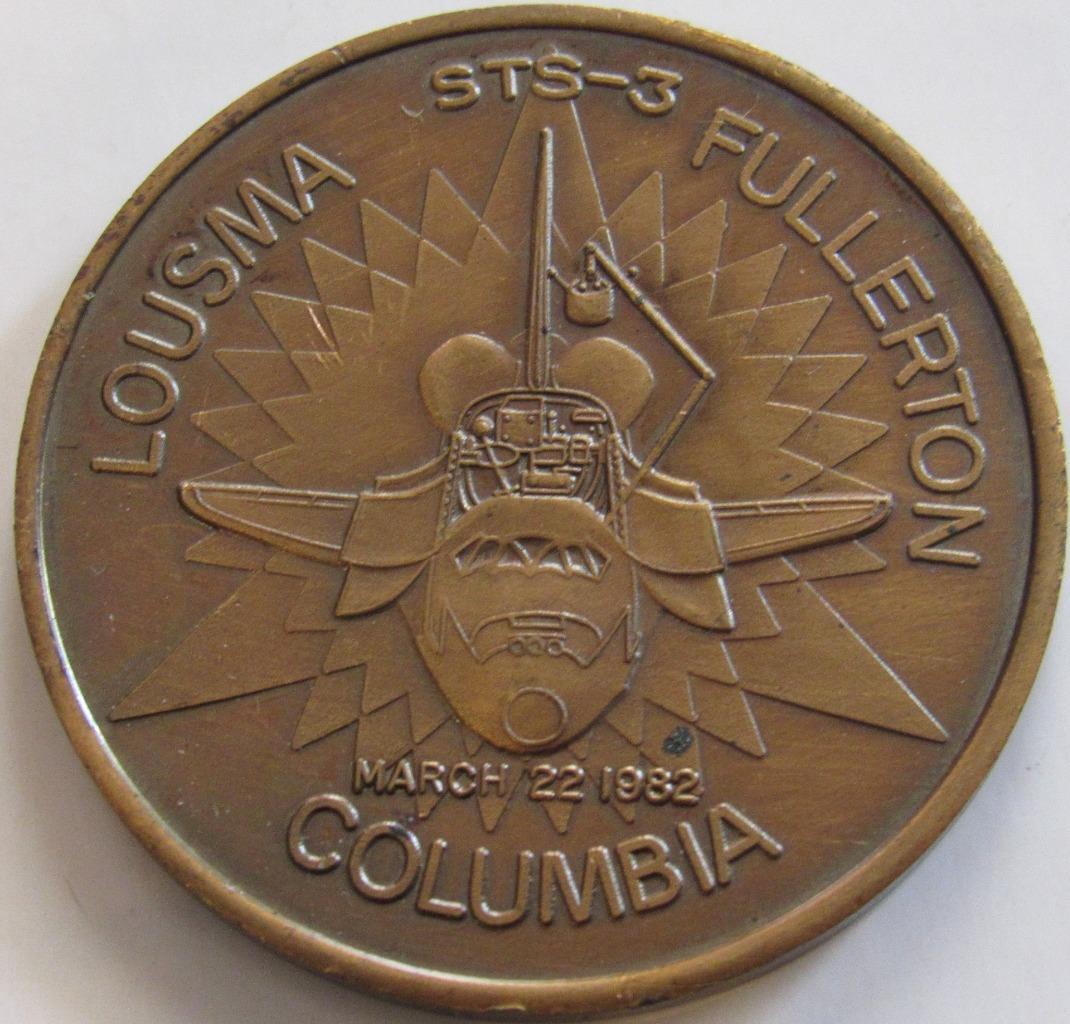
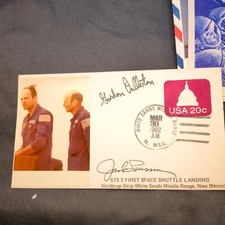
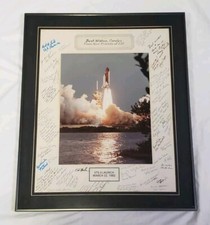
STS-3 SPACE TRANSPORTATION SYSTEM SHUTTLE MISSION COIN AB THE NEW ERA OF SPACE EXPLORATION1.5\" COIN - new but old NON-COLOR Mission ObjectivesThird Shuttle Mission/Office of Space Science-1 (OSS-1)Space Shuttle: ColumbiaLaunch Pad: 39ALaunched: March 22, 1982 at 11:00:00 a.m. ESTLanding Site: White Sands, New MexicoLanding: March 30, 1982 at 9:04:46 a.m. MSTRevolution: 130Mission Duration: 8 days, 0 hours, 4 minutes and 46 secondsReturned to KSC: April 6, 1982Orbit Altitude: 147 nautical milesOrbit Inclination: 38.0 degreesMiles Traveled: 3.335 millionMission ObjectivesDemonstrate safe re-launch and safe return of the orbiter and crew. Verify the combined performance of the entire shuttle vehicle – orbiter, solid rocket boosters and external tank. a.imagelink {color:#0000FF;} a:hover.imagelink {color:#0000FF;} a:visited.imagelink {color:#800080;} a.imagelink img.saleimage { border: 2px solid #0000FF; } a:visited.imagelink img.saleimage { border: 2px solid #800080; } STS-3 SPACE TRANSPORTATION SYSTEM SHUTTLE MISSION COIN AB THE NEW ERA OF SPACE EXPLORATION
1.5\" COIN - new but old NON-COLOR
Mission Facts
Third Shuttle Mission/Office of Space Science-1 (OSS-1)
Space Shuttle: Columbia
Launch Pad: 39A
Launched: March 22, 1982 at 11:00:00 a.m. EST
Launch Weight: 235,415 pounds
Landing Site: White Sands, New Mexico
Landing: March 30, 1982 at 9:04:46 a.m. MST
Runway: 17 – Northrup Strip
Rollout Distance: 13,732 feet
Rollout Time: 83 seconds
Revolution: 130
Mission Duration: 8 days, 0 hours, 4 minutes and 46 seconds
Returned to KSC: April 6, 1982
Orbit Altitude: 147 nautical miles
Orbit Inclination: 38.0 degrees
Miles Traveled: 3.335 million
Mission Objectives
Demonstrate safe re-launch and safe return of the orbiter and crew. Verify the combined performance of the entire shuttle vehicle – orbiter, solid rocket boosters and external tank.
Payloads included the 8,740 lbs. Office of Space Science (OSS-1) Pallet consisting of the Plant Lignification Experiment, the Plasma Diagnostic Package (PDP), the Vehicle Charging and Potential (VCAP) experiment, the Space Shuttle Induced Atmosphere experiment, the Thermal Canister experiment, the Solar Flare X-Ray Polarimeter, the Solar Ultraviolet and Spectral Irradiance Monitor (SUSIM), the Contamination Monitor Package and the Foil Microabrasion Package. Also in the payload bay was the 11,048 lbs. Development Flight Instrumentation (DFI) Pallet and the 448 lbs. Aerodynamic Coefficient Identification Package (ACIP).
The crew compartment housed the Monodisperse Latex Reactor (MLR) experiment and the Heflex Bioengineering Test (HBT) experiment.
Mission Highlights
The launch was delayed one hour due to failure of a heater on the nitrogen gas ground support line.
Testing continued of space shuttle systems for qualification for operational flights. Testing of remote manipulator system and measurements of thermal response of orbiter in various attitudes to sun conducted. Get Away Special test canister and Spacelab pallet-mounted experiments for NASA’s Office of Space Science-1 (OSS-1) carried in payload bay. OSS-1 obtained data on near-Earth space environment, including contamination (gases, dust, etc.) introduced into space by orbiter itself. Other experiments: Monodisperse Latex Reactor (MLR), Electrophoresis Equipment Verification Test (EEVT), Heflex Bioengineering Test (HBT) and first Shuttle Student Involvement Program (SSIP) experiment. Problems encountered: space sickness, malfunctioning toilet, thermostat difficulty and unexplained static interfering with crew sleep. Auxiliary power unit registered overheating during ascent, but functioned properly during descent. Three communications links were lost.
Get images that
make Supersized seem small.
THE simple solution for sellers.
Track Page Views With
Auctiva\'s Counter