When you click on links to various merchants on this site and make a purchase, this can result in this site earning a commission. Affiliate programs and affiliations include, but are not limited to, the eBay Partner Network.

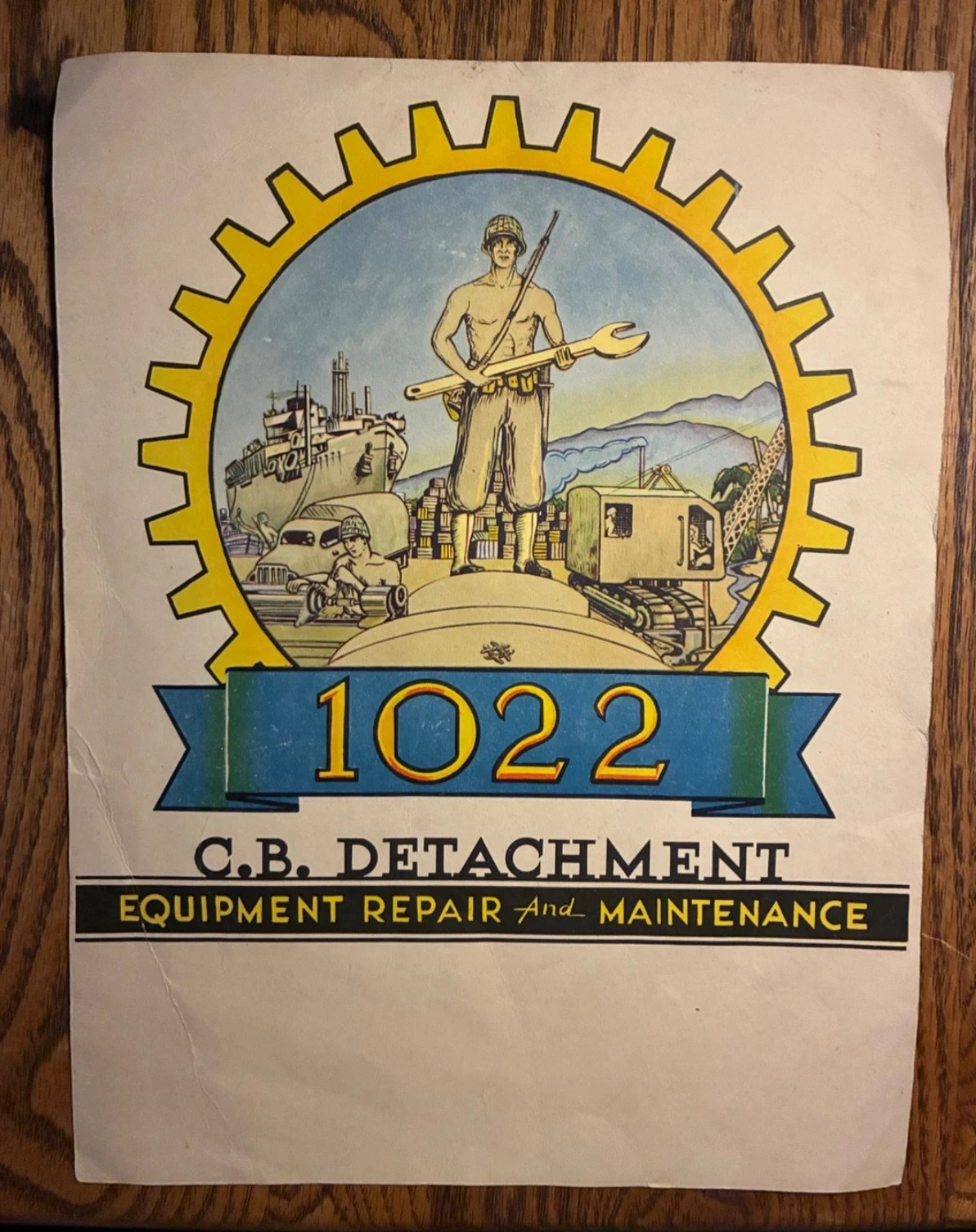
Vtg WWII US Naval Construction Detach 1022 Seabees CB Unit Original Insignia Art:
$595.00
- Activation: The unit finished organizing on August 25, 1943, at the United States Construction Training Center (UCTC) in Camp Peary, Virginia, with foundational officers.
- Transit: Transferred to the Advanced Base Depot (ABD) in Port Hueneme, California, on September 23, 1943, for outfitting.
- Arrival: The detachment arrived at Naval Operating Base (NOB) Adak, Alaska, in the fall of 1943. Operations officially commenced on December 15, 1943.
- Departure: Having completed its primary mission, CBD 1022 departed Adak on September 24, 1944, arriving at Camp Parks, California, on October 6, 1944.
- Initial Setup: The unit initially drafted 66 highly skilled mechanics (with records noting 65 to 68) from regular Construction Battalions already enduring the Alaskan theater.
- Reinforcement: On Christmas Day 1943, a casual draft of 170 mainland personnel arrived, bringing the unit to its standard first-tour operational baseline of roughly 250 men.
- Troop Footprint: Official records show a steady operational strength of 4 officers and 230–233 men through the summer of 1944.
- Inter-Service Integration: CBD 1022 worked closely with Army Engineer Battalions, facilitating a mutual exchange ofmaterials and services. During a critical juncture, CBD 1022 detached 25mechanics exclusively to the Army to keep their earth-moving lines running.They also directly sustained Stevedore Battalions by overhauling theheavy cranes and cargo trucks needed to offload fleet supply ships.
- Piston Rings: When Mack Truck lines stalled due to part shortages, the machine shops fabricated functioning piston rings out of 4-inch cast-iron soil pipes.
- Clutch Plates: Tractor clutch pressure plates were completely hammered and machined out of ordinary boiler plates.
- The \"Junk\" Lathe: Lacking a functional machine lathe, personnel salvaged a broken electric motor and scrap truck chassis parts to build a lathe from scratch, allowing them to grind crankshafts and rebuild motors in the field.
- The 900-lb Shaft: When the main base rock quarry went down due to a fractured 900-pound eccentric shaft, the unit bypassed a month-long factory shipping delay by sourcing a massive raw block of steel on the island and machining a replacement shaft themselves.
- Engineered and constructed an entire Fire Fighting School to train fleet personnel.
- Manufactured scarce torpedo firing mechanisms directly within their machine shop.
- Fabricated custom overhead cranes that maximized the storage capacity of local torpedo magazines.
- The \"Cub 16\" Track: On October 30, 1944, the Chief of Naval Operations (CNO) originally slated the detachment to deploy under Cub 16 (a coded designation for a mobile advanced tactical base).
- The Refused Reinforcement: In early March 1945, secret dispatches debated fragmenting CBD 1022 to augment Detachment 1007. High command intervened on March 8, 1945, explicitly ordering that CBD 1022 remain intact for its own independent mission to Samar.
- Deployment: On May 17, 1945, the fully augmented detachment left the United States, arriving at NavSite Guiuan, Samar, on June 11, 1945.
- Operations: Stationed at Leyte-Samar, they managed advanced base repair facilities and directly supported aviation repair components such as AEROU #1 (Aircraft Emergency Repair On-Beach Unit).
Inactivation:With the conclusion of hostilities, the unit\'s decommissioning was approved inSeptember 1945. Under the authority of the Commander of Service Force, PacificFleet (Comservpac), CBD 1022 was officially inactivated on October 17, 1945
|