When you click on links to various merchants on this site and make a purchase, this can result in this site earning a commission. Affiliate programs and affiliations include, but are not limited to, the eBay Partner Network.
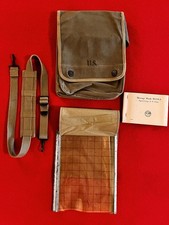
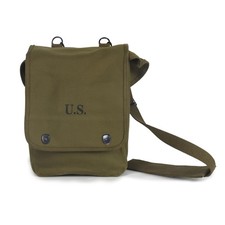
WWII M1938 Map/Dispatch Case
“KADIN 1943”
\"TRANSITIONAL\" mix of shades of Canvas, Webbing, and Edge Binding.
SHOULDER STRAP with PAD, Celluloid Acetate MAP INSERT,and MESSAGE BOOK M-210-A
“Signal Corps, U.S. Army - G.P.O. -1943\"
Mint NOS Unissued!
Condition! Condition! Condition!
If you have been holding out for an \"untouched\" stone-cold-mint example -- as removed from a \"time capsule\" from 1943 -- this museum piece is it.
This M1938 Map/Dispatch Case is in FLAWLESS condition!And it is in a highly desirableTRANSITIONAL\"mix\" of both the recently introduced (in 1943)Dark Shade OD#7 Canvas (for vastly superior camouflage purposes) and of Light Shade OD#3 and Dark Shade OD#7 Edge Binding and 1-inch and 2-inch Web Straps!
This came off the assembly line of KADIN BROS. Inc. contemporaneously with the Army and Marine\'s earliest campaigns both in North Africa, the Mediterranean, and the Southern Solomon Islands. Somehow this piece escaped issue from a QM Depot or was set aside mid-war by an officer. It had been in my possession for over half a century.
+ The Case has three pockets for maps and documents and a stitched piece 2-inch webbing on the front Pocket to accommodate six pencils or grease pens for marking maps.
+ ZERO holes, fraying at the corners, \"white-ish\" abrasions, stains, sun-fading, mildew spots, personal markings, A.S.N., loose stitching or blemishes of any sort. (Note: The Dark Shade OD#7 Canvas was very \"unforgiving\" of rubs and abrasions -- showing as \"white\" areas.)
+ ZERO corrosion, verdigris or wear to the finish any of the pieces of hardware!
+ ZERO cracks or \'warping\' of the Fiberboard Stiffener in the back of the Case!
+ This M1938 Map/Dispatch Case is from the KADIN BROTHERS (POCKETBOOKFACTORY) of Athens, New York, complete with itsoriginal loom-woven Padded Shoulder Strap and its original, intact, gridCelluloid AcetateMap Insert...complete with its original Tissue Sheet between the Acetate Panels!
+ The Case was carried byvirtually all officers, dispatch riders/couriers, and some NCOs.
+ NOTE #1: Even though the Marine Corps Equipment Board (MCEB)designed and issued contracts for a USMC-specific case (that differedin that Snap Hooks were substituted for D-rings on the rear of thecase to facilitate its being worn suspended directly from the pistolor cartridge belt), still, the Corps was pressed to “borrow” fromArmy supplies in the Pacific Theater to meet pressing supply needsand these Army contract M1938 Map Cases were carried by Marineofficers as well. The same was true for the USN -- they also adopted the Army\'s \"M1938-design\" with the USMC\'s modifications and also marked the Case on the underside of the Flap as did the USMC. But all three services ended up with these Army contract Cases in their supply chain by war\'s end.
+ NOTE #2: The photo of LTC Robt. L Wolverton, commander of the 3d Bn., 506th PIR, taken prior to the Normandy Jump -- next to photos of a similar KADIN 1943 Case -- is from pp. 348-349 of LTC(Ret.) John Angolia\'s superior work, HEROES IN OUR MIDST, Vol. 4, R.James Bender Publishing, 2018.
+ Included is a Mint NOS Unissued 1943-dated Message Book M-210-A, Signal Corps, U.S. Army (“U.S. Government PrintingOffice: 1943 10-27886-2” ) with its “InstructionsFor Using the Message Book M-210-A” on the inside flaps aswell as a “Partial List of Authorized Abbreviations.”All of the unused triplicate “Message” sheets arepresent, each with its own two copies and two carbon sheets arepresent, as well as all of the blank semi-transparent tissue sheetsfor drawing maps tracings!
+ Dimensions: 6 1/8\" x 4\"+ As carried in the officer\'s M1938 Map/Dispatch Case on in pocket of patrol leaders, NCOs, and officers.+ 25 Triplicate Sets of \"MESSAGE\" sheets with carbon sheets and DUPLICATE COPIES.+ 3 DuplicateSets for \'Pigeon use.\'+ 25 blank \"TRACING SHEETS\" for map overlays.+ Stiff cardboard writing surface stapled inside.+ \"INSTRUCTIONS\" for use of the Message Book on the inside of the front and back cardboard covers.+ \"PARTIAL LIST OF AUTHORIZED ABBREVIATIONS\" on the rear cover (taken from Field Manual).
+ Quite surprisingly, the heavy Celluloid Acetate ‘grid’ MapInsert with the distinctive \"crystalline-spangled\"Galvanized Steel Edge Trim and Web Bellows, and its attached thin-fabric Cover Sheet, are each in untouched, unscratched, un-cracked, un-torn condition condition. The originalprotectiveTissue Sheet is still present between the two layers of Acetate! This is an original!
+ ZERO rust to the Steel Edge Trim.
+ ZERO tears, fraying, stains, or \'dry rot\' to the fabric Cover Sheet.
+ The body of thisM1938 Map/Dispatch Case is made of the earlyDark Shade OD#7 Canvas and has BOTH Light and Dark Shade Edge Binding! All of the stitching is done in the contrasting Light Shade OD#3 Thread! and is boldly and crisply stamped on the the front of the flapwith the “U.S.” surcharge in serif font. On thereverse is the manufacturer’s name and date,
KADIN
1943
+ ZERO cuts, tears, abrasions, fraying, sun-fading, mildew spotting, loose stitching, orgrease pencil staining whatsoever. It is in immaculate inside andout, and is in absolutely“New Old Stock” condition!!!
+ ZERO rust, wear, or corrosion to the two blackened steel D-Rings onthe reverse, or to the blackened brass “Lift-the-Dot”Fasteners.
+ The early-war cast-alloy painted Adjustable Ladder Buckle and the sliding Shoulder Pad have never been moved or adjusted.
+ Perfect finish on the blackened steel Ball Tip, the early-war cast-alloy painted AdjustableLadder Buckle, and the two blackened Snap Hooks (marked with the‘Anchor’ logos of the famous hardware supplier to the WarDepartment since the 19th C, the NORTH & JUDDCO. of New Britain, Connecticut).
*****
KADIN BROS., INC.
Thelong history of Kadin Bags can be traced through the trade journalsof the handbags industry from the early 20th Century. TheBusinessProfiles of New Yorkdates the company\'s formation at June 2, 1924 and their location atthe time of their dissolution on March 25, 1992. The company producedan extensive line of women’s handbags and purses fro almost seventyyears. During WWII even as the company filled numerous contracts forthe WarDepartmentfor Shovel Covers, Map Cases, Magazine Pouches for the M1 Carbine,and other web canvas goods, the company continued to produce avariety of fine women’s purses.
Easterstyles for 1942 are introduced in the February 1942 issue of LUGGAGE& LEATHER GOODS,page 42.
Emphasisis on \"Morale!. . . one of the most important words in our vocabulary today. Whathas it to do with the handbag department? Plenty, we say! It\'s thegay novelties that lift many a spirit out of the doldrums. Handbagsthis season will play their part in adding color and life to even themost tailored costume.\"
Bagsfor Mothers Day 1942\"Stress Young Gay Types to Cheer Up Our War Time Mothers\"(onpage 42 of the April 1942 LUGGAGE& LEATHER GOODS).
Kadinputtheir designers to work, inventing innovative solutions to WWIIsupply restrictions dictated by the War Production Board (WPB) andshortages. (June 1942 LUGGAGE& LEATHER GOODSpage 58):
\"Accordingto Sidney Kadin of the firm, their designers are putting on fullsteam to complete the fall line by June 15. The firm expects topresent many new ideas in construction to offset the shortage and WPB (War Production Board) rulings on zippers, frames, etc. \"The same fast delivery servicewill prevail on the new line as customers have enjoyed in the past,\"says Mr. Kadin.\"
*****
KADIN BROTHERS, INC. (THE POCKETBOOK FACTORY)
by Jonathan Palmer, Greene CountyHistorian, February 8, 2021
Vedder Research Library
Theriverfront at Athens is celebrated by residents and visitors alike asits most beautiful asset, but its modern appearance andrecreation-oriented amenities bely the Riverfront’s originalfunction as the epicenter of all of the Village’s industrialventures. The Athens Riverfront Park, one of the Village’scornerstone features, is a prime example of this relatively recenttransformation. At the park today folks can enjoy weekly summerconcert series, an annual festival, quality drinks and food at nearbyrestaurants, and quick access by boat via the village docks toattractions such as the Hudson-Athens Lighthouse.
Oldtimers and lifelong residents will of course recall when this wasmost certainly not the case, ointing to a time over forty yearsago when the riverfront park was merely the footprint of the loomingKadinBrothers Pocketbook Factory.Where welcoming picnic tables now offer shaded seats below the park’strees there once loomed towering brick walls and a bell tower thatleft Water Street in shadow for half the day. From within emitted thehum and clang of industrial sewing machines, carding machines, looms,and packing rooms where residents from Athens and Hudson found steadywork in shifts manufacturing products for a ready market in New YorkCity.
ThePocketbook Factory,as it is still recalled by many residents, has a story much olderthan that of the KadinBrothersfirm which operated the Athens plant from 1937-1968. It begins
inthe 1890s when large regional manufacturing concerns dominatedAmerica’s economic landscape. This factory, which was originallyknown as the AthensKnitting Mill,sprang up as a textile plant around 1896. It replaced several oldstorehouses and expanded a historic wharf at that location, and wasideally sited hard by the slip of the Hudson-Athens Ferry. Itslocation presented an opportunity to source labor from not onlyAthens, but the City of Hudson as well.
Itis not known what was originally manufactured in the AthensKnitting Mill,but an interior postcard of the Mill taken sometime before 1910 showssome of the belt-driven carding machines on one of its floors,indicating the processing of wool for garments or blankets. A dockoffered ready access for barges bringing raw materials and takingaway finished products, a handy feature which probably factored inthe Mill being sited there. Generations of Athenians found work inthe mill on the manufacturing floors, in the machine shops, and inmanagement roles. Despite its formidable size, the KnittingMill wasstill only one of several manufacturing and service industries thatmade Athens a robust working community for the first 150 years of itsexistence.
TheKnitting Mill wasoffered for sale in the mid-1930s and KadinBrothers,a firm based in New York City, saw an opportunity for expansion. Theypurchased the plant and moved their manufacturing operations up theriver to Athens. KadinBrothers existedas a company 1924 to 1992, touting international designers and a“Made in the USA” tag on their products which were mainly women’shandbags and pocketbooks. The company’s products competedsuccessfully for decades against a slew of other affordable andfashionable women’s handbags while also offering frame bags andother items of a more utilitarian function that sported the company’ssensitivity to the latest styles. In the 1940s and ‘50s the wivesof several Athens Village officials were always pleased around theholidays to find a complimentary handbag from company management ontheir doorsteps.
WhenKadinBrothers purchasedthe old KnittingMill buildingit was in desperate need of upgrades. An announcement from a localpaper in 1937 noted that the machinery needed to manufacture handbagswas being shipped up the Hudson from a decommissioned KadinBros. plantin Phillipsburg, New Jersey. Local contractors were hired to makeimprovements to the physical plant and electrical systems, and by theend of the year the Athens factory was employing 150 women and 50 men- a welcome new source of employment in the depths of the Depression.These employees and the staff of a similarly scaled plant in Hudsonwere unionized, and the successfully fought for pay raises the yearafter the factories commenced operation.
Likecountless manufacturing firms across the country, competition fromcheaper overseas labor and the desire of managers to increaseprofitability led to the closure of the Athens plant in 1969. KadinBrothers’operations were consolidated with the Hudson plant, and the AthensKnitting Mill Building wentdormant. The Village seized the factory for back taxes in themid-1970s, and despite many ideas for repurposing the building(including an offer to convert it to apartments in 1975) no feasibleplan came to fruition. Finally the Village decided to have thebuilding demolished, and a contract crew removed the structure andcomponents in 1978 at no cost to the community, leaving only a largeconcrete slab that would remain for several more years.
*****
North& Judd“FROMEQUESTRIAN HARDWARE AND TROUSER CLASPS TO FASTENERS FOR MILITARY GEARAND SEAT BELTS, AMERICANS BUCKLE UP WITH NORTH & JUDD”
Theoldest manufacturer in New Britain, and one of the oldest in Connecticut,North& Judd’sbusiness and identity evolved over decades before incorporating in1863. In 1812, a company was started by Alvin North, H.C. Whipple andSeth North to make plated wire and articles from that wire such ashooks and eyes. The business was partially suspended during thecholera outbreak of 1832 and when it resumed the company began tomanufacture brass items and plated saddlery hardware. In 1855 thefirm became H.FNorth & Co.,incorporating as North& Judd in1863 when Lorin F. Judd bought out the interests of one of thepartners.
North& Juddbecame prominent in the manufacture of saddlery and harness hardwareincluding bits and spurs. This business led to a close and friendlyrelationship with William F. (\"Buffalo Bill\") Cody who wouldwrite letters to the company commending the quality of their spurs,and who would visit the company whenever he was in the area. WhenBuffalo Bill visited North& Judd,workers could bring their children into work to meet the famouswesterner and have their pictures taken with him.
Aslife in America became more mechanized and the need for saddlery andharness hardware decreased, North& Judd expandedproduction and development of other lines until they weremanufacturing and selling over 46,000 items under the name “AnchorBrand”.These products included belt buckles, shoe trimmings, clothingaccessories, upholstery nails, thumb tacks, and many others. Webstrap hardware was added to the line in the 1930s and, in addition tocommercial applications, a considerable amount of this hardware wasused by the military. The company was one of the first to produceautomobile seat belt buckles and with the purchase of theWilcox-Crittenden Companyof Middletown they added a full line of marine and boat hardware.
Inthe 1970s the company was merged into Gulfand Western,and then passed through the ownership of several other companiesuntil 1998 when it was acquired by Buckles International,whocontinues to sell AnchorBrand hardwarefrom their home office in Meriden.