When you click on links to various merchants on this site and make a purchase, this can result in this site earning a commission. Affiliate programs and affiliations include, but are not limited to, the eBay Partner Network.
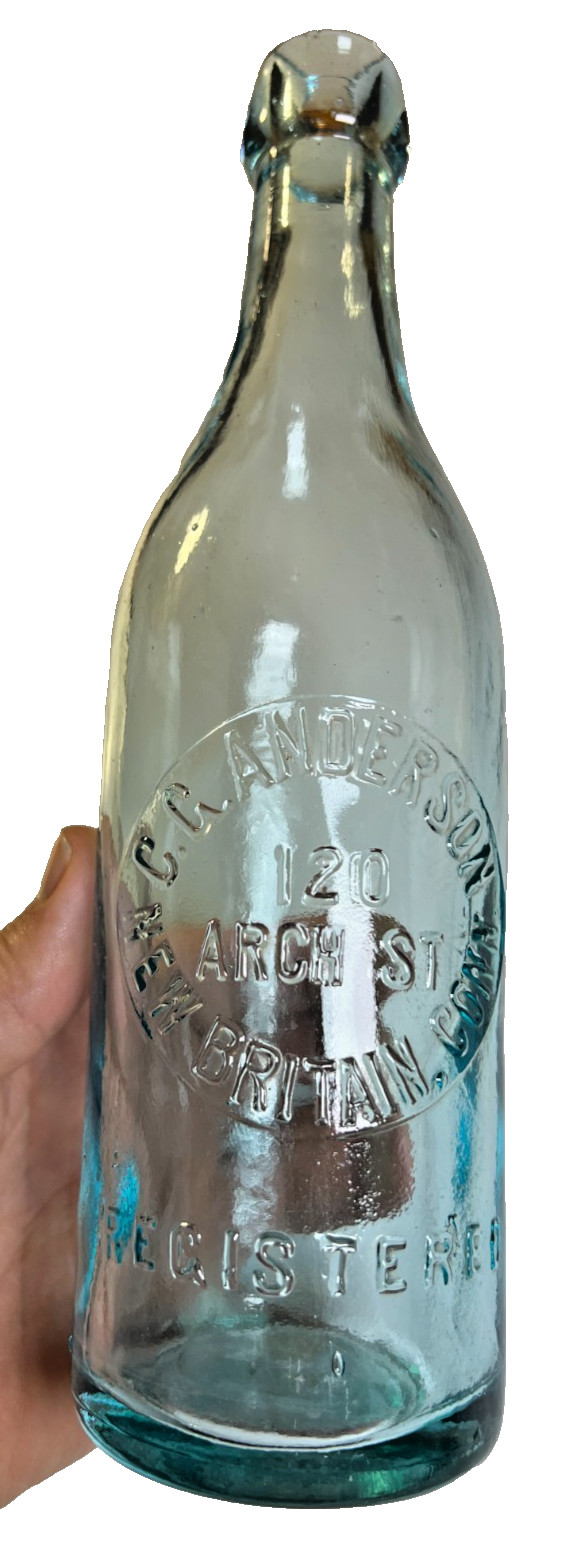
Antique C. G. Anderson aqua blob-top bottle — New Britain, Connecticut, circa 1885–1900
A remarkably clean example of antique Connecticut beverage glass, standing 9 3/8 inches tall, with luminous aqua color, bold embossing, and a handsome rounded blob top. The glass catches the light beautifully, with a deeper blue-green tone gathering along the thick base and edges.
Its large circular embossed panel makes an especially attractive centerpiece, identifying:
C. G. ANDERSON
120 / ARCH ST.
NEW BRITAIN, CONN.
Below the panel, REGISTERED appears in prominent raised lettering. The combination of proprietor’s name, street address, and hometown gives this bottle a particularly personal connection to the community it served.
The bottle and its purpose
This is the substantial, thick-glass form associated with late nineteenth-century bottled carbonated beverages. The rounded blob finish belongs to the period when bottlers used corks and various mechanical stopper systems to retain pressure.
Soda and mineral water are plausible original contents, although the embossing does not identify a particular beverage or flavor. Anderson’s exact product range remains unverified.
The bottle itself also functioned as a lasting advertisement: even without a paper label, the proprietor’s name and Arch Street address remained clearly visible in the glass. Today, that permanent lettering is its most compelling feature—an everyday commercial object that still tells you exactly where it belonged.
From Connecticut’s Hardware City
New Britain became internationally known for its hardware manufacturing, with firms such as Stanley, Corbin, and Landers, Frary & Clark helping shape its industrial identity.
This bottle belongs against that backdrop of busy factories, growing neighborhoods, and local businesses serving an expanding manufacturing community. It preserves a smaller, more intimate part of that history: the name of a local beverage proprietor and an address on Arch Street.
Excellent condition
An exceptionally attractive, minty example, with condition reported as:
The photographs show strong, sharply defined embossing and an appealing glossy surface. Small bubbles and subtle variations in the glass add visual character.
Height: 9 3/8 inches.
Life in America when this bottle was made — circa 1885–1900
When this bottle was first filled, America was undergoing extraordinary change. Factories were transforming cities, electric lights were beginning to illuminate streets and businesses, and inventions that now seem ordinary were still objects of wonder.
Technology — electricity, telephones, and the first automobiles
Steam power and railroads remained central to American industry, while electricity steadily changed urban life. Telephones connected a growing number of businesses and homes, although household service was far from universal. Horse-drawn vehicles still filled the streets, bicycles became a national craze during the 1890s, and the first American gasoline automobiles appeared toward the end of the period.
The practical world was changing just as quickly. Typewriters accelerated office work, photography became more accessible following the introduction of Kodak’s camera in 1888, and motion pictures emerged as a remarkable new attraction in the 1890s. In industrial New Britain, precision tools, machinery, and manufactured hardware connected local factory floors to markets across the country.
Politics — the Gilded Age and a changing nation
This period spanned the presidencies of Grover Cleveland, Benjamin Harrison, and William McKinley. Americans fiercely debated tariffs, immigration, railroad power, working conditions, and whether the nation’s money should be based on gold or include expanded silver coinage.
The Panic of 1893 brought bank failures, business closures, and unemployment. Labor conflicts exposed the tensions between industrial wealth and workers’ lives. Most women could not vote, while Black Americans faced escalating disenfranchisement and segregation; the Supreme Court’s Plessy v. Ferguson decision in 1896 upheld racial segregation under the “separate but equal” doctrine.
The Spanish-American War of 1898 further changed the country’s role abroad.
Medicine — major discoveries, limited treatments
Medicine stood between older traditions and emerging laboratory science. Germ theory was gaining acceptance, and antiseptic and aseptic practices were changing surgery. Anesthesia was already available, but modern antibiotics were still decades away.
Tuberculosis, pneumonia, and other infections remained serious threats. Patent medicines flourished alongside medical care, often promoted with sweeping claims and little reliable evidence.
Yet breakthroughs were arriving: X-rays were discovered in 1895, and diphtheria antitoxin introduced during the 1890s offered an effective treatment for a feared disease.
This clean aqua bottle survives from that world of factory whistles, horse-drawn deliveries, new electric lights, and rapidly changing ideas—a small, tangible piece of everyday life during America’s industrial transformation.